
Beckett’s Endless Game in Egypt: Between Socialist and Capitalist Contexts
Sixty-two years after al-Talea Theare (the Avant-garde Theater), previously known as al-Geib Theatre (the Pocket Theatre), first opened in Cairo, a celebration was held in 2024 to honor its legacy. To commemorate the occasion, Samuel Beckett’s play Endgame was restaged by the young director al-Saeed Qabil. Saad Ardash (1924–2008), a pioneering figure in Egyptian theatre, directed the play’s first Egyptian production, in December 1962 after he founded al-Geib Theatre. This paper compares those two productions, as indication of the evolution of absurdist theatre in Egypt over the past 60 years. In particular, the paper examines how the different socio, political, and economic contexts inform the productions. Ardash directed Endgame under Nasser’s socialist regime and, I will argue, mined the play’s potential as a post-colonial critique. Qabil directed the play in a capitalist age. He condensed the text and adjusted the ending to suggest that Clove has the ability to break free of the chains of oppression if only he has the courage to do so. During the 1960s, Ardash's performance shocked supporters of a socialist regime who failed to recognize the production’s anti-colonial stance but instead saw the play as nihilistic. In contrast, in the capitalist Egypt of 2024, audiences accepted Endgame as a canonical work as well as Qabil’s emphasis on individual responsibility.
Establishing al-Geib Theatre (the Pocket Theatre)
The Egyptian Theatre experienced a prolonged period of stagnation due to colonialism and the political and economic unrest that arose from the remnants of British occupation. This situation imposed numerous challenges on the artistic and cultural sectors, as artists faced significant censorship of their creative and journalistic works, particularly during and after the 1919 Egyptian Revolution. This censorship persisted until the end of World War II, severely impacting the country and its cultural landscape. The effects of this turmoil continued until the military coup of 1952, which ultimately led to Egypt achieving its independence by the late 1950s.
In the 1960s, under Nasser's regime, a significant renaissance in Egyptian state-sponsored theatre occurred. Firstly, Egypt officially launched an artistic initiative aimed at reaching out to residents of smaller cities and villages. As a result, many cultural centers were established outside Cairo, the capital, to serve these areas.[1] Additionally, numerous theatrical venues and performing arts troupes were established, such as the Puppet Theatre and the National Troupe for Folkloric Dance. Finally, those who received government scholarships to study in various European countries, such as Italy, France, England, and Hungary, brought back modern theatrical methods and styles to enrich Egypt's vibrant theatrical scene at that time. Expressionistic, epic, and absurdist theatre were all introduced into Egypt through translations and through the approaches of avant-garde designers and directors.
Among the artists of that time was a young director named Saad Ardash, who traveled to Italy in 1958 to study at the Rome Academy of Arts. When Ardash returned to Egypt in 1961, at a time when debate unfolded in official newspapers and among decision-makers regarding the socialist policies of Nasser’s regime. Ardash, an enthusiastic and well-trained artist, was primarily focused on his ambitious dream of establishing an avant-garde theatre. He envisioned a space where he and his colleagues, especially those returning from their scholarships, could apply the directing techniques they had learned abroad to innovative Western and Egyptian texts.
Ardash, who was influenced by his studies in Italy and by Giorgio Strehler’s founding of the Piccolo Theatre in 1947, proposed to the Egyptian Ministry of Culture the establishment of a new small theatre named al-Geib Theatre. This theatre was later renamed al-Taleea Theatre (The Avant-garde Theatre) in 1973 when it was relocated to its final location in al-Ataba.[2] Initially, in 1962, the decision was made to establish al-Geib Theatre at The Automobile Club, located in the prestigious Qasr al-Neele district of downtown Cairo.[3] (This venue served as the headquarters for al-Geib Theatre until it collapsed after a fire broke out on its second floor in 1963.[4]) Ardash, the first artistic director of the theatre, announced that the main goal of this new space was to stage both local and international avant-garde plays for a select audience of educated individuals.[5] The absurdist theatre was entirely new and experimental to Egyptian audiences in the 1960s. To kick off the theatre's activities, Ardash, agreed with the Ministry of Culture to direct Samuel Beckett's Endgame as a form of publicity for the newly established venue.[6] Al-Geib Theatre officially opened its doors on 20 December 1962. Earlier that month, Nasser’s socialist pledge was fulfilled with the December 7th directive which restructured Egypt’s political framework and consolidated “Arab Socialism.” This marked a significant departure from the previous feudal Egyptian royal reign. Nasser moved Egypt closer to its new political ally, the Soviet Union.[7]
Al-Geib Theatre, situated on the second floor of the Automobile Club, was a small venue that could accommodate around eighty audience members, most of whom were members of the Club.[8] The initial audience primarily consisted of elites and individuals with a high standard of living. In stark contrast to the official socialist slogans prevalent at the time, Ardash initially targeted a well-educated audience from higher social strata. His artistic aim was to introduce them to the first absurdist text ever performed in Egypt. This audience likely included liberals and avid readers familiar with contemporary foreign literary movements, which significantly influenced their reactions to the English and French theatrical texts presented in Egypt. As a result, the inaugural season was dedicated exclusively to elites, journalists, artists, and critics, many of whom were likely invited by Ardash, along with performers and executive members of the theatre.[9] Perhaps for this reason, the Ministry of Culture allocated a considerable amount of money for advertisements, propaganda, and theatre production. This financial support faced criticism from Ehsan Abdel-Quddous, one of Egypt's most prominent novelists, who considered it as an unnecessary extravagance at that time.[10] Nasser's regime adopted a similar attitude, striving to attract radical, well-educated individuals while also addressing the needs of the broader population. In Nasser's case, this approach aimed to unite these groups to establish and support the Egyptian National Socialist Union.[11] Consequently, during the subsequent season (1963/1964), al-Geib Theatre instituted quite affordable annual subscriptions for students and officers.[12] This shift from a selectively elite audience to a broader public included individuals, especially theatre makers, who may have initially been unfamiliar with absurdist theatre. This step prompts us to consider how this new theatrical movement was received by selective audiences, artists, critics, and journalists at the outset, and to what extent Ardash succeeded in introducing such an experimental approach to the public in 1962/1963 theatrical season.
Critical Resistance to Absurdist Theatre:
The responses from playwrights, journalists, and intellectuals can be categorized into two distinct groups. One group welcomed the experimental approach, appreciating its potential to offer fresh perspectives and theatrical methods to both the audience and the artistic community, while criticizing certain aspects of the Ardash’s direction.[13] For instance, Saad al-Deen Wahba, a key figure in writing realistic theatre from the sixties and chairman of al-Gomhuria Journal, acknowledged Ardash’s endeavor but criticized his directing style for lacking a distinct perspective or innovative approach.[14] Wahba pointed out that Ardash's technique involved a strict adherence to the original text without deviation or omission, a characteristic that became a hallmark of Ardash's work.[15] According to Abd al-Qadir Humaydah, a journalist and editorial secretary of Radio and Television Magazine, the play, which lasted two hours, left the audience anxious in their quest to find a coherent interpretation of what he described as a shockingly dull performance.[16] Nonetheless, Humaydah encouraged al-Geib Theatre to continue presenting a diverse array of international drama.[17]
The second reaction to the new theatrical experiment was one of complete rejection, largely due to the authors’ political beliefs, which often aligned with Nasser’s socialist regime. Noaman Ashour, an Egyptian poet and prominent playwright, and Abd al-Rahman al-Khamissi, a poet, musician, and director, represented this viewpoint. Ashour criticized the intentions and context of the play, noting that unless the acting was performed with exceptional skill, audiences would find it difficult to endure until the end.[18] Furthermore, he criticized supporters of absurdist theatre as disruptors of cultural life.[19] Similarly, al-Khamissi lamented Ardash’s theatre, which he felt was isolated from the public.[20] Critics largely dismissed absurdist content, as nihilistic and only relevant to Europe and its capitalist roots.[21] They believed absurdist theatre lacked relevance for a nation with a socialist ideology that was working to overcome the legacies of colonial occupation.[22] Presenting realistic and target-oriented art was essential for reinforcing Egypt’s political, economic, and ideological framework during that period.[23]
Barely stepping in a postcolonial era, these responses to absurdist theatre highlight a gap in theatrical criticism of the time. Contemporary critics have examined the play as a postcolonial critique and, we will see, Ardash’s direction presages such interpretations. However, newspaper reviews described the play and the production as depicting isolated human beings trapped in the prison of life, surrounded by a frozen, gloomy, and frustrating atmosphere. Confronted with strong socialist opposition, Ardash himself retreated. Instead of insisting on the need for a distinction between the philosophical foundations of art and the ideological bases of society when approaching an artistic work, he described his experimental approach as merely a means to breaking the stagnation that had impacted the growth of Egyptian theatre.[24]
Bahgat, who attended two consecutive nights, noted that the critics present on opening night “disguised themselves behind their conventional, frowning expressions, despite their desperate desire to laugh at certain moments.” The following day, he described the audience's response, stating, “They laughed a little, but for much of the time, they were speechless. However, in the end, they applauded the performers for a long time.”[25] In addition, Wahba highlighted the audience's confusion, noting that their expressions reflected a search for meaning in “this weird and obscure work.”[26] Asserting the same meaning, Humaydah suggested that the applause from the audience might have been a habitual response rather than a reflection of a deep understanding of the performance, or perhaps it was simply an acknowledgment of the performers' efforts.[27]
The critical and popular response does not undermine Ardash’s accomplishment. By embracing this new dramatic style in Egypt, Ardash created a genuine theatrical shock and disrupted the stability of the realistic theatrical scene. By his own account Ardash remained aligned with Egypt’s nationalistic social goals, while introducing a different form of theatre to complement the two dominant directorial schools of the time: the naturalistic style led by director Zaki Tolaymat and the aesthetic realistic style exemplified by Nabil al-Alfi and Hamdi Ghith.[28] Ardash’s alignment with Nasser’s regime and its goals is demonstrated by the fact that he was the first to stage Brecht’s The Exception and the Rule in Egypt, a learning play exposing the injustices of capitalism and class power.[29] Finally, Ardash introduced Egyptian audiences to absurdist theatre, a genre that would influence major Egyptian playwrights such as Tawfiq al-Hakim, and Yusuf Idris.
Ardash’s Production of Endgame
Ardash’s direction can be interpreted as exploring anti-colonial and anti-capitalist subtexts in Endgame, presaging the approach of contemporary critics. For example, scholars have examined the play in the context of Irish postcolonial history (while highlighting the play’s universality).[30] In this analysis, the relationship between Hamm, representing the British master, and Clove, the impoverished Irish man, is a focal point.[31] Similarly, another scholar suggests that the dynamic between Hamm and Clove can be viewed as that of a soldier and his superior during or after a devastating war.[32] Additionally, another study emphasizes the religious, historical, and existential symbols within the play, arguing that Beckett denounces the distorted state of social, familial, religious, and economic life in the West during the first half of the twentieth century, following the two World Wars.[33]
Interestingly, no scholars in Egypt have approached the text from a Marxist perspective, even though socialism was adopted in the 1960s. This is particularly striking among those who criticized absurdist texts, such as Ashour and Al-Khamisi. If they had taken a Marxist perspective, they might have recognized Hamm as a representative of imperialistic capitalism, driven by an endless ambition to conquer new markets. In this context, Clove could be seen as the worker who is inextricably linked to Hamm. Meanwhile, Nag and Pegg could symbolize the elderly, showcasing the challenges they face in their later years. Another relevant aspect is the racial implications of Hamm’s description of “the black toy dog,” which serves as a contrast to the notion of whiteness.[34] This symbolism would resonate with audiences in Egypt and other Arab and African nations, many of which were emerging from the domination of Western powers. This observation prompts a closer examination of how Ardash and his team presented Beckett’s Endgame on stage. By adhering closely to the text, they inadvertently lay the groundwork for a Marxist interpretation.
Critics praised the virtuosity of the new acting style, characterized by its recurring pauses and silent moments, which was unfamiliar to both the audience and the performers.[35] Despite the play's lengthy duration, Ardash remained dedicated to the dramatic text during that period.[36] However, this methodology does not impede a director’s ability to advocate for, change, or visually contradict the message of the text[37]. Only Yusif Adris, an author, theorist, and notable Egyptian novelist, expressed astonishment at the predominance of the tragic acting style throughout the play. From his perspective, the play was inherently comical, indicating that whoever determined the acting style had made a misjudgment.[38] This observation was previously noted by Beckett himself in his notes on directing his plays in France, where he referred to them as a type of ‘burlesque comedy,’ yet the performance maintained a general atmosphere of gloominess.[39]
Design elements in Ardash’s production amplified the play’s anti-colonial and anti-capitalist subtexts. In addition to the fixtures called for in the text (such as two ashbins, an armchair on castors, and the ladder) set designer, Salah Abdel-Kreem, hung a backdrop that included elements like an apartment building, an open eye with the arms of a clock, and two severed black hands hanging from strings. The severed black hands suggest the violence of racism, providing a new valence to imagery in the backdrop seemingly inspired by surrealist art. [40] Hamm’s dressing gown became a luxurious robe and Clove was clothed in a servant or waiter’s uniform. These details give pointed meanings to elements in Beckett’s text. Hamm’s bloody handkerchief can now be interpreted as a representation of the relentless blind capitalism he embodied, despite his paralyzed legs, presumably a result of World War II. Clove, on the other hand, served as Hamm's follower or cheap labor, working for a mere biscuit. The severed black hands of the backdrop added additional association to Hamm’s domination of Clove, evoking the contemporary economic relationship between affluent capitalist countries and developing nations, highlighting their struggle to escape economic dependency.
Ardash’s direction generated a sense of stasis. Lighting, in the words of one reviewer, was used to “freeze the audience's feelings at one point.”[41] To further enhance this expression of estrangement and emptiness, Ardash invited Awatif Abdel-Kerim to create the music for the play. A pioneer in music theory and composition, Awatif chose electronic music as the most fitting medium to convey the play’s themes.[42] On one hand, this static presentation likely reflects the absurd and stagnant condition between capitalist imperialism and economically dependent countries. On the other hand, it expresses the profound void and alienation experienced by the characters.
This production had a significant influence on the Egyptian theatre. When Ardash proposed a plan to introduce Egyptians to international theatrical trends, Tawfik al-Hakim, a prominent playwright and one of the supervisors in establishing al-Geib Theatre, took the opportunity to embrace these new styles.[43] Proficient in French and familiar with absurd theatre from his travels in France during the 1950s, al-Hakim wrote the innovative play Ya Tali al-shajarah (The Tree Climber), which Ardash directed at al-Geib Theatre in 1964.[44] This work diverged from the existentialist philosophy that often underpins absurdist theatre.[45] Other writers, including Yusuf Idris with his play al-Farafir,[46] also began to adopt characteristics of absurdist theatre. However, many Egyptian critics and scholars argued that the ideal balance between form and content in absurdist theatre was not fully accomplished in Egypt.[47] This is largely due to the significant differences between the cultural context in Egypt and that of European countries, as noted by Ali al-Rai.[48]
In summary, socialism had a significant impact on all aspects of life during the 1960s. Consequently, most theatre makers and their collaborators aligned themselves with Nasser’s regime. This influence is evident in the comments from critics and journalists, which, whether negative or constructive, primarily aimed to support Nasser’s socialist agenda and ensure that artists aligned with the regime. This occurred despite the absence of a Marxist critical approach within Egypt’s cultural criticism landscape during that time. Additionally, this influence was reflected in Ardash's decision to direct absurdist theatre for a select audience, followed by his later work in epic theatre for a broader audience.
Qabil’s Production of Endgame
In the more than sixty years since the founding of al-Geib Theatre (later known as al-Taleea Theatre), alternative and experimental theatre has experienced declines and advances in Egypt. After the setback in 1967, when Israel occupied Sinai, a period of theatrical regression began, that persisted until the mid-1980s. During this time, Ardash and many of his colleagues traveled to Arab countries, such as Algeria, Qatar, Iraq and Kuwait, to escape the various prohibitions resulting from the political landscape.[49] More recently, the creation of the Cairo International Festival for Experimental Theatre (CIFET) in 1988 helped Egypt’s text-based theatre embrace various forms of physical theatre. Afterwards, numerous theatre departments were established in cities such as Cairo, Alexandria, Bani Suef, and Al-Minya in Upper Egypt. Currently, only a limited number of new texts are presented at al-Talea Theater.[50] Most of the texts, both Western and Egyptian plays, are drawn from the existing repertoire. This contradicts Ardash's main goal for establishing the theater, which was to serve as a laboratory for introducing new dramatic and directorial styles. In this context, a young Egyptian director named al-Saeed Qabil[51] mounted a new production of Endgame at al-Taleea Theatre to commemorate the founding of al-Geib.[52]

1. Mahmoud Zaki plays Hamm, while Mohammed Salah portrays Clove. Photo Credit: Fatma Shaban. In this scene, Hamm asks Clove to move his chair around the room, highlighting Hamm's dependence on Clove for mobility due to his paralysis.
Qabil fashioned an Endgame for the short attention span of late-stage capitalism. He crafted a forty-five minute adaptation of the play incorporating colloquial Egyptian. Egyptian audiences show a strong preference for entertainment and comedy performances; therefore, Qabil maintained a sense of tragic comedy during the performance. Qabil’s streamlined version retains Beckett’s circular plot and sense of oppression but introduces a critique of the individual who symbolizes the other oppressed people and fails to embrace change. Instead of the original ending, where Clove gazes motionlessly towards Hamm, suggesting that the never-ending game is destined to continue forever, Qabil depicts Clove opening the exit door, allowing light to seep into the dreary room. Faced with the light, Clove does not dare to cross the door's threshold and attain his freedom. He bends his knees and stands still, terrified by this new vision.
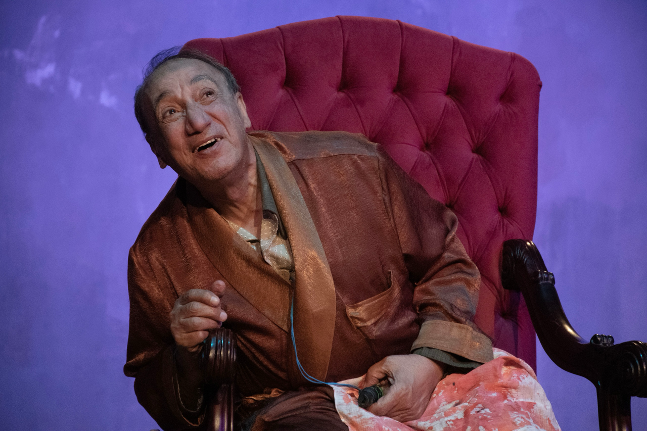
2. Mahmoud Zaki, as Hamm. He uses the whistle to signal Clove to continue the endless game and uses the bloody handkerchief to cover his face during his naps. Photo Credit: Fatma Shaban.
Qabil would seem to blame the oppressed for their victimization by those in power. Hamm, who is positioned in the center of the bare stage, is accompanied only by a small ladder and the wheelchair in which he sits. He embodies a character who is paralyzed yet exudes a sense of authority. This authority is further emphasized by the red back of his chair and the bloody handkerchief in his hand. He appears desperate, gloomy, and pessimistic about the value of his own life and that of Clove, his companion. Both characters are trapped in the prison of life, but Clove has the option of climbing the ladder, "trying to find any life outside this place," according to the company’s synopsis of the play.[53]

3. Mohammed Salah, as Clove, observes what may happen nearby. Photo Credit: Fatma Shaban.
In Qabil's interpretation, the younger generation, or the oppressed, possess the ability to make a choice. What they need is courage, rather than being intimidated or wearied by the prospect of taking that step. This ending reflects a revolutionary perspective influenced by the Arab Spring and its impacts in Egypt. If Clove/the oppressed had stepped out the door when he saw the light, he would have gained his freedom and broken the chain of oppression. Instead, Clove chose to kneel and stay in the same fixed position like before. In this updating, Clove is responsible for breaking the endless game. Otherwise, the absurdist cycle will continue.
To convey his message, Qabil blended a sarcastic tone with a pessimistic one, utilizing pale lights and completely undecorated, fixed walls. This choice reflected how the two characters perceived their barren unchangeable lives. Hamm contended that he attempted to leave his position, but ultimately stayed in the same location out of boredom, choosing to demonstrate the role of a father. Meanwhile, Clove, who had modest aspirations of maintaining a stable position, reinforced Hamm's claims and authority.
The actors portraying Hamm, Mahmoud Zaki and Clove, Mohammed Salah, worked diligently to evoke the bitterness, emptiness, and void stemming from their monotonous daily routines. The back of the wheelchair—a vibrant red—held Zaki’s immobile body, while a bloody handkerchief served as an accusation against the character. Salah played Clove dressed in casual pants, a vest, and a shirt—in contrast to Ardash’s use of costume to indicate a master-servant class divide. Salah’s Clove moved tirelessly, despite his limp, as if his freneticism might alleviate any potential boredom for the audience. This constant movement contributed to the feeling that life was exhausting, burdensome and oppressive, because Clove—at Hamm’s beck and call—must work continuously.
Audience and actors occupied a space with minimal separation, with playing and seating areas on the same level. The minimalistic set—especially the broken alarm clocks arranged on a shelf to the left of the actors—enhanced the feeling of emptiness. The lighting, designed by Ibrahim al-Fourn, effectively maintained this atmosphere. Subtle lighting changes suggested a world in which change could come, in contrast to the more static environment in Ardash’s production. Nonetheless, the overall effect remained consistently dull, dark, and mysterious. Shades of purple, grey, and dark blue were used to emphasize the void in which we all exist. Additionally, the somber music aimed to deepen the frustrating moments experienced by Hamm and Clove and the two elder characters.

4. Clove, Mohammed Salah, opens the garbage lids, allowing Hamm's father, Mohammed al-Rayess, and mother, Lamiaa Gafer, to participate in Hamm’s game, where he shares the anecdotes he wishes to tell. Photo Credit: Fatma Shaban.
Ultimately, audience reactions and critics’ reviews of the play were positive and encouraging, as absurdist theatre has become canonical and less provocative in recent capitalist times. For example, journalist Mona Abu al-Nasr noted at the beginning of her article that Beckett's play is classified as part of the theater of the absurd. She explained that the genre emphasizes the alienation of human beings in the contemporary world and that the relationship between Hamm and Clove can be interpreted as a master-servant dynamic. In al-Nasr’s interpretation, when Clove opens the door, the game concludes because he realizes that the emptiness he perceives through the open door reflects a moment in which he challenges his master. While it is uncertain when he will remain or leave, the absurdity of life persists. A similar interpretation was presented by Nesreen Nour, a playwright, who highlighted the context surrounding Beckett's Endgame, specifically World War II. According to Nour, the play follows a nuclear conflict and serves as a reminder of the many wars that continue to impact our lives, isolating us from one another and obscuring hope for the future. “In such a bitter world, waiting seems to be the only viable solution.”[54]
These two examples, along with many others, highlight the positive reception of Beckett’s Endgame.[55] Qabil’s Endgame premiered at al-Taleea Theatre in June 2024, and the play was selected to represent Egypt at the 25th session of the Carthage Theatre Festival in November of that year. Endgame continued to be staged at al-Taleea until the end of June 2025, signifying its success in Cairo.
Conclusion
Sixty years have passed since the inception of al-Geib Theatre in Egypt and different economic and socio-political policies have emerged. Ardash adhered strictly to Beckett’s text when directing Endgame, but presented it through an anti-colonial and a Marxist lens, using the play to criticize Western capitalism. However, that interpretation was lost on critics and audiences who saw the play as nihilistic. Since then, fruitful experiments have transformed the directorial landscape, as Ardash and his colleagues began directing avant-garde and modern texts in Egypt, leading to significant developments in all aspects of theatre, particularly in writing.
Endgame is now accepted as a canonical work in Egypt, making it a valuable commodity in these capitalist times. In the 1960s, the arts, theatre, and criticism were expected to conform strictly to the country’s socialist policies and slogans. In the current capitalist environment, a similar expectation exists for state-sponsored theatres. However, Qabil made significant contributions to the introduction of Beckett's absurdist text by implementing key changes. Firstly, he adapted the text to match the hectic rhythm of our modern life by cutting the play in half. He applied his contemporary vision by altering the final scene, introducing a single, powerful silent movement that added new and significant meaning. This movement suggested the possibility of breaking free from the endless cycle, signifying that the exit door and the morning light are always within reach. It ultimately depends on Clove, or the oppressed. Furthermore, the use of slow motion and subtle changes in the lighting emphasized this same message: despite the seemingly static or fixed nature of the scene, change is still occurring. In Egypt, these innovative approaches to absurdist theatre dramaturgy and direction were both commendable and meaningful.
[1] Al-Rai, Ali, al-Marsrah fi al-Watan al-Arabi, (Kuwait: Alam al-Marifah, 1979), p. 93-5.
[2] Musa, Fatma, et al., eds. Qamus al-Masrah, Vol. 5, (Cairo: al-Hayaa al-Masria al-amah llkitab, 1996-1997), p. 63, 970.
[3] After the 1952 Revolution, the military coup officers renamed the Royal Automobile Club, removing the ‘Royal’ to simply become the Automobile Club.
[4] The theatre burned down on 16 January 1963, a few days after the launch of Eugene Ionesco’s The Chairs, directed by Muhammed Abdel Aziz. This coincidence raises questions: Was it an accident, or was it deliberately set to prevent the public from entering such a prestigious Automobile (formerly the Royal) club during that time?
[5] Advertisement, al-Ahram, Issue No. 27456, Monday February (1962), p. 8.
[6] Faraj, Nabil, Saad Ardash, Rajul al-Masrah, (Cairo: Dar al-Hana, 1985), p. 26-7.
[7] Advertisement, al-Ahram, 14 December (1962), p. 12.
[8] Sakhsukh, Ahmed, Sunaa al-Masrah al-Masri, (Cairo: Sanduq al-Tanmya al-Thaqayia, The Ministry of Culture, Vol.3, 2008), p. 112.
[9] Please refer to a note in the Egyptian theatre magazine al-Masrah, which states that ‘the first season of al-Geib Theatre in 1962-1963 was limited to members of the Automobile Club.’ I could not identify any other reason for this restriction aside from what has been mentioned earlier in this paper.
[10] Adel-Quddous, Ihsan, ‘Khawatir Fanniyeh’, Rose al-Yusif Magazine, No. 1802, 24 December (1962), p. 37.
[11] Gervasio, Gennaro, al-Harakah al-Marksiyah fi Misr 1967-1981, (Cairo: Mashru al-qawmi lil-tarjamah, Vol. 1604, 2010), p. 212-15.
[12] The annual public subscription costs one Egyptian pound for adults and fifty piasters for students. Refer to:
Advertisement, al-Ahram, No. 27762, Friday 14 December (1962), p. 12.
-Advertisement, al-Ahram, Issue No. 27758, 10 December (1962), p. 12.
-“Masrah al-Geib Yabdaa fi al-Qahera,” al-Ahram, Issue No. 27456, Monday 12 February (1962), p. 8.
[13] More examples are: Ahmed Abbas Saleh, a prominent journalist at al-Ahram and al-Gomhuria, who was very supportive of this new trend. Another supporter, Muhammed Mandour — a critic, who completed his master's degree in France — wrote extensively about the play, providing a professional analysis of its themes. See:
-Ahmed Abbas Saleh, ‘Hazehi al-Aaseer’, al-Gomhuria, Issue No. 3315, Friday 18 January (1963), p. 12.
-Ahmed Abass Saleh, ‘al-Ragul al-Thawri Man Yakuon?’, al-Gomhuria, Issue No. 3303, Sunday 6 January (1963), p. 10.
-Muhammed Mandour, al-Gomhuria, Issue No. 3292, Wednesday 26 December (1962), p. 10.
[14] al-deen Wahba, Saad, al-Gomhuria. Issue No. 3297, Monday 31 December (1962), p. 10.
[15] Ardash’s directing approach is primarily characterized by a strong commitment to the original text. The director tends to stay faithful to the content, making only limited modifications when necessary. In some cases, Ardash may choose to add, replace, or omit a song or poem. Ultimately, this method reflects his dedication to the text while allowing room for his creative interpretation of the visual elements.
Khatir, Sayyid, Tarikh Misr fi al-ibdaa al-Masrahi (Cairo: al-Hayaa al-Masria al-amah llkitab, 2015), p. 133.
Al-Shiwi, Ayman, al-Mokhrig al-Masrahi Bayna al-Nass wa al-Ard, (Cairo: Matbuaat Tiywuf, 2015), p. 157-8.
[16] Humaydah, Abd al-Qadir, Layal Masrahyah, (Cairo: al-Markaz al-Qawmi lil-Masrah wa-al-Musiqa wa-al-finon al-Shabyah, 2007), p. 111.
[17] Ibid, p. 120.
[18] Noaman Ashour is considered the father of new realism in Egyptian theatre. To understand this socialist perspective see Terry Eagleton, Criticism and ideology: A Study in Marxist Literary Theory (London & NY: Verso Books, 2006), p. 8
[19] Ashour, Noaman, ‘al-Qahira Tazkhar bi Mabahig al-finoon’, al-Gomhuria, No. 3312, Tuesday 15 January (1963), p. 10.
[20] al-Khamissi, Abd al-Rahman, ‘Nahno la Nafsil Byn al-fann wel Mogtaa’, al-Gomhuria, No. 3214, Thursday 17 January (1963), p. 10.
[21] al-Khamissi, Abd al-Rahman, ‘Dawa Khatiyra li-takhreeb Arwah al-Shabab’, al-Gomhuria, No. 3200, Thursday 3 January (1963), p. 6.
[22] Also, in one of his articles, writer and journalist Muhammed Oda stated the same ideas. Refer to:
-Muhammad Oda, ‘al-Khubz al-Masmuom’, al-Gomhuria, No. 3296, Sunday 30 December (1962), p. 10.
-Muhammad Oda, ‘Rudyard Kipling wa Masrah al-Geib’, al-Gomhuria, No. 3300, Sunday 13 January (1963), p. 10.
-Al-Rai, Ali, Humum al-Masrah wa-Humumi, (Cairo: Kitab al-Hilal, No.522, 1994), p. 475.
A similar focal point emerged once again, particularly after the 1967 Israeli aggression in Sinai, Egypt. However, this time, the discussion centered on the form of theatre. Many playwrights, including Tawfik al-Hakim and Yusif Idris, advocated for a new theatrical style that was deeply rooted in Egyptian and Arab culture and heritage.
[23] In one of his articles titled “Arts for Art’s Sake: Deceit and Counterpropaganda in a Socialistic Society,” Samy Dawood, a playwright for films, criticized the tough reaction that many critics launched against Ardash absurdist productions and stated that if writers refused to embrace such openness, it would reflect the closed and regressive mindset they possessed. He suggested that encouraging Ardash's initiative would better demonstrate the progressive nature of the society in which they lived, despite adopting a target-oriented sort of art.
Sami Dawood, ‘al-Fan lil Fan, Khudaa wa Deaya Mudadah lil Mugtamaa al-Ashrtaki’, al-Gomhuria, No. 3312, Tuesday 15 January (1963), p. 10.
[24] al-Khamissi, Abd al-Rahman, 17 January (1963), p. 16.
Ardash, Saad, ‘“al-Masrah al-Masri 1952-1966”; Dirasah Shamilah’, al-Masrah Magazine, Issue No. 31, July (1966), p. 49.
[25] Bahgat, Ahmed, ibid, p. 11. All translations are my own.
[26] Wahba, Saad al-deen, ibid, p. 10
[27] Humaydah, Abd al-Qadir, ibid, p. 112
[28] Ardash, Saad, al-Mukhreg fi al-Masrah al-Muaser, (Cairo: al-Hayaa al-Masria al-amah llkitab, 1998), p. 348.
- Ardash, Saad, ‘al-Etegahat al-Tleaya fi al-Masrah al-Masri al-Muasir’, al-Masrah Magazine, Issue No. 17 March (1983), p. 30.
[29] Advertisement, al-Ahram, Issue No. 27762, Friday 14 December (1962), p (15).
[30] Moosavinia, Sayyed R., and Bamshad Hekmatshoar Tabari. “Waiting for Godot is an Irish Endgame: A Postcolonial Reading of Samuel Beckett’s Waiting for Godot and Endgame.” International Journal of Applied Linguistics and English Literature 2, No. 1 (2013): p. 60-7.
[31] Ibid, p. 66.
[32] Anghel, Camelia, ‘Reading Samuel Beckett’s Endgame as a Tale of War’ Philologica Jassyensia 15, Rome, Italy: No. 1 (29) (2019), p. 18. (Access on 24 May 2025).
[33] Adnan alAladhami, Noorulhuda, ‘Symbols And Themes In Samuel Beckett’s Endgame And Waiting For Godot.’ Social, Humanities and Administrative Sciences (JOSHAS Journal) 8, No. 51 (2022), p. 450.
http://dx.doi.org/10.29228/JOSHAS.61798. (Access on: 10 September 2025).
[34] Beckett, Samuel, Endgame, (UK: Faber and Faber, Internet Archive Books, in library; 2006), p. 25.
https://archive.org/details/endgame0000samu_b9n4
[35] In addition to the previously mentioned articles about the performers' clever enactment, refer to:
- Mustafa Mahmoud, ‘Masrah al-Dabab wa al-genuon’, Rose al-Yusiff Magazine, Issue No (1803), 31 December (1962), p. 40.
Fawzi, Hussin, ‘Muhemt Masrah al-Geib’, al-Ahram, No. 27699, Friday 10 October (1962), p. 15.
See also: Mustafa Mahmoud, ibid, p. 40.
[36] Bahgat, Ahmed, ‘Asbahat al-Shams Sifran fi Masrah al-Geib’, al-Ahram, No. 27775, Cairo, 27 December (1962), p. 11.
[37] Two years later, or possibly even sooner, Karam Motawea, an actor and prominent director, returned from Italy to introduce a new approach to interpreting theatrical texts. He emphasized that the director is, in essence, the true author of a performance based on the text.
[38] Adris, Yussif, al-Gomhuria, No. 2312, Monday 14 January (1963), p. 10.
[39] Beckett, Samuel The theatrical notebooks of Samuel Beckett. 2. Endgame. (UK, Faber & Faber, 1992), p. xiv, xvii.
[40] When al-Geib Theatre moved to Pharaonic Village, it did not have a traditional stage. Instead, a small acting area was created within the designated space of the theatre. This arrangement was probably similar to what existed at the theatre’s original location at the Automobile Club.
[41] Bahgat, Ahmed, ibid, p. 11.
[42] The esteemed Egyptian scholar Awatif Abdel-Kerim, who studied music in Austria in 1957, studied this new perspective of electronic music abroad and embraced it.
[43] Sakhsukh, Ahmed, ibid, p. 112
[44] Sadiq, Mona, Ruyati, Aham Ittijahat al-Ikhraj al-Masrahi al-Misri fi al-Sitniyat, (Cairo, Dafatir al-Acadimiyah, Academy of Arts, 2005), p. 64.
- Badawi, Muhammad Mustafa, Modern Arabic Drama in Egypt, (UK: Cambridge University Press. 1987), p. 77.
[45] Following this, al-Hakim produced al-Ta’am li-kull Fam (Food for Every Mouth) in 1963 and Masir Sursar (A Fate of Cockroach) in 1966, which were influenced also by the spirit of the absurdist theatre.
Amina ElHalawani, ‘Beckett as Muse for Egyptian Playwrights; Rereading the Theatre of the Absurd as Revolt’, Brill, Vol. 31, No. 2, (2019), p. 219-33. Web https://www.jstor.org/stable/10.2307/26840373 (Accessed on 04 Jan 2025, 09:27:38 UTC)
[46] Muhammad, Hayat J., ibid, p. 140 – 66.
[47] Ibid, p. 162. See also: al-Khashab, Walid, ‘Masrah al-Abass fi Misr, byna al-Abass al-Mahali wa al-Mustawrad’, Fusul Magazine, Vol. 11, Part 1, Issue No. 1, Summer (1992), p. 199-209.
[48] al-Rai, Ali, (1994), p. 475.
[49] Gammal, A., 2022, Fursan al-Masrah al-Arabi, Karam Motawea Ayqunat al-eghrag wa Fanan al-Maham al-Saba, aljarida Journal, https://www.aljarida.com/articles/1649509492031580700.
Al-Samahy, A., 2022, al-Raid al-Masrahi Nabil al-Alfi, Shahrayar al-Nugoom Journal.
https://shahrayar-stars.com/2022/07/39463/
[50] As an evidence revise the theatre 2008–2011 season’s book by: Amro Dawarah, ed., Al-Musim al-Masrahi 2008-2011, (Cairo: al-Markaz al-Qawmi lil-Masrah wa-al-Musiqa wa-al-finon al-Shabyaed, 2002).
[51] Al-Saeed Qabil is an accomplished actor and director. He graduated from the Theatre Department of the Faculty of Arts at Alexandria University in 1999. Following that, he studied at the New York Acting School for Film and Television. Qabil has managed a variety of national and international artistic and cultural festivals and events. Most recently, he served as the manager of cultural programs at the American University in Cairo.
[52] I attended the performance of Qabil’s Endgame at al-Taleea Theatre in November 2024.
[53] https://jtcarthage.tn/en/endgame/.
[54] Noor, N. “Luabat al-Nihaya” Uzla wa Intizar bila Ufoq, Masrahuna Magazine, General Organization of Cultural Palaces.
https://www.gocp.gov.eg/masr7na/articles.aspx?ArticleID=67026.
[55] See also the following articles regarding Qabil's Endgame:
https://alqaheranews.net/news/106110.
https://www.gocp.gov.eg/masr7na/articles.aspx?ArticleID=56449.
https://gate.ahram.org.eg/daily/News/205032/124/960838.
Bibliography, References & Endnotes
About The Author(s)
Hadia Mousa is an Egyptian associate professor of performance studies in the Faculty of Arts, Theatre Department, Acting and Directing Branch, at Capital University (formerly Helwan University). She was a visiting scholar at NYU and CUNY from 2012 to 2013. In 2019, Mousa published her first book titled Egyptian Women Directors from 1990 to 2010 (The Arab Theatre Institute). She has contributed to numerous publications including the Arab Stages online journal (United States), International Centre for Performance Studies Publications (Morocco), Sharjah, Arabic and Egyptian Theatre Magazines and Routledge.
Arab Stages is devoted to broadening international awareness and understanding of the theatre and performance cultures of the Arab-Islamic world and of its diaspora.
The journal appears twice yearly in digital form by the Martin E. Segal Theatre Center of New York and is a joint project of that Center and of the Arabic Theatre Working Group of the International Federation for Theatre Research.
