
Robert Wilson's Oedipus: The Postdramatic Journey of the Oedipus Story from Sophocles through Freud
Antal Bókay
By
Published on
May 1, 2026
Oedipus and Wilson
Robert Wilson's Oedipus is a major Wilsonian production that presents all the elements of Wilson's magical theatre—its soul, theory, and postdramatic theatrical character. It is Schauspiel, the director's “show game” with himself, with us, with the audience. On July 5, 2018, it was first performed in Pompeii at the Teatro Grande Scavi, followed in fall 2018 by the early Baroque Teatro Olimpico in Vicenza, and then Naples on the traditional stage of the Teatro Mercandante. I saw it in a traditional stage space in 2021 at the National Theatre of Budapest.
Why is Oedipus Rex interesting? The significance of Sophocles' drama lies in the fact that 2,500 years ago it articulated an experience, a knowledge of life, which for centuries had preoccupied us, forcing us to repeat and reflect on the nature of personal life, that is, on ourselves. Sophocles put the process of the formation of the individual, of the creation of personal life, into a play, making it perceptible and articulate. A kind of genetic primacy is thus conferred on it; the drama is an arche-écriture which, despite all its factual absurdity, enchants the spectator and reader.
Wilson's theatrical presentation was always titled as Oedipus, not Oedipus Rex, not Oedipus Tyrannus, just Oedipus, the man himself, without rank, without social position. Everywhere, the prior announcement of the theatrical event emphasizes that it is not the Sophocles drama that will be on stage but that what we are seeing is only “based on Sophocles' tragedy Oedipus Rex.” The primary purpose of my writing is to interpret this “based on.” For in these words lie the secret, the essence of Wilson's theatre.
For Wilson, the work of Sophocles is a borrowed narrative and structure, an associative possibility, a connection, which makes the director's (and, because of the elemental effect of the process, the spectator's) expression a theatre of cruelty, his visual and textual experience of trauma, which is doomed to repetition, articulable in fragments. There is a radical difference between the theatrical, dramatic representation of Sophocles' drama and Wilson's postdramatic Oedipus. According to Lehmann, "Wilson's theatre is a theatre of metamorphoses. He leads the viewer into the dreamland of transitions, ambiguities, and correspondences,"[1] and this, on the postdramatic viewer's side, "leads to another mode of theatrical perception in which seeing as recognition is continually outdone by a play of surprises that an order of perception can never arrest.”[2]
The production, through the metonymies of the Oedipal scene, showers the audience with a flood of images and sounds, engaging them in the event, the creation, and the effect of the performance, taking on an essentially therapeutic character. Wilson does not seek to make the audience “understand” the performance in the traditional sense but to evoke a radical compulsion to participate. Oedipus' story, the representational interest of dramatic theatre, is absent, erased by postdramatic theatrical techniques. Umberto Eco asked: if Wilson turns off the story, what is the audience responding to? Wilson replied, “I think that figures like Sigmund Freud, Joseph Stalin, and Queen Victoria are the gods of our time. They are mythic figures, and the person on the street has some knowledge of them before they enter the theatre. We in the theatre do not have to tell the story because the audience comes with a story already in mind. Based on this communally shared information, we can create a theatrical event.”[3] The important phrase "based on" is present in Wilson's answer.
There is, however, an intermediate layer in Wilson's reading of Oedipus: it is now impossible to read the Greek drama without including in the reading the Oedipus complex idea of psychoanalytic interpretation.[4] Oedipus Rex suggested to Freud a personal and general human background that creates an unconscious narrative of individual life, one that appears in psychoanalytic therapy, one whose metapsychological term becomes the Oedipus complex. Freud confronted the story of the drama's protagonist with his own personal fate. Still, beyond this, or extending it from his own fate, he also recognized and created psychoanalytic therapy as a performance re-enacting the Oedipal conflict. Referring to the Oedipus play Andre Green states that "There is a mysterious bond between psycho-analysis [sic] and the theatre,"[5] and that is why, he continues, "Sophocles tragedy has become for a whole civilization the very essence of tragedy."[6] With genius sensitivity, the Greek playwright conceived the primary, at that time, hardly visible traumatic event and process of the creation of the individual.
I suppose it would have been impossible to read Sophocles in 2018 without Freud; it would have been impossible even more for Wilson, who, in 1969, with his production of The Life and Times of Sigmund Freud, came into close proximity with the creator of psychoanalysis. Wilson was always sensitive to psychoanalysis. The 1969 Freudian play was a product of Wilson's first period, in the "florescence of vision." The theatrical logic was markedly different from that of the second period, which began after 1974, and which was at the heart of the “Assault on speech. Decline of the theatre of visions.”[7] Holmberg, under a subtitle "How To Do Things with Words"[8] places Wilson's fourth creative period as the director's turn towards Sprachteater with the Orlando monologue of 1989. Oedipus is a late production in which speech “blossoms.” “In theatre no one has dramatized this crisis of language with as much ferocious genius as Robert Wilson.”[9] The discourse of Wilson’s theatre is extraordinary: its form is a multiplicity of languages, from sound to word and back again, and the translation of meaning into action into performative. It is a technical sign that the texts in Wilson's Oedipus are extremely abbreviated excerpts of Sophocles' drama, and they are almost identical to what Freud evokes in The Interpretation of Dreams. More importantly and more relatedly, Wilson constructs the same therapeutic theatrical happening in the public space through free associations, as Freud used in his self-analysis and his transference in therapies.
Hans-Thies Lehmann called Wilson, with absolute aptness, not a director, not an author, but (like the choreographer) a “scenographer.”[10] Wilson’s theatre is scene "writing” in the écriture sense that Derrida speaks of. But Freud was also a scenographer, the performative, therapy-structuring activity he developed and followed in response to King Oedipus: stage space writing, scenography. But the original scene (the arche écriture) is always "somewhere" else, "the scene of dreams is a different one" [“dass der Schauplatz der Träume ein anderer sei” ][11] because it is essentially linked to the unconscious. Freud's theatre, like Wilson's, is a theatre of metamorphosis, a play that is never fixed, a transition between the unconscious and the conscious. It is not unconscious because it is ineffable, nor is it conceptual-conscious because it is partially meaningless. This in-betweenness is a key characteristic of Wilson's theatre and psychoanalytic therapy. Freudian self-analysis taps into it, and two-person analytic therapy acts out the copies of this other scene, the in-betweenness of the imagination available at the moment. It is worth looking at the more general strategic features of Freud's theatre of Oedipus, for in his own more conceptual and simplistic way, Freud also turns drama into postdramatic theatre.
Freud’s postdramatic Oedipus
Freud's first encounter with King Oedipus is the most straightforward and earliest example. On October 15, 1897, in a letter to his friend Wilhelm Fliess in Berlin, he writes: “My self-analysis [Meine Selbstanalyse] is, in fact, the essential thing I have at present and promises to become of the greatest value to me if it reaches its end.”[12] In this “other scene,” an unconsciously based childhood story, a mini-play, emerges, pointing towards a long-repressed mother-element:
Thereupon, a scene occurred to me which, in the course of twenty-five years, has occasionally emerged in my conscious memory without my understanding it. My mother was nowhere to be found; I was crying in despair. My brother Philip (twenty years older than I) unlocked a wardrobe [Kasten] for me, and when I did not find my mother inside it either, I cried even more until, slender and beautiful, she came in through the door.[13]
Freud turns to the drama of Sophocles that he had seen earlier:
A single idea of general value dawned on me. I have found, in my own case too, [the phenomenon of] being in love with my mother and jealous of my father, and I now consider it a universal event in early childhood. If this is so, we can understand the gripping power of Oedipus Rex, despite all the objections that reason raises against the presupposition of fate; the Greek legend seizes upon a compulsion that everyone recognizes because he senses its existence within himself. Everyone in the audience was once a budding Oedipus in fantasy, and each recoil in horror from the dream fulfillment here transplanted into reality... His conscience is his unconscious sense of guilt.[14]
The drama of Oedipus evokes associations that create a story with its own unconscious roots without directly stating the unconscious content. A mini theatre is thus born. In the next step, Freud takes this own experience out of the personal frame, speaks of it as a general human experience—this is done in The Interpretation of Dreams— and narrates the plot of the Greek drama in detail suggesting that this is something that everybody lives through.[15] But there is no word here of the “Oedipus complex”; the presentation takes place in the chapter "Typical Dreams.” The "Oedipus complex" as a metapsychological concept had not yet been invented; that happens much later, in 1910.
From our point of view, the third step in inventing Oedipus is essential, and the Oedipus complex becomes a defining element of all psychoanalytic therapy. Psychoanalytic therapy is a scenic, theatrical event; it is a theatrical performance of two people. In it, imagined or real memories of early childhood are elaborated as scenes, imagined stories, created and relived through associations. The same creative-cognitive event occurs in Freud's self-analysis, the psychoanalytic therapeutic situation, and even in dreaming and dream interpretation.
My hypothesis is that Wilson's theatrical creation is patterned on precisely this process, using this strategy. What then is the essence of this staged spiritual activity?
The complexes of unconscious energy and imagery, the desires banished into the unconscious, are repressed and, therefore, cannot be expressed directly, and the everyday or scientific referential language cannot reach these inner energies and images. Psychoanalysis, however, makes use of discursive techniques that can create a “substitute for the repressed” (Ersatzbildung), a substitute to fulfill a desire. There are two discursive mechanisms involved: free association and dream-work.
Free association, independent of the limitations of logical language, can represent themes and contents related to unconscious energy and image constructs using this substitution. Dream-work, which we might more generally call "psychic work," assembles and directs the process of free association through formal, figurative, and performative constructions. Freud's self-analysis quoted above also produced a scene from a formally constructed series of free associations exploring memory. This duality is essential, both free association and, alongside it, a formal organizing force, a technique that constructs a narrative. The associations are directed towards hidden meaning, but the images, fantasies, and dreams that emerge in this way cannot reach the memory of energy plus images once stored in the unconscious. Free associations, however, if not directly expressing the repressed contents of the unconscious, create a mediating mechanism that works with the background of the unconscious, transforming its energies and images into dreams, fantasies, and hallucinations. "Free association is memory in its most incoherent and therefore fluent form; because of repression, the past can only return as disarray in de-narrativized fragments. And the analysis reveals the patient's unofficial repertoire of incoherence.”[16] Free association is like a collage, adds Adam Philips.
Dream-work, often intertwined with free association, is a linguistic-visual activity (dream, joke, fantasized or real memories) that can activate and translate the related unconscious contents. The elements and processes of dream-work are condensations, displacement, image substitution, and, finally, secondary elaboration. The dream-work "does not think, calculate or judge in any way at all; it restricts itself to giving things a new form" Freud warns.[17] The dream-work, which Freud considered increasingly important throughout his work, is a set of formal, predominantly rhetorical (metaphorical and metonymical) and/or performative procedures. About its nature in 1925, Freud added a critical note to the text of The Interpretation of Dreams. He writes:
[The psychoanalysts] seek to find the essence of dreams in their latent content and in so doing they overlook the distinction between the latent dream-thoughts and the dream-work. At the bottom, dreams are nothing other than a particular form of thinking made possible by the state of sleep. It is the dream-work which creates that form, and it alone is the essence of dreaming.[18]
Freud then, in 1925, made dream-work a central activity at the expense of free association. Yet in 1900, when the book was published, in the analysis of the Irma dream, the specimen dream, the steps of interpretation were born around free associations. Free association is a meaning-giving action, while dream-work is a meaning-editing activity.
Creating Theatre – Free association and dream work
What does all this have to do with Wilson's theatre? My hypothesis is that Wilson's Oedipus, in an act of genius, draws Sophocles' drama into a therapeutic, dream-like discourse that can be connected to spectators simultaneously. Oedipus of Wilson excludes all traditional dramatic elements: no story, no characters, no dialogue. What we see on the stage consists of Wilson's free associations with Sophocles’ drama and the dream-work[19] formalizations linked to them. Lehmann has already very sensitively indicated that Wilson creates a scene by projecting a dream-like vision, i.e., free associations. This dream-like quality has a definite formal, even sometimes mathematical (i.e., dream-work) character:
A definite connection exists between the dream-like certainty with which Robert Wilson's theatrical images and figurations are chosen and Wilson's ability to allow himself to be guided by the impulses and memories that beckon to an adult from childhood. (...) A deep-rooted association with, even a regression to, early childhood experiences are so closely linked with radical mathematization and composition that they produce the paradox of a profoundly reflected infantility that excludes any vague sense of self-sufficiency.
Some elements of the free-associative projection, the images of the stage and the objects and persons appearing on it, are sometimes decipherable allegories and sometimes childhood traumas unknown to the audience. What is interesting, however, is that Wilson regularly and willingly talks about these overwhelming childhood traumas in his many interviews, about life in a small Texas town, about a firm, abusive father and an unavailable mother, and about the agonies of his own growing up.
Wilson's associative background is his own childhood memories, which are excluded by the movement, the dance, and the dream-work of the fragmented text. But the selection, as I will show later, is very personal. Concrete memories of his own, many of them repressed, are woven into the sequence of images and texts we see on stage. In this discourse, the director is both the analyst and the analyzed.[20] We, the audience, identify with this self-analytical original production. At the same time, we glimpse the secrets of our own Oedipal life management, transformed by Wilson into a 21st-century one.
Wilson consciously uses free association, as a basic acting technique for himself and to influence the audience's behavior. In an interview with Holger Teschke in 1997, he precisely defined the function of free association as a basic staging technique. In his youth, long before a career in the theatre, Wilson studied architecture at the Pratt Institute in Brooklyn. He says the following about the lecture style of his "most important teacher," Sibyl Moholy Nagy:
You could not take notes during his lectures. There was only a light on it, and behind it were three screens on which images were projected in rapid succession: a car from the 1950s, a Renaissance painting, a Baroque candelabra, a Byzantine mosaic, a chair by Flloyd Frank Wright, a shoe from the early 19th century, different artistic and utilitarian objects from different centuries, and these images changed very quickly, so that there were 100 in a single lecture. But there was nothing to connect the images to the performance, and that was very confusing at first.
After a while, however, our thinking changed, as we started to associate freely both what we saw and what we heard. The course was announced for five years, and after five years and five years, one was able to put together for oneself a wide variety of information and images, and I was surprised again and again at the conclusions I drew from all this material. I think this had a huge impact on my theatre firstly because the visuality was completely independent of what I was hearing, and secondly because so many unexpected connections could be made through free associations. Audiences and critics often go to the theatre trying to find meaning in a performance, even though the performance in question, at least in the logical sense of the word, has no meaning except in terms of free associations with a theme or a very personal experience.[21]
However, this is only one side of Wilson’s theatrical technique. Lehmann's study of Wilson as scenographer also indicates another process, the role of the dream-work in giving form: “Wilson could be echoing Artaud's words: ‘I yield the fever of a dream, but my aim is to obtain new laws.’”[22] Free associations lead to a dream-like regression, "regression to the experiences of early childhood," but this process also "implies the strictest formalism, geometric construction, and aesthetic calculation." Wilson regularly returns to the definition and emphasis of this formalism in his interviews, and it is to this that his work as a visual artist is linked.
Wilson's artistic performance is strongly formalized; the way he wants it to be perceived is highly informal. His images and sketches for theatrical performances are always formal, indicating structures. Dream-work is exactly this; it is "an operation which transforms the raw materials of the dream . . . so as to produce the manifest dream.”[23] Wilson’s favorite painter is Cézanne. In an interview, he states:
Cézanne is my favorite painter. My work is closer to him than to any other artist. My production of Hamletmachine is like a Cézanne painting in its architecture. Cézanne simplified and purified forms to reveal classical structure and composition. I learned everything from Cézanne, including his use of color, light, diagonals, and space - how to use the center and the edges. His images are not framed by the boundaries.[24]
Cézanne's key concept is “realization,” an analytical-structural projection of reality that avoids the lightness of the surface, which is misleading for the modern, and it reveals an often-destructive structural depth behind this surface. Wilson also projects a structured plane onto the stage. The figures—shapely, usually masked, strange, often in geometric shells and costumes—play in a two-dimensional space, not in contact with each other. The planes of the stage are separated by bright lines, which no one crosses.
Structure and Narrative
Wilson (through free associations and the dream-work activities) deconstructs the play by Sophocles, disrupts all the elements of a dramatic, coherent referential play, and creates a postdramatic double-faced visual-verbal sequence. He does not stage the play but recreates it through fragmented visual and verbal associations. "In the first period, Wilson ignored language; in the second, he deconstructed it," writes Holmberg.[25] The purely visual plane precedes speech. The beginning and end of the play (the prologue and the epilogue) are speechless visual-dance performances, a series of visual associations. In the intervening passages, the parallelism of the two discourses dominates. The visual events of the scene, however, are usually not connected to the themes of the speech; very rarely, for a flash, is there a connection between them.
In his introduction to the Budapest production of Oedipus, Wilson briefly outlines the structure of the play:
The performance is structured in a classical way: five parts and a prologue, the first part being echoed in the fifth part, the second in the fourth. The third part, a wild pagan wedding ceremony, is the centrepiece. Each part is defined by the materials of scenic elements used onstage: wooden planks, leafless branches, steel paper and sheets of galvanized metal, green branches, contemporary folding chairs, tar paper, and vegetable woven fabrics with silk. Music plays a central role.[26]
This logic does not belong to the speech level. (There is always the theme of the prophecy and the repetition of events that connect with it). Wilson’s description refers to the image level where it is a little bit easier to sense a narrative sequence. Moreover, the logical listing of the five parts in Wilson's reference does not really prevail. The events of the drama are mixed on the stage. Oedipus' self-blinding occurs once in the middle of the play but is followed by earlier events like the patricide and the incest scene, and only at the very end of the play does blind Oedipus return. The individual episodes are built, like the shells of an onion (see Peer Gynt), around the enigmatic, never shown but always suspected center. This center is the unconscious energy of desire. The individual parts are different, heterogeneous examples and spaces of Oedipal desire-realization. The sketch, told in Wilson's voice, is both illuminating and concealing, both helpful and misleading. The structure Wilson asserts and confesses is a construction of the dream-work of theatrical performance.
But speech is crucial to the production. The spoken text, however, never follows the drama's narrative; its fragmented representation brings an unmarked and immeasurably repetitive mixing of different speakers and linguistic positions in the past story. Moreover, all this is done in different languages—ancient Greek, modern Greek, German, French, and English. Wilson's voice and announcements separate the parts and the scenes; he is the master of the time structure of the formal theatre world.
In the beginning, his announcements seem logical, but "Part One" is spoken twice, and immediately after the second, we hear the distinct sound of "Headline A," but there is no Headline B or Headline C; only in the later part are “Headline D” and “Headline E” spoken. But at the two-thirds mark of the play, between two scenes on a completely dark and silent stage backdrop, Wilson retells the text of the adult Oedipus' Corinthian escape and the prophecy given to him. In addition to him, three narrators—Witness 1, Witness 2, and Woman—speak in Budapest and Epidaurus. Witness 1 and Woman narrate the prophecy and its consequences in different styles. Witness 1 is intense and often aggressive, representative of the unconscious part of the superego, speaking from the lower level of the scene. Woman talks in a soft voice, but she is objective with Oedipus’ situation and also often reacts with ironic laughter. She is always on the upper part of the middle level of the stage. No character position is owned by any of them, they all mix the sentences of Oedipus, Iocaste, Tiresias, and the Chorus. Witness 2 narrates the father-murder, the text of the Iocaste-Oedipus dialogue; she is kinder, more maternal, unsuccessfully trying to talk Oedipus out of his search for the past. An additional voice is inserted into the text of Witness 2, Christopher Knowles's destructive-deconstructive speech; this spoils the meaningful speech and shows language in its materiality.
The Oedipal Edifice of Existence
In his introduction to the Budapest theatre, Wilson states the absolute essence of the performance:
The main theme of the story of Oedipus to me is darkness. He vows to shed light on the murder of Laius in order to free the city of Thebes from the plague. But can he bear the light when it finally shines on him? Is he able to confront his own past, his origins? As Tiresias, the blind seer, puts it: as long as Oedipus has eyesight, he is blind. When he starts to see the truth, he blinds himself. Can we bear to look at the truth today?"[27]
For Wilson, the scene, the living, performative scene, the natural-objective environment in light, was always of absolute importance and priority. The prologue, drawn into this duality of light and dark, marks out, even without words and speech, the foundational being and story-position of the play. But the text, the speech, is already present here; obviously, every spectator knows who Oedipus was, what happened to him, where he started, and where he ended up. Therefore, the scene that begins before the play depicts three allegorical-metonymic, easily understandable themes.
One is the sun, Apollo himself, Phoebus the Sun-God, the source of the blinding light, the source of the prophecy, in whose light a definite responsible self of Oedipus (never fulfilled here, only realized in death in Colonus) is born from the many and varied, confused desires. With Apollo's allegory, the Sun, we are confronted not only by Oedipus but also by us, the spectators, while everyone else who will appear on stage does not perceive it, only Oedipus and us, the spectators. The role of the Sun/Apollo is decisive in the construction of the self and the construction of Oedipus' life. He is the gaze whose existence and self-creating/destructive capacity were described by Sartre and Lacan in this concept. Man looks at the world and believes he exists as a coherent, reliable and powerful center. This was Oedipus' mode of existence, his relation to the world and Thebes, until the beginning of the drama. In Wilson’s project (unlike in Sophocles’), however, there is the power of the gaze, the danger of the otherness of desire, the impossibility of the organization of one's own desire into life, from the very first moment. This is on the visual level (and shortly after the prologue, in the text too). The gaze is such a view of ourselves, says Lacan, from where we never see ourselves and never want to see ourselves. In Wilson's theatre, this gaze has a decisive effect; this is the blinding light in which the subject is absorbed.

Figure 1
The allegorical establishment of the Oedipal scene. Oedipus is blinded by the sun, and by the darkness into which he stares, but by too much light. He begins blind and ends blind. Photo credit: © Lucie Jansch.
The other allegorical-metonymic element of the opening image is a knotted rope in a ring, sharply (blindingly?) illuminated (put into the light), the rope with which the father (Laius), under the influence of the prophecy, pierced the legs of the three-day-old infant, tied his ankles, wanted to make Oedipus' growth, his life, impossible. Neither in Sophocles nor in Freud is this severe, fate-defining event, experienced after birth, a fundamental central component. Wilson, on the other hand, makes it a dominant visual message. The rope is an allegorical metonymic symbol of trauma. The trauma is an event, a memory that is imperceptible when it happens; Oedipus, the infant, freed from the rope, becomes a successful man, a royal successor in Corinth, and has no memory of his origins or early fate. As an adult, however, this traumatic past returns in a fate-turning way (Freud described it in terms of Nachträglichket); his, in that time, unknown past helps him in solving the riddle given to him by the Sphinx. Later, in the course of the revelation of his own fate, he fully understands his own history. In Sophocles and Freud, this event, the attempted infanticide, is not mentioned, but it is of crucial importance in Wilson's stage, and it is an important component of his personal past, his childhood.

Figure 2
The complete structure of the Oedipal space (here from Vicenza). Light strips separate the space of the scene. Photo credit: © Lucie Jansch.
The third, much less clearly allegorical and perhaps more symbolic-metonymic pictorial component of the introductory image component is the gap, the dark entrance between the walls. The gap, in my interpretation, is the body of the mother, the abjected place of birth and the place of the incest. It is the rightful realm of the Father, Apollo (and Laius). But after arriving to Thebes it is a great joy of jouissance and a disgusting horror at once.
The purely visual prologue happens very slowly; it is impossible for the viewer not to be drawn into the event; it is not a spectacle; it is happening. In the black gap, in the closed, darkened mother body, the light appears, the sun, the ancestor, shedding rays, sometimes fading, sometimes intensifying to unbearable sharpness, blinding the spectator.
Meanwhile, there is a confused confusion of annoying noise emanating from stringed instruments, which fade away as the color darkens and the sun disappears. Quietly turns into soft, embracing music. The sun reappears in this black, total darkness. Oedipus moves exceptionally slowly toward the light; his clothing is a translucent shroud, and his body remains a dark drawing with no shadow. He is standing in an absolute light, and his entire upper body (hands laden with sin, the bodily part of sex) disappears, absorbed in the light, leaving visible in the sun’ blinding light only the two legs, the once cruelly bound legs for which he is named. That was the prologue.
The pictorial vision is essentially figurative, working in a very mixed dream-work, rhetorical modality. At times, it is hermeneutic, symbolic-metaphorical-allegorical (sun=Apollo and rope=pictures of infantile trauma); at other times, it is metonymic-catachrestic, without any reference to meaning, literally unintelligible, “displaced” to something else. The series of images, the vision of the scene, works in such a way that the director freely associates (in a psychotherapeutic way) certain parts and fragments of Sophocles' drama. The free association breaks up the logos and opens up the subjective, receptive dimension of the text. Still, the meanings are organized and arranged by the rhetorical, performative machinery of the dream-work.
As a next step, the space is transformed and furnished with Oedipal figures and objects.
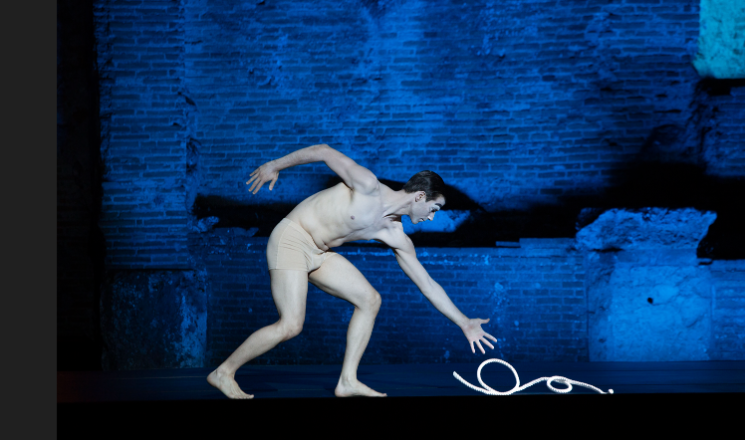
Figure 3
Another element of the allegorical setting of the scene, the infant Oedipus and the rope that sends him to his death, piercing his legs. Photo credit: © Lucie Jansch.
Sometimes, one or two horizontal light lines divide the space into two or three parts. The stage, divided into these planes and layers, is a typical stage technique of Wilson. This was already done for Freud in 1969, and Wilson mentions it in his 1969 Speech before Freud:
The stage is divided into zones - stratified zones one behind another that extend from one side of the stage horizontally to the other. And in each of these zones there's a different "reality"-a different activity defining the space so that from the audience's point of view one sees through these different layers, and as each occurs it appears as if there's no realization that anything other than itself is happening outside that particularly designated area. People might associate this with Freud and the layers of consciousness-different levels of understanding-but that kind obvious intention has been erased or eradicated from this production. I see it more simply as a collage of different realities occurring simultaneously like being aware of several visual factors and how they combine into a picture before your eyes at any given moment.[28]
Oedipus, however, is a tragedy of the inner soul, and the tripartite division here is definitely Freudian. The lower level is the unconscious, the ancestor. This level is forbidden even to Oedipus, and he does not enter it. In the middle is the world of the self, the performative actions and gestures, the conscious human world. Up on the top is the superego, the divine presence of Phoebus, the Sun, and Apollo. In the opening scene, which remains valid for the whole performance, Oedipus stands under the sun, a shepherd to the left, telling the authentic story, with another narrator, an elegant black woman in mask-like make-up (she later tells the prophecy in French), Iocaste in a strange cloak-like costume, Oedipus in the middle, and a saxophonist to the right, who wrote and plays the music. Then, the narrator of the lower level disappears, and the event is shifted up to the top, to Oedipus and the sun. A young female figure running through the stage appears; she is then absorbed into the light.
Forms of Narration
Image and language occur in parallel, side by side, against each other, or even building on each other after the prologue. The narration is referential, it is a storytelling, as opposed to the figurative level of the image. However, the speech is systematically deconstructed, and in a hermeneutic sense, clear meaning is excluded by various means.
The text is not narrated by the characters, for example, not by Oedipus, but only by narrators. The classical dramatic position of the "actor" ceases to exist. There are no actors; Oedipus appears in the form of one actor or dancer or another. Sometimes, there is more than one Oedipus on the stage at the same time, the adult confronted with Apollo, who is already in the prologue, a nearly naked dancer dancing with the rope; there is also an actor with a face distorted by a glass plate, all are of course mute.
There is no dialogue, only narration in a proclamatory mood; Oedipus never speaks; his lines, like those of Iocaste and the chorus, are spoken by narrators. The narrators' texts are not linked to a person; each narrator's speech is interspersed with the characters' sentences in the drama, sometimes the chorus is spoken, sometimes Oedipus is quoted, and quite a lot of Iocaste's text is spoken. The text is very sparse, and the same theme and the exact text are repeated many times. Wilson deconstructs the narrative in its very form, in that the language the narrators speak is often echoed, noisy, and indeed unusual because of the mixture of languages. Sometimes, a single narrator speaks in several languages, switching from one to the other sentence by sentence. It is a real Babelian situation; a kind of "untranslatability" prevails. The audience will not understand a large part of the text. For them, the spoken word is a material sound, with only its accents indicating moods. A gesture helps the situation (I wonder if Wilson required it) at the Budapest performance; translations in English and Hungarian were displayed above the stage. The costumes of the narrators are interesting. Witness 1, who speaks at the lower, unconscious level, appears in a black cloak with mask-like face paint; the narrator, who is called Woman, is in a colorful floor-length dress, her repeated ironic laughter emphasizing his white teeth and the white paint around his eyes, which is similar to Iocaste's. Finally, Witness 2 is wearing ordinary clothes with a small cap on her head, which resembles a contemporary housewife.
Wilson's procedure for the reductive representation of the indicated text shows another interesting poetic character. At the center of the text is the oracle, which is not constative and does not refer to a situation; it is an action prescribed by language. The oracle is performative; it is a speech act. The space of Oedipus' existence, of his coming into being, is performative; he cannot create his life, but the oracle creates it. Language can act; it is not referential or imitative but has something powerful: a subjective plus and an energy of action. This purified, aggressive performativity is itself an Oedipal story.
The prophecy is of divine origin, coming from Apollo himself. Apollo does not appear on the scene in person, but only through his allegory: the sun, in the form of blinding light, is almost ever-present. He himself does not even make a prophecy. His semi-divine agents, Pythia and Tiresias tell the oracle. In the case of the performative, contextual (i.e., subjective, personal, and at the same time relational, communal-social) expectations, traditionally accepted communal mechanisms must operate behind the validity of the act of illocution. In Sophocles and textually in Wilson, it is the scene of the Delphic oracle, a transcendental scene, a strange theatrical event with sacral and creative powers. In psychoanalysis, the super-ego is in place of Apollo. In Oedipus's life, this initially unconscious superego forces itself into real life, “blinding” compulsion. The oracle also provides the structure of the play, the two significant actions created in the prophecy, the murder of the father and the incest with the mother.
The prologue and the first long section, which sets up the oedipal situation, present the fate and life of a determined self cursed by gaze and trauma. The third and fourth sections bring the two most important moments and performances of the oedipal fate, patricide, and incest, to the stage.
The Patricide
On the stage, dance and noise from the iron plates are given while the female voice, recorded text, repeatedly retells the killing. On the visual level, there is dancing on metal plates. Five men, Oedipus in the middle. The harsh sound of the metal plates may evoke the beats of the patricide event, the projection of aggressive unconscious anger. Besides them, we see a single woman, Witness 2, Angela Winkler; her recorded voice evokes what really happened at the time. The text spoken is primarily a fusion of the dialogue of Iocaste and Oedipus.

Figure 4
The wedding scene of Oedipus and Iocaste. Photo credit: © Lucie Jansch.
There are five, Witness 2 says of the event, and Oedipus is the sixth. But here on the stage with Oedipus, there are only five: Oedipus facing the light, facing Apollo, and the other four victims facing the audience, with their backs to Apollo. I assume (and this can be an important Wilson message) that the fifth is none other than the Sun, Apollo. Is he Laius? Is Apollo punishing the rebellion against the father, that is, against him, by the oracle?
The images weave an associative web, a translation of the prophecy story, breaking through from the text's conscious level to the emotional-intellectual performance of the unconscious. The images tell a story through their associative compulsion, but this story is fragmented and hermeneutically indecipherable. The viewer is compelled to make associations, to invent something; it is so shocking.
Incest
Headline E – announced by Wilson, Iocaste, and Oedipus are standing in the middle level of the stage facing the audience. Above them, the sun. A single statement is repeated many times, first in Greek and then in various languages: "Oedipus marries Iokasta, King Laius's widow. They have four children.”

Figure 5
The murder of the father. "There were five of them,” Iocaste tells the story. Photo credit: © Lucie Jansch.
Wilson's voice joins the narrators here, saying the sentence in English. The pictorial association mixes allegorical and indecipherable catachrestic figurativity. Oedipus's face and head are not visible, and his whole head is covered with a giant mask. The mask, however, has a phallic form, showing the acorn of a penis. Oedipus has a metallic tree branch in his hand that he sometimes moves before Iokaste; at this point, she reacts by raising her hands in a defensive gesture. Then, the lower, unconscious level of the stage opens up. It is, probably, the level of sexual pleasure of jouissance. Male dancers in masks similar to Iokaste's face painting, holding green tree branches, dance to the forbidden desire. Above them, in the superior self, is the sun watching. The linguistic plane is monotonous, an annoying repetition, the same sentence repeated several times in different languages, thus spoken in the present tense.
Closing scene
It starts in total darkness, and then, with the arrival of the light, we see Witness 2, Andrea Winkler, sitting on a chair. Her speech is not live but in a recorded, replayed voice; she sits silently and speechlessly in the chair. The text recalls the confused, disjointed conversation between Oedipus and Iocaste. But the whole text is told by Andrea Winkler:
The wise seer told me horrible things!
I have no idea what to think of this.
What can I say?
Laius was killed by thieves, at a three-way cross road.
What height what age was Laius?
Tall; He looked quite like you do now.
I look at you, and I am terrified.
There were five of them
Laius was in a carriage. As I got to that spot, both,
man and driver came and tried to push me out of the way.
In a very rough manner.
Oh, Zeus! / Ó, Zeusz!
What do you have in store for me next?
There were five of them Laius was in a carriage.
I got so angry that, in the fight, I hit the charioteer. And the old man.
O Zeus, / Ó Zeus! what have you planned for me?
With these very hands I had gripped at the man whose wife I hold now.
I killed them all
The narration mixes the texts of Iocaste and Oedipus. This is the moment when Oedipus discovers the truth: he killed the old man and that he was his father. Another important theme in this narration is the early history of the infant Oedipus.
The key question is: Who am I, and how did I become me? "Tell me who my father was. Who was my mother?" The Corinthian king and queen? Or Laius or Iocaste?

Figure 6
Chairs. Two women illuminated by light. On the left, Witness 2, narrating in German, retells events, the story, in a low voice with maternal accents. The other is Iocaste in silent scream. Photo credit: © Lucie Jansch.
Meanwhile, more modern folding chairs arrive on the stage; the chair on which Andrea Winkler is sitting multiply, and unlit shadows, man and woman dancers bring them in, sometimes looking at the seated woman, who does not perceive them but tells the story. In Pompeii, Iocaste, her face contorted into a scream, appears sideways. And, of course, the sun comes out in the gap between the walls. The German-Italian monologue is interrupted by the ragged, disordered voice of Christopher Knowles, repeating in English, "My name is Oedipus, Oedipus, Oedipus, my name is known to, who can be confident, how can be, Creon, my old trusted family friend, I ask you to stand by, words, words..." The speech and language here revert to the preoedipal, the meaning, the Lacan sense of symbolism disappears, the Father's Name is bracketed, and the speech slips back to an earlier phase of a life in turmoil.
Wilson is known to have been "obsessed with collecting chairs since he was young" and recalls his mother as saying that "no one could sit like her."[29] In his conversation with Umberto Eco, Wilson returns to chairs twice. He says: "I think chairs are sculptures. They are pieces that you can sit on, or be seen sitting on, or imagine someone sitting on. They create their own personality, they evoke associations and thoughts."[30] In the play's penultimate scene, Oedipus appears at the end, destroys the row of systematically arranged chairs, and for a moment seems to be contemplating a deadly revenge on his mother. But (unlike killing Laius) he does not. This scene is Wilson's own personal therapeutic arena, his self-interpretation, and it carries forward and comprehensively extends the model of psychoanalytic therapy onto the stage. The therapeutic performance takes place. Indeed, analytic therapy is the activity of the self-creation of the pathological self, the performativity of the self, a life activity that is also a fundamental deconstructive process of personal existence. This is the subject of Wilson's staging, his figurative-textual transcription.
A parallel process is the dismantling of language, the symbolic, the denunciation of the power of the father's name. Christopher Knowles’s fragmented text, sometimes wholly devoid of symbolic logic, indicates that "who am I" is absolutely inexpressible because "I" becomes identical with what the gaze, the Apollonian light, demands. And from this gaze, from the influx of monsters, one can only protect oneself by losing sight. Apollo's prophecy is fulfilled, yet the gaze he has created is eradicated by Oedipus' blinding, castrating himself.
In the final scene, monsters enter, and a disharmonious flood of sound is heard while the lone mother figure continues to sit motionless on her chair, still oblivious to everything. In the final minutes, Oedipus emerges from the monsters, now blind but as naked as a baby. Once again, two iterations of Oedipus are present, as the shepherd leads the dancer who plays the naked infant by the hand. Oedipus crawls on all fours, returning to the moment he is pierced through the leg and thrown out on the mountain. Blindly, he turns around, climbs to his feet, and walks towards the increasingly bright sun, just as he did at the beginning of the play—the lifeway returns to itself. But the light has a different role, a different potential here. The light does not blind a blind man; Apollo's power of light fades into nothingness. We do not know, however, what happens in the end, whether the blind Oedipus can enter Apollo's light because before this happens or not; the play ends.
Endnotes
[1] Hans-Thies Lehmann, Postdramatic Theatre (London: Routledge, 2006), 78.
[2] Ibid., 77.
[3] Robert Wilson and Umberto Eco, “A Conversation,” Performing Arts Journal 15, no. 1 (January 1993), 89.
[4] Hans-Georg Gadamer, Truth and Method (New York: Crossroad, 1982), 305–331.
[5] André Green, The Tragic Effect: The Oedipus Complex in Tragedy (Cambridge; New York: Cambridge University Press, 1979), 1.
[6] Ibid., 188.
[7] Stefan Brecht, The Theatre of Visions: Robert Wilson (London: Methuen, 1994), 41.
[8] Arthur Holmberg, The Theatre of Robert Wilson (Cambridge: Cambridge University Press, 1996), 28–40.
[9] Ibid., 41.
[10] Hans-Thies Lehmann, “Robert Wilson, Scenographer,” Mercury: German Journal of European Thought 7 (1985): 554–63.
[11] Sigmund Freud, Traumdeutung (Frankfurt am Main: Fischer Verlag, 1996), 527.
[12] Sigmund Freud, The Interpretation of Dreams, vols. 4–5 of The Standard Edition of the Complete Psychological Works of Sigmund Freud, trans. and ed. James Strachey (London: Hogarth Press, 1985), 270.
[13] Ibid., 271.
[14] Ibid., 272.
[15] Ibid, 260–64.
[16] Adam Phillips, On Flirtation (London: Faber and Faber, 1994), 67.
[17] Freud, The Interpretation of Dreams, 506.
[18] Ibid., 506.
[19] Holmberg has an entire chapter titled “The Dream Work” in The Theatre of Robert Wilson (19960. This dream work concept, however, connects only to this psychoanalytic concept's very surface.
[20] The biographical component often returns in Wilson's work. See Egri (2022.)
[21] Robert Wilson, “Listening with the Body, Speaking with the Body,” in Drive b: Brecht 100. Workbook. Theater der Zeit 1997/10 / The Brecht Yearbook, ed. Marc Silbermann (Berlin: Theater der Zeit, 1998), 47.
[22] Hans-Thies Lehmann, “Robert Wilson, Szenograph,” Pittura/teatro (1998): 50, ETH-Bibliothek Zürich, e-periodica, https://www.e-periodica.ch/digbib/view?pid=ptt-001:1988:0::983#266
[23] Jean Laplanche and J.-B. Pontalis, The Language of Psychoanalysis, trans. Donald Nicholson-Smith (New York: W. W. Norton, 1973), 12.
[24] Holmberg, 79.
[25] Ibid. 9.
[26] Robert Wilson, quoted in Ildikó Gáspár, “(Szem)tanúk – Witnesses,” Szinhaz.net, September 28, 2021, https://szinhaz.net/2021/09/28/gasparildiko-szemtanuk-witnesses
[27] Wilson, quoted in Gáspár, “(Szem)tanúk – Witnesses.”
[28] Robert Wilson, “From Speech Introducing Freud,” in Twentieth Century Theatre: A Sourcebook, ed. Richard Drain (London: Routledge, 1995), 60.
[29] Ildikó Gáspár, “(Szem)tanúk – Witnesses,” Szinhaz.net, September 28, 2021, https://szinhaz.net/2021/09/28/gasparildiko-szemtanuk-witnesses
[30] Robert Wilson and Umberto Eco, 89.
About The Author(s)
Antal Bókay is a Professor of Theatre at the University of Pécs, Department of Modern Literature and Psychoanalysis, PhD Program in Hungary.
Robert Wilson Yearbook
The Robert Wilson Yearbook, published annually by the Martin E. Segal Theatre Center, offers a dedicated platform for scholarly and creative engagement with the life, artistry, and enduring legacy of Robert Wilson (1941–2025), one of the most original visionaries in contemporary theatre and performance. The Yearbook seeks to explore and expand upon Wilson’s groundbreaking approaches to staging, lighting, movement, and visual composition. Each issue will feature a diverse range of content—including original essays, critical commentary, archival materials, artist reflections, and photography—examining facets of Wilson’s multifaceted practice across genres, eras, and geographies.
The Robert Wilson Yearbook is a publication of the Martin E. Segal Theatre Center.

