
W. E. B. Du Bois’s Krigwa Little Negro Theatre Movement in Harlem and Beyond
Kirsten Lee
By
Published on
May 26, 2026
W. E. B. Du Bois is often recognized as a pioneering supporter of Harlem Renaissance theatre, particularly for his involvement with the Krigwa Players at the 135th Street Branch of the New York Public Library (NYPL). Committed to the development of a “real Negro theatre,” as he called it, Du Bois’s work with the Krigwa Players brought him into close contact with amateur and professional African American playwrights, dramaturgs, and performers.1 Du Bois’s involvement with the Krigwa Players of Harlem represents only one facet of his work with African American theatre in the 1920s. A more expansive view of Du Bois’s involvement with theatre during the Harlem Renaissance would show how he collaborated with Black community theatres outside of Manhattan. Indeed, part of the Harlem Krigwa Players’ interpretation of Negro life celebrated Black migrations throughout the United States, illustrated by the fact that “Persons from 27 states have enrolled in Krigwa,” according to Du Bois on January 1, 1926.2 As this article argues, Du Bois tried to represent and facilitate a broader movement promoting Black theatre grounded in Harlem but not limited to there. Ultimately, tracking the Krigwa Players’ impact inspiring Black theatre-making during the interwar period restores to view drama’slongstanding importance in African American communities.
Du Bois always saw the growth of Black theatre as a national project that would rely on and speak to “Negro districts” across the United States.3 These “Negro districts,” Du Bois understood, were cityscapes shaped by the population flows summarized as the Great Migration. Though Du Bois argued that “The Negro [was] already in the theatre and [had] been there for a long time,” he lamented that performance for “mainly a white audience” expecting “a minstrel, comedian, singer” was “the norm for the black actor” in the United States.”4 Under such circumstances Du Bois insisted that “a Negro audience desiring to see its own life depicted by its own writers and actors” was the foundation for the “new Negro theatre” capable of contesting the racist stereotyping on display in American performance traditions.5 For Du Bois, “Negro districts” would prove essential to provide both the audience and the artists, for Du Bois, and thus to transformation of American theatre. Black theatre’s growth in these decades was the direct beneficiary of such migrations and emerging cityscapes, which brought artists from across the United States and the world into dense urban communities. Though we may be tempted to think of the Great Migration showing up in African American plays of a slightly later period, associated with works like James Baldwin’s Amen Corner (1954), Lorraine Hansberry’s A Raisin in the Sun (1959), and August Wilson’s The Century Cycle (1982-2005), Du Bois’s stewardship of the Little Negro Theatre movement provides an earlier example of the Great Migration’s impact on African American drama. While Baldwin, Hansberry, and Wilson contend with the cultural transformations and consequences of the Great Migration in African American communities through playwriting, Du Bois’s work within the Little Negro Theatre movement provides an example of African Americans experimenting with theatre-making during the Great Migration’s heights. Studying Krigwa in Harlem and beyond shows that Du Bois saw the Great Migration and its émigrés as critical to the national development of African American theatre.

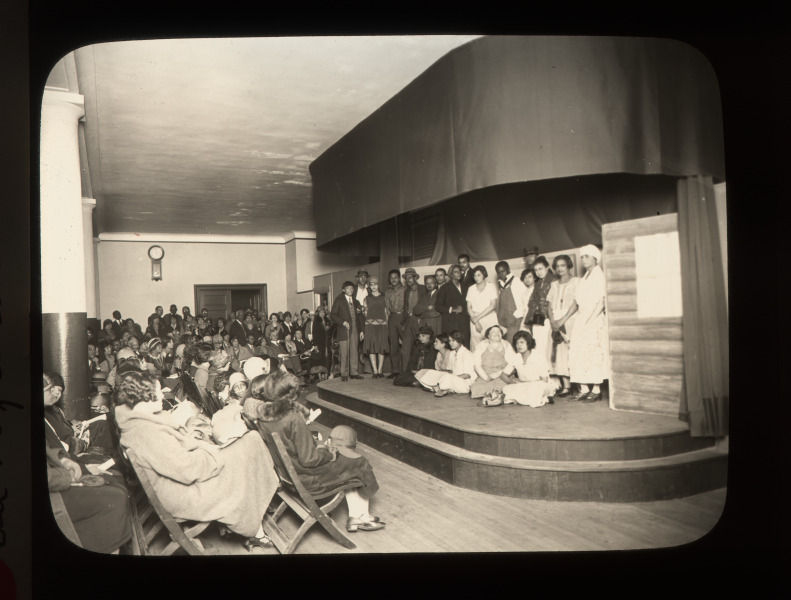
In July 1926, Du Bois penned a piece in The Crisis announcing a launch of a project he had been working on for the past three years at the 135th Street Branch of the New York Public Library. Over these three years Du Bois had been working closely with Ernestine Rose, head librarian of the 135th Street Branch, on the possibility of a “proposed ‘Little Negro Theatre,’” as he wrote on April 17, 1923.6 Rose proved receptive to the idea from the first moment Du Bois presented it, passing along the request to the library's central administration in May 1923. The NYPL agreed to support the “theatre matter” provided that the Harlem Krigwa Players kept the operation rather small, offering the 135th Street Branch basement as a potential location (Fig. 1 and Fig. 2).7 By July 1923 local theatre professionals such as Anne Wolter, a former director of Harlem’s Acme Players, were offering their services to Du Bois for the creation of a Negro drama company housed at the 135th Street Branch.8 Though Rose wrote to Du Bois in September 1923 suggesting that there was a groundswell of interest in the library’s theatre project, it was not until December 1925 that Du Bois submitted a memorandum to the NYPL outlining the specifics of such an African American theatre.9 According to his memorandum, Du Bois waited in part because he wanted to be sure that the project would fill a need the existing landscape of New York’s Black theatre scene (Fig. 3).10

Du Bois’s 1925 memorandum to Rose acknowledged the then-cresting renaissance of African American drama, noting that “We have today, as we did not have previously, a half dozen or more good plays, several Negro dramatists who are writing, and a number of artists and painters who are willing to cooperate.”11 Critically, though he would lead the Krigwa Players who would call the 135th Street Branch their home, Du Bois viewed this collaboration with Harlem’s public library as the beginning of a broader and cross-regional “Little Negro Theatre movement.”12 The ethos of Krigwa, an initialism adapted to transliterate “Crigwa” or “The Crisis Guild of Writers and Artists,” foregrounded Black arts as a foundation of thriving Black communities.13 In their 1926 handbill announcing their values and plays for the season, the Harlem Krigwa Players introduce the project’s mission, namely to build “in High Harlem, New York City, a Little Theatre which shall be primarily a center where Negro authors before Negro audiences interpret Negro life as depicted by Negro artists.”14 The Harlem Krigwa Players thus envisioned this urban “center” as the heartbeat of the 135th Street Branch’s dramatic productions and also the “headquarters in New York” coordinating a network of Black theatre companies across the U.S.15
In his first public-facing article on the project, the now-famous "'Krigwa Players Little Negro Theatre': The Story of a Little Theatre Movement," Du Bois introduced the Krigwa Players as part of a national renaissance in Black theatre. In this 1926 article for the Crisis Du Bois describes the national development of “a new Negro theatre,” which he identifies as the as-yet underdeveloped form of the Renaissance: “Today as the renaissance of art comes among American Negroes, the theatre calls for new birth.”16 Though Du Bois’s article on the Krigwa Players is often celebrated for its theory of the four principles that should guide “a real Negro theatre,” namely that African Americans should create theatre about us, by us, for us, and near us, he identified the Great Migration as a major precondition for "assembling the “us” in his reference.17 Inherent in Du Bois’s definition of real Negro theatre is an urban landscape of segregated neighborhoods: “The theatre must be in a Negro neighborhood near the mass of ordinary Negro people.”18 Through Krigwa the theatre becomes a way to re-imagine Black communities’ relationship to “expressions of racial and spatial violence” within cities as an invitation to make art.19 In Du Bois’s theory the majority-Black area of a city becomes as important a precondition for theatre-making as Great Migration émigrés themselves.
Du Bois's diagnosis of African American theatre of the New Negro era fixates on the markets for dramatic productions in Black urban hubs across the Midwest and Mid-Atlantic especially. For Du Bois, newly congregated densities of African Americans across the country, especially in cities being transformed by Great Migration émigrés, made the national growth of Negro theatre possible. Du Bois’s diagnosis of African American theatre of the New Negro era fixates on the markets for dramatic productions in Black urban hubs across the Midwest and Mid-Atlantic especially. For Du Bois, the idea of “real Negro theatre” could be made real through a model he would at times call the Krigwa Players Little Negro Theatre (or KPLNT) aligned with the principles out Black theatre-making he developed in Harlem. In the 1926 Crisis article, for example, he announces that “A second K. P. L. N. T. is being organized in Washington, D.C.,” expressing hope that “the movement will spread widely” beyond the nation’s capital.20 He also praises “some excellent groups of coloured amateurs are entertaining colored audiences in Cleveland, in Philadelphia and elsewhere” in the same article.21 Yet he criticizes Philadelphia and Cleveland “groups of coloured amateurs” for casting Black performers in white-authored plays rather than writing and mounting their own productions.22 To transform these tendencies, Du Bois suggests that there must be a total overhaul of how Black communities view and make theatre, a transformation only possible in response to “a Negro audience desiring to see its own life depicted by its own writers and actors.”23 By being on stage or writing plays, Black actors, dramaturgs and playwrights could reconfigure their relationship to the Great Migration by aestheticizing its causes, its consequences, and its cityscapes. Du Bois saw this aestheticization as Krigwa’s major work.
Du Bois believed Harlem’s Krigwa Little Negro Theatre would provide a portable model to unite Black creatives around the issue of producing theatre. The Little Negro Theatre model ultimately was meant to stimulate Black art in all its forms. Dedicated to spreading the Little Negro Theatre model beyond Harlem, the Krigwa Players Cabinet encouraged African Americans across the country “to get together a small congenial group of persons who want to do artistic work, who want to write, draw, paint, produce plays, recite, embroider, or work in any other artistic line.”24 According to a circular written by the Krigwa Players dated January 1, 1926, each local Krigwa band, as they were to be called, would be expected to “each year produce a play, one written by its own members or one of The Crisis prize plays, or any other good play.” 25 In addition to producing an annual play, the 1926 circular encouraged local Krigwa bands to buy books, host poetry readings, curate art exhibits, visit local museums together, and to publish their works in The Crisis.26 As the 1926 circular emphasized, each local band was to prioritize “meetings of artists who are working at their art” over “formal organization with a lot of officers and points of order.”27 The Harlem Krigwa Players planned for The Crisis to help these local bands to connect with each other, imagining the magazine as a mediator.28 For Du Bois and the Krigwa Players, the Litte Negro Theatre model was a way to build a national network of Black artistic communities across the United States through theatre. Their excitement for the nationalization of Black art via theatre motivated the 1926 circular’s hopeful conclusion, asking, “In how many centers can we have next the beginning of a real Krigwa Theatre which will put on a play” by 1927.29 This hopeful conclusion was more than idealism and declared a commitment to growing Black theatre and drama as a craft.
Many Black communities wrote The Crisis in 1926 indicating their interest in forming a local Krigwa band and the corresponding Little Negro Theatre, showing the immediate popularity of Krigwa’s model. Leota A. Bell of Kalamazoo, Michigan, for example, wrote to Du Bois on April 1, 1926 expressing her regrets that she could not at that time organize a local Krigwa band while confirming that she hoped to in the future.30 That same month Reverend Neol L. J. Gonsalves of Lexington, Virginia wrote to Du Bois indicating that despite his best efforts he could not form a local Krigwa band due to lack of interest.31 In late April 1926 W. R. Herndon of Denver, Colorado wrote Jessie Fauset at The Crisis regarding local interest in forming a Little Negro Theatre, pending further information “concerning the Krigwa idea and about organization.”32 In November 1926 the Dixwell Community House of New Haven communicated interest in organizing “a group of players at the Dixwell Community House,” hoping to collaborate with The Crisis to produce plays the magazine publicized.33 In reply to Du Bois’s recommendations, a Miss Leonora E Pritchett asks for the rules for a local Krigwa band at the Dixwell Community House.34 Carrie Clifford of the Washington, D.C. Krigwa band wrote to Du Bois on July 12, 1926 asking for help sourcing a play for their debut production. In her letter Clifford took care to mention to Du Bois that the D.C. Krigwa band hoped to generate materials that could be used by other Little Negro Theatres. As Clifford posits, “Some of our members are also writing plays and hope the N.Y. Little Negro Theatre may use some of theirs some future day.”35 The D.C. Krigwa band’s playwrights epitomized Du Bois’s dream for the Little Negro Theatre model, namely, to grow the development of Black-authored plays performed by Black actors in Black communities. But the D. C. Krigwa band’s ambitions also made real the dream of the Harlem Krigwa Players Cabinet to stimulate cross-regional collaboration among Black playwrights, dramaturgs, and performers.
Though he only led the Krigwa Players of Harlem from 1925 to 1927, Du Bois calls the 135th Street Branch’s Little Negro Theatre a small triumph in “a long wearisome fight” to develop African American drama during the New Negro era.36 Reflecting on his work in Black theatre in a 1927 draft of an essay titled “The New Negro Theatre,” Du Bois identifies a few select cities confirming as the sites of recent national progress “toward Negro drama.”37
Three times great pageants of Negro history and aspiration have been given in New York, Washington and Philadelphia, where audiences of perhaps 30,000 saw thousands of colored actors do folk-drama with surprising aptness and simplicity. Then there came in Harlem and spread to other cities companies of colored players in conventional Broadway plays who outside of certain obvious misfits of bloodplot and circumstance rose to heights of real dramatic ability and drew large colored audiences.38
For Du Bois the genre of folk-drama, often understood to “arise from the community for which it was intended,” was more suited to real Negro theatre because he believed in the importance of Black artistic self-determination in all media.39 It would not be enough to have “companies of colored players in conventional Broadway plays”: to Du Bois the growth of African American drama required Black creative collaboration and leadership on and offstage.40 Though the Harlem Krigwa Players are speculated to have disbanded in part due to creative and financial disputes between Du Bois and playwright Eulalie Spence, their impact endured throughout the decade.41 At the end of the 1920s African Americans were still writing the Harlem Krigwa Players expressing fervent interest in joining “the National Negro Little Theatre movement,” sometimes writing Du Bois personally to ask “Couldnt[sic] we have a little colored theatre here, such as you have in New York.”42 The Little Negro Theatre model continued to inspire Black communities to democratize the dramatic arts throughout the New Negro Renaissance.
Poised at what he thought would be the end of his formal leadership in New Negro theatre, Du Bois celebrates how the Little Negro Theatre movement “has been suspiciously begun” and “leave[s] it with fondest benediction to those better able than [he] to conduct its growth.”43 He offers the following questions as a method for aligning the priorities of African American theatre with the values of Black artistic self-determination:
The future is bright for the Little Theatre idea in Harlem. But the seed sown needs a period of incubation. We must make up our minds to certain things.
Is Negro life dramatic and interesting?
Do we want profit or art?
Will we subordinate ourselves to authority?
When these things are settled we can build a real Little Theatre movement.44
Du Bois positions Harlem’s Little Negro Theatre as one of many sites nationally of New Negro era theatre where “the future is bright.”45 Seeing New Negro theatre as a medium for movement-building irrevocably tied African American drama to the Great Migration and the mass movements that created “Negro districts” across the country. It is these “Negro districts” bustling with Black (im)migrants that Du Bois sees as the critical laboratories of “real Negro theatre.”46 Krigwa Little Negro Theatres were to be the means of Black creative freedom made real through the work of theatre-making. As Du Bois well understood, building a “real Little Theatre movement” would require Black creative communities united around the issue of artistic and political freedom, committed to the liberatory potential of art rather than a particular medium.47 A hundred years later, projects like the National Black Theatre and the Black Ensemble Theatre continue to treat theatre-making as movement work and as a medium capable of harnessing “the Liberationist spirit of the past […] as a catalyzing force for our collective creative future.”48 In such contemporary declarations, the Krigwa ethos lives on.
References
1W. E. B. Du Bois, “‘Krigwa Players Little Negro Theatre’: The Story of a Little Theatre Movement,” The Crisis, July 1926, 134.
2 Krigwa Players, “Krigwa Circular B,” Typescript, New York, N.Y., January 1, 1926, W. E. B. Du Bois Papers, Robert S. Cox Special Collections and University Archives Research Center, University of Massachusetts Amherst, https://credo.library.umass.edu/view/full/mums312-b034-i170.
3 W. E. B. Du Bois, “In High Harlem, ca. October 5, 1927,” Typescript, New York, N.Y., October 5, 1927, 3, W. E. B. Du Bois Papers, Robert S. Cox Special Collections and University Archives Research Center, University of Massachusetts Amherst, https://credo.library.umass.edu/view/full/mums312-b208-i040.
4 Du Bois, “‘Krigwa Players Little Negro Theatre,’” 134.
5 Du Bois, “‘Krigwa Players Little Negro Theatre,’” 134.
6 W. E. B. Du Bois, “Letter to New York Public Library,” Typescript, April 17, 1923, W. E. B. Du Bois Papers, Robert S. Cox Special Collections and University Archives Research Center, University of Massachusetts Amherst, https://credo.library.umass.edu/view/full/mums312-b022-i296.
7 Ernestine Rose, “Letter to W. E. B. Du Bois,” Typescript, April 24, 1923, W. E. B. Du Bois Papers, Robert S. Cox Special Collections and University Archives Research Center, University of Massachusetts Amherst, https://credo.library.umass.edu/view/full/mums312-b022-i297; Ernestine Rose, “Letter to W. E. B. Du Bois,” Typescript, May 10, 1923, W. E. B. Du Bois Papers, Robert S. Cox Special Collections and University Archives Research Center, University of Massachusetts Amherst, https://credo.library.umass.edu/view/full/mums312-b022-i301.
8 Anne Wolter also developed the National Ethiopian Art Theatre, which maintained some correspondence with Du Bois during these years as well, and requested his expertise and oversight. Anne Wolter was white, though she worked closely with many Black collaborators.
9 Ernestine Rose, “Letter to W. E. B. Du Bois,” Typescript, September 29, 1923, W. E. B. Du Bois Papers, Robert S. Cox Special Collections and University Archives Research Center, University of Massachusetts Amherst, https://credo.library.umass.edu/view/full/mums312-b022-i303.
10 W. E. B. Du Bois, “Memorandum to the Librarian of the 135th Street Branch of the New York Public Library,” Typescript, New York, N.Y., December 18, 1925, 1, W. E. B. Du Bois Papers, Robert S. Cox Special Collections and University Archives Research Center, University of Massachusetts Amherst, https://credo.library.umass.edu/view/full/mums312-b030-i555.
11 Du Bois, “Memorandum to the Librarian of the 135th Street Branch of the New York Public Library,” 1.
12 Du Bois, “Memorandum to the Librarian of the 135th Street Branch of the New York Public Library,” 1-2.
13 Krigwa Players, “Krigwa prize leaflet,” Typescript, New York, N.Y., 1927, 1, W. E. B. Du Bois Papers, Robert S. Cox Special Collections and University Archives Research Center, University of Massachusetts Amherst, https://credo.library.umass.edu/view/full/mums312-b039-i276.
14 “Krigwa Players Little Negro Theatre Handbill,” Typescript, New York, N.Y., 1926, W. E. B. Du Bois Papers, Robert S. Cox Special Collections and University Archives Research Center, University of Massachusetts Amherst, https://credo.library.umass.edu/view/full/mums312-b034-i166.
15 Krigwa Players, “Krigwa Circular B,” 1.
16 Du Bois, “‘Krigwa Players Little Negro Theatre,’” 134.
17 Du Bois, “‘Krigwa Players Little Negro Theatre,’” 134.
18 Du Bois, “‘Krigwa Players Little Negro Theatre,’” 134.
19 Katherine McKittrick, “Plantation Futures,” Small Axe: A Caribbean Journal of Criticism, vol. 17, no. 3, 2017, 10.
20 Du Bois, “‘Krigwa Players Little Negro Theatre,’” 136.
21 Du Bois, “‘Krigwa Players Little Negro Theatre,’” 134.
22 Du Bois, “‘Krigwa Players Little Negro Theatre,’” 134.
23 Du Bois, “‘Krigwa Players Little Negro Theatre,’” 134.
24 Krigwa Players, “Krigwa Circular B,” 1.
25 Krigwa Players, “Krigwa Circular B,” 1.
26 Krigwa Players, “Krigwa Circular B,” 1.
27 Krigwa Players, “Krigwa Circular B,” 1.
28 Krigwa Players, “Krigwa Circular B,” 2.
29 Krigwa Players, “Krigwa Circular B,” 2.
30 Leota A. Bell, “Letter to W. E. B. Du Bois,” Manuscript, April 1, 1926, W. E. B. Du Bois Papers, Robert S. Cox Special Collections and University Archives Research Center, University of Massachusetts Amherst, https://credo.library.umass.edu/view/full/mums312-b171-i485.
31 Neol L. J. Gonsalves, “Letter to W. E. B. Du Bois,” Manuscript, April 19, 1926, W. E. B. Du Bois Papers, Robert S. Cox Special Collections and University Archives Research Center, University of Massachusetts Amherst, https://credo.library.umass.edu/view/full/mums312-b033-i360.
32 W. R. Herndon, “Letter to Jessie Fauset,” Manuscript, April 27, 1926, W. E. B. Du Bois Papers, Robert S. Cox Special Collections and University Archives Research Center, University of Massachusetts Amherst, https://credo.library.umass.edu/view/full/mums312-b033-i503.
33 B. V. Lawson, “Letter to W. E. B. Du Bois,” Typescript, November 3, 1926, W. E. B. Du Bois Papers, Robert S. Cox Special Collections and University Archives Research Center, University of Massachusetts Amherst, https://credo.library.umass.edu/view/full/mums312-b033-i114.
34 Leanora E. Pritchett, “Letter to W. E. B. Du Bois,” Manuscript, November 10, 1926, W. E. B. Du Bois Papers, Robert S. Cox Special Collections and University Archives Research Center, University of Massachusetts Amherst, https://credo.library.umass.edu/view/full/mums312-b033-i116.
35 Carrie W. Clifford, “Letter to W. E. B. Du Bois,” Manuscript, July 12, 1926, 1, W. E. B. Du Bois Papers, Robert S. Cox Special Collections and University Archives Research Center, University of Massachusetts Amherst, https://credo.library.umass.edu/view/full/mums312-b032-i497.
36 W. E. B. Du Bois, “The New Negro Theatre,” Typescript, New York, N.Y., 1927, 2, W. E. B. Du Bois Papers, Robert S. Cox Special Collections and University Archives Research Center, University of Massachusetts Amherst, https://credo.library.umass.edu/view/pageturn/mums312-b215-i129.
37 Du Bois, “The New Negro Theatre,” 2.
38 Du Bois, “The New Negro Theatre,” 2-3.
39 Helene Keyssar, “Theodore Dreiser’s Dramas: American Folk Drama and Its Limits,” Theatre Journal, vol. 33, no. 3, 1981, 367.
40 Du Bois, “The New Negro Theatre,” 2-3.
41 For more on Du Bois’s dispute with Eulalie Spence, see Kathy A. Perkins, ed., Black Female Playwrights: An Anthology of Plays before 1950 (Indiana University Press, 1989), 106; New Perspectives Theatre Company, “Eulalie Spence,” accessed January 26, 2026, https://www.newperspectivestheatre.org/eulalie-spence. For more on Harlem’s Black theatre scene after the Krigwa Players, see Claude McKay, “The Negro Theatre Movement in New York,” Typescript, Federal Writers’ Project New York Negro Group, n.d., Federal Writers’ Project Negro Group Papers, Beinecke Rare Book and Manuscript Library, accessed January 27, 2026, https://collections.library.yale.edu/catalog/10563282.
42 Ardella V. Richardson, “Letter to KRIGWA,” Manuscript, December 26, 1931, W. E. B. Du Bois Papers, Robert S. Cox Special Collections and University Archives Research Center, University of Massachusetts Amherst, https://credo.library.umass.edu/view/full/mums312-b060-i379; Sharlie Norman and Charlotte Van Buren, “Letter to W. E. B. Du Bois,” Typescript, July 9, 1928, W. E. B. Du Bois Papers, Robert S. Cox Special Collections and University Archives Research Center, University of Massachusetts Amherst, https://credo.library.umass.edu/view/full/mums312-b044-i150. For examples of late 1920s correspondence to Du requesting information on the Black theatre movement, see J. W. J. Lovell, “Letter to W. E. B. Du Bois,” Typescript, February 24, 1929, W. E. B. Du Bois Papers, Robert S. Cox Special Collections and University Archives Research Center, University of Massachusetts Amherst, https://credo.library.umass.edu/view/full/mums312-b049-i387; Mila M. Bray, “Letter to W. E. B. Du Bois,” Manuscript, June 6, 1929, W. E. B. Du Bois Papers, Robert S. Cox Special Collections and University Archives Research Center, University of Massachusetts Amherst, https://credo.library.umass.edu/view/full/mums312-b047-i333.
43 Du Bois, “In High Harlem, ca. October 5, 1927,” 1.
44 Du Bois, “In High Harlem, ca. October 5, 1927,” 4-5.
45 Du Bois, “In High Harlem, ca. October 5, 1927,” 4-5.
46 Du Bois, “‘Krigwa Players Little Negro Theatre,’” 134.
47 Du Bois, “In High Harlem, ca. October 5, 1927,” 4-5.
48 National Black Theatre, Our History, https://nationalblacktheatre.org/mission/, accessed 17 Apr. 2026.
Footnotes
About The Author(s)
Kirsten Lee is an Assistant Professor of English at Auburn University, where she specializes in early African American print and material culture, intellectual history, transnationalism, archival poetics, and Black women writers. Her current book project studies the aesthetic relationship between calls for reparations and abolitionism in Black print and manuscript across the long nineteenth century. Her work has appeared or is forthcoming in Early American Literature, American Literary History, and Resources for American Literary Study. Since 2025, she has served as a co-director of the Black Women Diaries Project alongside Dr. Jennifer Putzi of the College of William and Mary.
JADT publishes thoughtful and innovative work by leading scholars on theatre, drama, and performance in the Americas – past and present. Provocative articles provide valuable insight and information on the heritage of American theatre, as well as its continuing contribution to world literature and the performing arts. Founded in 1989 and previously edited by Professors Vera Mowry Roberts, Jane Bowers, and David Savran, this widely acclaimed peer reviewed journal is now edited by Dr. Benjamin Gillespie and Dr. Bess Rowen.
Journal of American Drama and Theatre is a publication of the Martin E. Segal Theatre Center.


