
Robert Wilson on Screen, Anthology Film Archives
Audrey Rogulski
By
Published on
September 1, 2025
On the evening of June 5, the audience slowly filed out of Anthology Film Archives and into the streets of the East Village, haunted by the final shot of the final screening of the week-long retrospective: the newly restored Robert Wilson and the Civil Wars (1985), directed by Howard Brookner. In that shot, Robert Wilson lies on an unmade bed, haphazardly gathering pillows before burying his face beneath one: exhausted, frustrated, but at last at rest after the inconclusive adventure of the CIVILwarS project in 1984. This image of Wilson at rest, the only one I encountered all week, proved a particularly fitting conclusion to a series that had opened with the similarly moving Einstein on the Beach: The Changing Image of Opera (dir. Mark Obenhaus, 1986). That film offered an entry point into the mystery of a grandiose, revolutionary theatre-making whose opacity did not diminish its deeply personal character. By closing on the artist at rest, if only momentarily before the next project, this homage to Wilson, who died on July 31, 2025, demonstrated two things. First, it showed the breadth of work he managed to stage under unlikely and constrained conditions (with the notable exception of The CIVIL warS: a tree is best measured when it is down, which was never staged in its entirety). Second, it showed the value of screening archival materials for an audience with varying degrees of familiarity with the productions and with the man himself. In keeping with Wilson’s refusal to teach anyone a lesson or to tell anyone what to think, what follows is less a work of criticism than an account of a gradual encounter, one that, as I write these lines, feels personal and oriented toward the future rather than commemorative.

The sudden freedom from schedules that marks the end of an academic semester is perhaps best spent immersed in the work of a towering figure in one’s field, whether to study it, to seek an impulse to make something of one’s own, or simply to drift between admiration and boredom. Spending a week with a two-dimensional, diachronic, and non-linear Wilson on the screens of Anthology Film Archives felt like far more than a tribute to the visionary theatre-maker and visual artist, although the timing of the program made clear that the question of his legacy lay at its core. For a week, Anthology’s regular audience and I were surrounded by his figure. At times he appeared as a performer in his own work, whether on stage (Hamlet) or on video (The Death of Molière); at others he appeared as a commentator or talking head, his hands perpetually drawing. Most compellingly, he appeared as a director at work in a number of “making-of” documentaries (Einstein on the Beach: The Changing Image of Opera, The Making Of: Hamlet, A Monologue, The Black Rider, The Life and Death of Marina Abramović, and Robert Wilson and the Civil Wars). Far from depicting Wilson as the sole creative force in his own multiverse, many of these documentaries foregrounded the eclectic artists he assembled for some of his most iconic productions: William S. Burroughs and Tom Waits, who wrote and composed The Black Rider; Philip Glass and Lucinda Childs on Einstein on the Beach; and ANOHNI and Marina Abramović in the production devoted to the latter’s “Life and Death.” They also featured the actors, costume designers, musicians, and many other theatre workers and interlocutors without whom the scale of Wilson’s freedom could not have materialized across the more than 400 productions that, according to former Watermill Center archivist Clifford Allen, constitute his body of work.
Spectating Archives
Throughout the week, Clifford Allen introduced several of the films, offering otherwise inaccessible insight into the state of the archive. He alternated with the series’ curators: Frank Hentschker, Executive Director of the Martin E. Segal Theatre Center, who performed in Wilson’s The Forest in the 1980s and subsequently worked as his personal assistant and tour manager; and Tomek Smolarski, a producer and programmer of Polish and international theatre. Hentschker reflected on his experiences with Wilson, expressed regret that the retrospective had not taken place during the artist’s lifetime, and opened the floor to an unusual question-and-answer format that produced some remarkably moving exchanges. He asked whether anyone had “a comment or a question” and invited individual spectators to recount their own experiences with Wilson. This unquenchable curiosity extended each film into the present and blurred the boundaries between Wilson’s theatre-making and our individual lives. The programming itself granted extraordinarily privileged access, and the audience, constituted as a collective, transformed an homage to a recently deceased artist into an exercise in theatre historiography through anecdote and encounter, gossip and speculation. Somewhere between oral history and casual conversation, audience members became the very talking heads they had been watching minutes earlier, revealing their own expert spectatorship of, or participation in, Wilson’s universe. The screening of one production recording would prompt discussion of others that most of the audience could only imagine. After the screening of the video work Deafman Glance, for instance, several audience members remarked that A Letter for Queen Victoria (1975), Wilson’s only Broadway production and one not included in the retrospective, had “changed their lives.” The follow-up question, “Can you try to describe in which ways the show changed your life?” turned this offhand remark into an intergenerational, maieutic exchange on the phenomenology of theatre. What does it mean for a work of theatre to change one’s life? While some audience members conveyed what they could of the incommunicable experience of Einstein on the Beach or The Life and Death of Marina Abramović, others, myself included, developed memories of performances we never attended, through a newfound proximity to their creative process, and came to long for performances we will never see. “Performance remains again,”[i] in performing bodies and in the transmission of performance: in embodied transmission, of course, but also in the opening of the material archive to new lives, without attempting (and failing) to redeem the archive from its patriarchal reputation.

The scholarly and creative questions surrounding the activation of performance archives, understood as an epistemic gesture that includes the ephemeral “repertoire” of embodied practice,[ii] remained on my mind throughout the week. Clifford Allen addressed these questions directly during the screening of recently rediscovered footage of Overture for KA MOUNTAIN AND GUARDenia TERRACE, an iteration performed at the Byrd Hoffman School of Byrds’ Spring Street loft, rather than the full production presented a few months later in Shiraz, Iran, in 1972. Found by sheer luck in Anthology’s own archives and never before screened publicly, the footage constitutes the “most extensive extant documentation” of the piece: an hour and a half of silent, black-and-white clips of Wilson and several of his closest collaborators, including Andy de Groat, Edwin Denby, and his grandmother, Alma Hamilton. Allen spoke of the archivist’s practice of “having your hands in it” as a distinct mode of experiencing otherwise lost performance. There was also genuine pleasure in sharing, with an audience and on a large screen, recordings that are usually accessible only on small monitors under the constrained conditions of performing arts archives. I am admittedly an archetypal spectator for these sometimes demanding screenings, since sitting before such a screen to witness the low-resolution remains of the most elusive of art forms is part of my work as an emerging theatre scholar. Yet what I had previously regarded as an inevitably solitary, unshareable activity, far removed from the Metropolitan Opera’s Live in HD broadcasts, became a ritual of collective curiosity, inspiration, remembrance for some, and, at times, endurance. This was certainly the case with Overture, a temporally disconcerting experience in which lateness, length, and silence shaped a void perhaps not unlike that of the entire week over which the piece was performed, six hours a day from April 24 to 30, 1972. This is not to claim that our spectating of the archive recovered the irretrievably lost experience of performance. Rather, three conditions together “unlocked” resources for a sustained yet diffuse attention: (1) opening one’s senses to the dust and archival wonder of the identified 16 mm print; (2) becoming part of a silent collective in a silent room, which makes silence an active task rather than passive obedience to the conventions of spectatorship; and (3) sitting through moments of near-stillness and Andy de Groat’s bewildering spinning alike. Despite the speechless, black-and-white blur, this attention extended to gesture and small movement, to the developing relationships between performers, and to the performers’ own focus and exhaustion. Illuminating our viewing after the fact, one audience member summarized Overture’s approach to Genesis (the creation of a world, or of the world, over the course of a week) and directed us toward further reading, notably The Theatre of Visions by the critic Stefan Brecht, who himself performed in Overture.

In this spirit, the newly formed audience collective pooled its knowledge and aesthetic experience after each screening, debriefing and introducing ourselves to one another. Some attendees were at home in the series: Philip Glass attended several screenings, and Keith McDermott, Wilson’s friend and co-author of his forthcoming memoir, The Space Behind the Face: Life Stories by Robert Wilson, helped clarify timelines and recounted anecdotes. Others with whom I spoke, by contrast, felt “challenged” by this sudden and immersive exposure to Wilson’s theatricality: challenged and, at the same time, inspired by a kind of unmatched freedom, one envied by theatre-makers of every generation.
Hands, Sharp and Free
The term “making of” is at once banal and apt, given Wilson’s apparent inability to refrain from using his hands to make something during an interview. His final interview, recorded by the channel Artifacts for the production of Mary Said What She Said at NYU Skirball in March 2025, is a case in point. He drew continuously, translating each thought into an image as he spoke, a practice documented in most of the retrospective’s films.
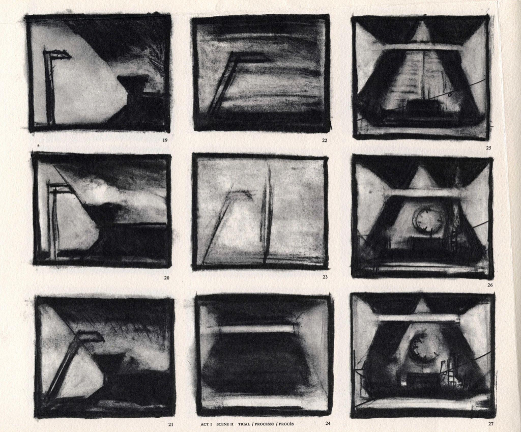
Cameras frequently and eagerly capture his hands, which offer an apt metonymic image of creation and direction, including the exacting precision Wilson demanded of himself and his performers alike. Fingertips, angles, the placement of hands, and the placement of light are all in dialogue within a rehearsal method that seeks exactitude as the precondition for freedom. As Wilson put it: “People are afraid of that, in the beginning, counting numbers and learning this. But once one learns it and can do it without thinking so much about it, then one is free to think about other things.”[iii] Only once performers have become comfortable with the mechanical repetition of choreography and with a relationship to the lighting measured in millimeters can they imbue gesture and expression with everything that makes them who they are, which is the reason for their presence on stage in the first place. A frequently told anecdote illustrates his unusual approach to casting. While creating Deafman Glance with the School of Byrds during a 1970 residency at the University of Iowa, Wilson saw Sheryl Sutton, then a student at the university, pointing at something on the street (some accounts say this happened more than once). He recognized immediately that her elongated arm and finger, her posture, her gaze, and her presence belonged in the work. This encounter led to their collaboration not only on Deafman Glance (both the theatre piece and the 1981 video work Wilson made for television) but also on Einstein on the Beach, as Sutton pursued her career as a dancer and performer alongside Andy de Groat and Lucinda Childs. The episode attests to the power of free and sharp hands, which could be anyone’s hands, including those of Einstein in photographs of the scientist and in his handwritten equations, both of which informed de Groat and Childs’s choreographic masterpieces for Einstein on the Beach. Mark Obenhaus’s remarkable film of the Wilson and Glass opera, made for PBS’s Great Performances series, captures hands in all the intensity and diversity of the signs they afford.

Across Einstein on the Beach, The Black Rider, and The Life and Death of Marina Abramović (which is also the order in which I saw them), the development of Wilson’s singular stage language generates certain expectations: of style (few but distinctive set pieces, an abundance of singular chairs, modernized period costumes, and colored backdrops, often blue and sometimes red), of rhythm (long scenes; slow yet continuous movement), and of repetition. Most instructive for young artists developing their own stage language is that these expectations never harden into fixity; rigorous technique serves instead to allow the unexpected to emerge. One can quickly become familiar with Wilson’s “theatre of visions,”[iv] provided one relinquishes the desire to understand and instead basks in the alluring, opaque glow of its illegibility. “It’s okay, and even good, for the audience to get lost,” he remarks in The Making Of: Hamlet, A Monologue, and I did indeed get lost watching his retelling of Shakespeare’s much-staged tragedy, conceived as Hamlet’s near-death, flashback dream, in which Wilson played the title role and the only role. An audience needs no permission to get lost, though disorientation in the theatre can certainly be unpleasant for what it seems to reveal about gaps in one’s cultural reference points, particularly a “learned” capacity to appreciate “postdramatic theatre.”[v] Wilson’s work demonstrates how fragile that impression is. This is not to say that performing or witnessing his work is undemanding: duration, precision, repetition, and slowness test our senses and our mental and physical capacities. Yet one need not know and love Balanchine, Merce Cunningham, or John Cage in order to “understand” or appreciate Wilson’s theatre. There is no fixed meaning to grasp, no code to decipher, and no elite set of references shared among a select few. In this sense, and to adopt a Bourdieusian reading of “taste,” his theatre stands quite far from the forms of cultural capital often associated with the appreciation of non-narrative, non-linear, and at times nonsensical theatre. It is a profoundly non-manipulative theatre, in that it does not seek to elicit any specific emotion from its audience. The absence of targeted tears or laughter produces a form of agency that disorients a domesticated audience while leaving unconstrained those who enter such spaces less often. Watching Wilson at work makes all of this explicit, since he regularly articulates these tenets of his method. Above all, it allows a creative audience to see how he works, and thus how one might in turn generate associations pertinent to one’s own vision.

The demonstration of freedom at stake in the retrospective offered discovery to non-specialists and inspiration to artists. For me, and probably for other scholars in the room, it also offered a welcome reprieve from academic discourse, through an experience that blurred the categories established by our field and at times suspended the very terms of categorization. Whenever the films presented analytical discourse about the productions, contradiction inevitably followed, sometimes as an intended effect and sometimes as a consequence of the sheer incoherence and mystery of the work itself. This was most explicit in Robert Wilson and the Civil Wars, in which several theatre theorists openly disagree about the “abstract” or “nonsensical” dimension of the work and about the value of comparing it to the visual arts. Wilson clearly embraced these contradictions in his pursuit of work with “very little separation between life and the making of art,” as he states in the same documentary. Certain “great men” can stifle their admirers’ creativity through the sheer scope of their accomplishments, their looming presence in curricula, and an extraordinary, legendary aura that either eclipses their struggles or acknowledges them only to mythologize them. This could easily have been the case with Wilson, whose name is so familiar and whose pioneering status is so widely celebrated. It is therefore surprising that watching him at work produces the opposite effect: his embrace of an open theatre, and of an open art, is so complete that it acts as a kind of revelation. Hearing him distill fragments of experiential wisdom (which, again, are not lessons) is persuasive, without any effort to persuade, that there is always theatre to be made, that any image or thought can serve as a starting point or seed, and that a universe is already absently present within it, in the manner of a monad. His fragmentary, oneiric video work (notably Stations and Video 50) offers a distinctive experience of this principle; it stands apart from his stage work by seeming at once “unrealized” and laden with potential. The anecdotes scattered across the films and the post-screening conversations among audience members highlighted the contingent and serendipitous nature of these moments of impulse. Visions. Suspended chairs. The mother holding the knife. A chandelier on a stone. The self-stirring teaspoon of La femme à la cafetière.


These are the “negative squares of reality,” as Louis Aragon wrote of Deafman Glance in 1971, in his open letter to André Breton, who had died in 1966:
“Never as here, from a dark hole in the theatre, have I ever experienced the feeling, in confronting the spectacle of Robert Wilson, that if ever the world finally changes, and ceases to be this hell one sees at the end of almost four hours on the stage, and it is the hell where there is the slag pit and the mine, that if ever the world changes and men become like the dancer I spoke of, free, free, free . . . it’s through freedom man will have changed. Freedom, radiant freedom of the soul and the body.”[vi]
References
[i] Rebecca Schneider, “Performance Remains Again,” in Archaeologies of Presence: Art, Performance and the Persistence of Being, ed. Gabriella Giannachi, Nick Kaye, and Michael Shanks (London: Routledge, 2012).
[ii] Diana Taylor, The Archive and the Repertoire: Performing Cultural Memory in the Americas (Durham, NC: Duke University Press, 2003).
[iii] Einstein on the Beach: The Changing Image of Opera, directed by Mark Obenhaus (PBS, Great Performances, 1986), documentary.
[iv] Stefan Brecht, The Theatre of Visions: Robert Wilson (Frankfurt am Main: Suhrkamp, 1978).
[v] Hans-Thies Lehmann, Postdramatic Theatre, trans. Karen Jürs-Munby (London: Routledge, 2006).
[vi] Louis Aragon, “An Open Letter to André Breton on Robert Wilson’s Deafman Glance” trans. Linda Moses (Performing Arts Journal, Volume 1, Number 1, Spring 1976).
About The Author(s)
Audrey Rogulski is a PhD candidate in the Department of French Literature, Thought and Culture at New York University. Her doctoral research focuses on the circulation of French-language theater in the United States in the late twentieth century. She is a theater practitioner and translator.
Robert Wilson Yearbook
The Robert Wilson Yearbook, published annually by the Martin E. Segal Theatre Center, offers a dedicated platform for scholarly and creative engagement with the life, artistry, and enduring legacy of Robert Wilson (1941–2025), one of the most original visionaries in contemporary theatre and performance. The Yearbook seeks to explore and expand upon Wilson’s groundbreaking approaches to staging, lighting, movement, and visual composition. Each issue will feature a diverse range of content—including original essays, critical commentary, archival materials, artist reflections, and photography—examining facets of Wilson’s multifaceted practice across genres, eras, and geographies.
The Robert Wilson Yearbook is a publication of the Martin E. Segal Theatre Center.

