
Polyphonies of the Present: The Pulse of the Almada Festival
Published:
December 1, 2025
By Savas Patsalidis

Image Credits:
Returning to Almada
As I have done in recent years, this July (2025) I returned once again to Almada, drawn not only by the calibre of its annual festival, one of Portugal’s most significant theatrical events, but also by the atmosphere it cultivates: warm, relaxed, and almost familial in its sense of coexistence.
In contrast to larger, often impersonal festivals with their endless parallel events and hurried transitions from venue to venue, the Almada Festival offers a markedly different experience. Here, one feels at home. The experience is more embodied, more communal, and, in a subtle yet clear sense, quietly anti-systemic. There is no imperative to engage in relentless networking, business cards at the ready, pressure to "see everything." Instead, there is time, time to watch, to listen, to feel, to reflect, to write, to encounter the city and its people.
For me, this constitutes a form of cultural resistance: an alternative to the dominant festival logic of overproduction and consumption, what we might describe as the “festival-as-supermarket” model.
Under the artistic direction of the energetic Rodrigo Francisco, the Almada Festival has organically embraced a philosophy of community, not merely as a thematic or managerial motif, but as the core of its artistic practice. Its programming does not cater to any particular aesthetic ideology or social elite, nor does it play into the dichotomy of "experts" versus "the masses." Instead, through its inclusive framework, it opens aesthetic proposals to a wide-ranging public, aiming not simply to disseminate the art of Dionysus, but to cultivate spectatorship itself, exposing audiences to a plurality of theatrical quality languages and stylistic vocabularies.
One particularly emblematic gesture is the festival’s annual invitation to audiences to vote for the performance they would most like to see return the following year. This is not merely symbolic; it re-enacts a genuine form of co-curation, an authentic dialogue rather than a token gesture of “participation.”
Staged in Restraint, Anchored in Emotion: Marius (Directed by Joël Pommerat)
The first performance I attended was Marius, drawn from Marcel Pagnol’s emblematic Marseille Trilogy, directed by Joël Pommerat and staged on the main stage of the Teatro Municipal Joaquim Benite.
The plot is relatively straightforward, some might even call it predictable: a young man (Marius) is torn between the dream of escape and the pull of romantic love. Life unfolds in a small café owned by his father, César, near the Marseille harbour, a place of routine, familiar encounters, philosophical banter, quarrels, and laughter. It serves as a communal hub, a kind of agora or informal tribunal, where everyday lives are continuously staged and restaged. For Marius, who longs to become a sailor and flee toward the unknown, the tightly composed and almost claustrophobic stage design by Éric Soyer becomes a metaphor for entrapment.

Into this enclosed world enters Fanny (Elise Douyere), Marius’ great love. Yet, as is often the case in narratives of departure, it is the dream, rather than the love, that ultimately prevails. Marius departs secretly at night, chasing the freedom promised by the sea, forsaking the stability and emotional security his relationship offers.
Pommerat’s direction adopts an everyday, almost anti-theatrical rhythm, one that allows silences, hesitations, and tentative confessions to generate atmosphere. The staging resists melodrama; emotional charge emerges organically through dialogue, through the cadence of the local dialect, through understated humour tinged with melancholy, and through small, restrained gestures: a glance, a touch withheld, two bodies falling in love without ever fully closing the physical distance between them. Particularly in the scenes with Fanny, the physical detachment intensifies the spoken word, as the absence of bodily expression lends weight and space to language itself to perform its acoustic “physicality.”
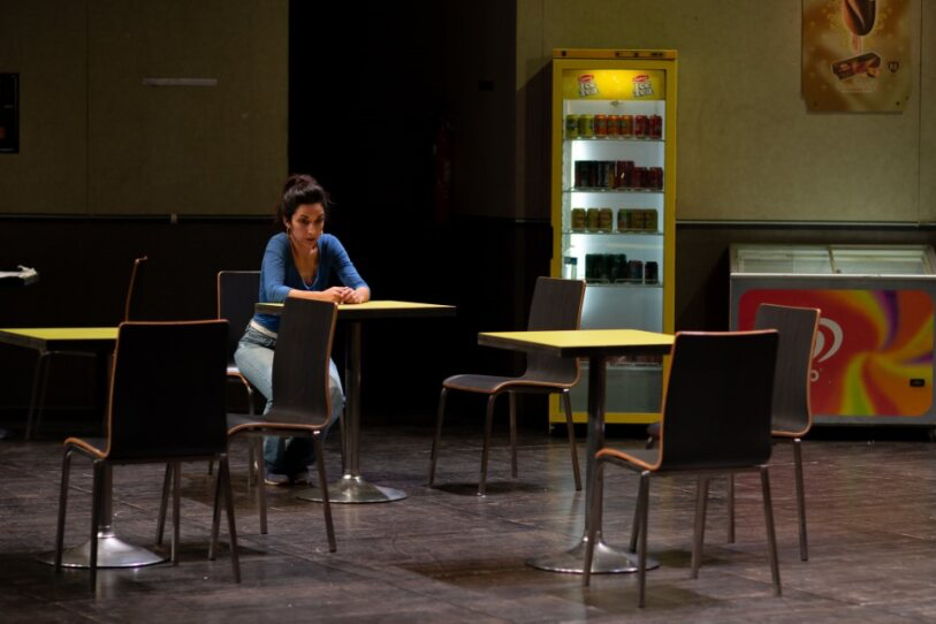
A striking aspect of this production is its origin in carceral space. Marius was first developed and staged in a high-security prison (2014–2017), with most of the current cast composed of formerly incarcerated individuals. Only the actress playing Fanny is a trained professional. This choice lends the production not only a profound social resonance but also a form of raw authenticity. Even the occasional performative imperfections or technical inconsistencies do not weaken the work’s power; on the contrary, they enhance its credibility and emotional depth.
As noted earlier, thematically, Marius does not tread new ground: the sea as desire, love as dilemma, the conflict between duty and longing, father and son, these are familiar tropes. One might even be reminded of Eugene O’Neill’s sea plays, written during roughly the same period as Pagnol’s trilogy. Nor is the portrayal of Fanny, patient, compassionate, self-sacrificing, foreign within the representational codes of early 20th-century patriarchy.
And yet, Pommerat’s direction holds the viewer’s attention through emotional restraint and formal discipline. The intensity is not on the surface, but it is there, quiet, unmistakable.
In a world driven by acceleration and spectacle, Marius reminds us of the power of waiting, of deliberation, of the understated.
Behind the Curtain, Beyond the Gaze: Teatro Delusio (Familie Flöz)
At the open-air theatre of Escola António da Costa, we watched Teatro Delusio by the internationally acclaimed German ensemble Familie Flöz, a wordless performance imbued with the atmosphere of silent cinema and the precision of corporeal theatre. Its narrative centre is not the stage, but rather its backstage, that liminal zone where the dream of theatricality collides with the muted, repetitive routines of its unseen labourers, electricians, stagehands, ushers.

At the heart of the piece are three theatre technicians, Bob, Bernd, and Ivan (played by Andre Angulo, Johannes Stubenvoll, Thomas Van Ouwerkerk), who emerge as emblematic figures of a world both invisible and essential. Through a sequence of slapstick-inflected episodes, we follow their backstage frictions, aspirations, vanities, and unspoken dreams. While the "front stage" dazzles with lights, applause, and spectacle, the backstage unfolds as a silent tragedy, the tragedy of waiting, invisibility, and failure, the tragedy of an unacknowledged life.

The three performers portray a total of 29 characters, ranging from conductors and dancers to eccentric directors and narcissistic stars. Their performance displays remarkable technical precision, choreographic clarity, and performative dexterity in their seamless transitions between roles, bodies, and tasks. This is physical acting par excellence, where the mask, intricately designed by Hajo Schüler, becomes a living surface, capable of transmitting fear, joy, awkwardness, and despair. Rather than concealing, the mask reveals.

Using purely visual means, without a single line of spoken dialogue, Teatro Delusio manages to explore themes of human solitude, the yearning for recognition, jealousy, love, and fulfillment. It is a dramaturgy of silence, where laughter and poignancy coexist in a fragile equilibrium. One does not laugh at the characters, but rather through them, recognising in their gestures the viewer’s own minor failures, deferred desires, and the barely perceptible weight of obscurity.
The absence of linguistic barriers explains why Teatro Delusio has toured in 34 countries to this day. Though meticulously structured, the performance might have benefited from a slightly tighter dramaturgy, particularly in the final twenty or so minutes, where the repetition of certain motifs risked narrative dilution. The birth scene, for instance, felt inventive but dramaturgically unanchored, an idea left unexplored.
Nevertheless, this is a profoundly hybrid and meta-theatrical work where puppet theatre, mime, physical comedy, slapstick, tragedy, and farce are woven into a fluid structure that dialogues with the tradition of theatre within theatre. It is, in many ways, a reflexive homage to theatre itself, and especially to the mask, both as material object and as metaphor for identity, secrecy, duplicity, and existential disappointment
Familie Flöz turns our attention to the invisible processes of stage-making, evoking resonances with productions like Ellie Dubois’ No Show (the Herald Award recipient at Edinburgh Fringe, 2017) in which the audience watches what does not happen when a performance collapses before their eyes, or Constanza Macras/Dorky Park’s Open for Everything (2012), which centres on marginalised performers (from Roma communities), giving voice to those who remain in the shadows. Most notably, it echoes Michael Frayn’s ageless Noises Off (1982), an ingenious meta-farce that reveals the chaos behind the scenes of a matinee performance.
In all these cases, gaze shifts from centre to margin, from performance to infrastructure, from protagonist to technician or outsider. What emerges is a commentary on theatrical visibility and the politics of spectatorship: Who is seen and thus rendered a subject of the gaze? And who remains unseen? What does it mean, literally and metaphorically, to be offstage, in theatre and in life?
The closing moments offer no catharsis, only a bittersweet image of a world perpetually left behind. The characters remain there, in a space with no curtain, no lighting, no applause, only their breath, and their gaze, fixed upon an audience that does not see them.
The performance does not speak.But it is loudly heard.
A Classroom Against Oblivion: El mar. Visión de unos niños que no lo han visto nunca (Concept Xavier Bobés & Alberto Conejero)
This Spanish documentary-style performance, El mar. Visión de unos niños que no lo han visto nunca (“The Sea: As Seen by Children Who Have Never Seen It”), performed by Xavier Bobés and Sergi Torrecilla, is based on the true story of Antoni Benaiges, a teacher in a remote village school in Bañuelos de Bureba (Burgos) in 1936. It is rooted in an act of historical remembrance and poetic reconstruction, a gesture of tender resistance through memory and education.

The story begins in 1934, when Benaiges, using his own savings, purchased a gramophone and a printing press for his rural classroom, encouraging the children to express themselves creatively. Two years later, his students produced a small booklet titled El mar. Visión de unos niños que no lo han visto nunca, in which they described how they imagined the sea, though none of them had ever seen it. Benaiges promised to take them to the coast that summer. However, the outbreak of the Spanish Civil War and his execution (July 25, 1936) at its onset rendered this promise tragically unfulfilled.

The performance treats this historical episode with emotional delicacy, ethical clarity, and narrative restraint. Built around the aesthetics of documentary theatre and object theatre, the piece deploys minimal theatrical resources. Objects do not simply support the storytelling; they act as catalysts of emotion, charged relics that summon the affective memory of a vanished world. Through the use of live cameras, the children's perspective is expanded and brought into the visual field, layering the adult narration with the imaginary gaze of childhood.
There is nothing ostentatiously innovative about the staging. On the contrary, the production is deliberately unassuming, almost “non-theatre” in its visual economy. It pivots around empathy, emotional presence, and the quiet beauty of relationality. Though it occasionally borders on melodrama, the performance maintains its composure, evoking emotion for the right reasons. It creates a subtle oscillation in which the spectator feels at times like the teacher, and at others, like the child.
On stage, the two performers, Xavier Bobés and Sergi Torrecilla (wearing the red shirt), engage in a complementary enactment of memory: Bobés through the material activation of objects, and Torrecilla through the performative narration of texts drawn from the children’s writings, Alberto Conejero’s script, and Antoni Benaiges’ own words. Together, they articulate the dialectic between the “here-and-now” of theatrical presence and the “there-and-then” of historical absence, thereby bridging past and present with nuanced subtlety. With humility and clarity, they share the story and the memories it holds, honoring the legacy of Benaiges while elevating the values of hope, education, and human dignity, all conveyed through the fragile yet enduring voices of children.
It is unsurprising that the piece has been presented widely across Latin American countries. Originally premiered at the Teatre Nacional de Catalunya in February 2022, it has since been nominated for several Max Awards, including Best Play, Best Direction, and Best Actor (Bobés) for its performance at Teatro Corral de Comedias.
To Move Is to Survive: Zugzwang (Concept and Performance Le Galactik Ensemble)
Presented in the outdoor space of Escola D. António, Zugzwang (2021) marks the second collective creation of the French company Le Galactik Ensemble, following their earlier piece Optraken (seen at the same venue the previous year). Borrowing its title from the chess term zugzwang, a situation where any move leads inevitably to disadvantage or loss, the performance transforms this concept into an explosive physical allegory of human precarity and imbalance in a world of constant destabilisation.

Five acrobats encounter one another in a volatile scenographic landscape, somewhere between workshop, construction site, and laboratory. For sixty minutes, they compose a narrative of survival, not through language or plot, but through somatic confrontation with risk. The body becomes a storytelling device, contending with gravity, collision, imbalance, and fear. Each movement appears to be dictated by an environment that resists trust. The performers live, quite literally, in a constant state of zugzwang.

The set design by Mathilde Bourgon, a kinetic, fragile mechanical architecture, populated by rails, pulleys, ropes, collapsing doors, and unpredictable surfaces, plays a pivotal role. It is not a passive backdrop but an active opponent, reactive, obstructive, sometimes deceptive. Visually, the piece evokes the mechanical traps of silent cinema, yet it resonates with a distinctly contemporary anxiety: the instability of material systems and environments. The performers do not merely move upon it, they survive within it.


For those unfamiliar with Le Galactik Ensemble, it is worth noting that their work specializes in what they call “situational acrobatics,” a form of real-time physical risk-taking, in which safety is never entirely guaranteed and failure is always a possibility. Nothing is wholly predetermined. The tension derives from this very volatility: perpetual edge, where everything could go wrong, and often nearly does. It s precisely at this threshold that theatricality emerges.
Humour plays a crucial role, not as comic relief, but as a mechanism of resistance. It is the humour of despair and survival. The figures on stage are not superhumans but clowns, fragile, fallible, exposed. The grotesque, the comedic, and the existential coexist in a performative poetics of insecurity. As in the work of Aurélien Bory’s Compagnie 111[i] or Cirque Inextremiste,[ii] physicality here is not for spectacle, but a necessary language for articulating the inexpressible.
The ensemble performs with remarkable collective precision. There are no individual protagonists; the group functions as a single, interdependent organism navigating a hostile world. Acrobatics, choreographic tension, and acting discipline converge, not to showcase virtuosity, but to reveal necessity. This is a dramaturgy of survival rather than display.
Zugzwang offers no resolution. There is no comfort, no catharsis. It presents a world that remains unstable, where every move carries the risk of collapse, and yet... stillness is not an option. One must keep moving, because to stop is simply to cease to exist.
Listening to Absence: A Sorrow Beyond Dreams (Directed by Teresa Gafeira)
Staged in the experimental venue of Teatro Joaquim Benite, this production by Companhia de Teatro de Almada is based on Peter Handke’s deeply personal novella A Sorrow Beyond Dreams, written in the aftermath of his mother’s suicide. The work resists conventional, plot-driven dramaturgy, opting instead to trace the inner rhythms of grief, and the writer’s struggle to render them communicable through language.

Set in rural Austria between the two World Wars, the narrative unfolds against the backdrop of Handke’s mother’s life, her marriage, her disillusionment, her psychological collapse, and eventual death by overdose. Handke offers no sentimental embellishments. His narration oscillates between clinical observation and introspective inquiry, not aiming to provoke emotion, but to understand: How does one do justice to a life that disappeared in silence?

This very question forms the basis of Teresa Gafeira’s directorial approach. The piece is delivered as a dual vocal monologue, wherein two performers do not “act” but testify, functioning as emissaries of an internal elegy. Their delivery is austere emotionally contained, eschewing outbursts of sentimentalism in favour of restraint.
However, the absence of surtitles made the work significantly less accessible for non-Portuguese speakers. Despite prior familiarity with the source text, the live experience lacked linguistic and emotional immersion. It became difficult to apprehend how the words carried their weight, how silences sculpted their resonance, or how the performers physically processed the inner landscape of grief.
While the vocal interpretation remained faithful to Handke’s style, the visual and spatial potential of the stage was left largely underutilized. The projected images functioned more as atmospheric backdrop than dramaturgical interlocutors. As a result, the possibility of a multimodal dialogue with memory remained underdeveloped. The performance lingered in a liminal space, powerful in speech, but theatrically rather undercharged.
And yet, the ethical core of the work remained intact. The performance did not “display” grief, it remembered it. It whispered sorrow through language. That act alone carried immense weight. Mourning was not an emotional identification but a form of justice through articulation.
Handke does not ask the audience to empathise but to reflect: How can theatre represent a life shaped by silence? How does theatre speak when the other no longer can? In this regard, the production aligns with other theatrical meditations on mourning, not as pathos, but as remembrance of absence. From Samuel Beckett’s Krapp’s Last Tape, where the voice of a cassette becomes the medium of grief, to Theodoros Terzopoulos’ Antigone, where loss is rendered as somatic burden and vocal repetition, theatre becomes not a mirror of life, but a ritual of memory.
Such performances do not scream. They do not shock. They demand attention, silence, and time. They ask us to listen to what is never fully said. And the very fact that they continue to exist, and to insist, in an age of speed and information saturation, is itself a political gesture of interiority. A quiet monument to theatrical dignity in the face of erasure.
A Language of Gesture, A Geometry of Motion: Quatro Cantos num Soneto and The Look (Choreography Fernando Duarte and Sharon Eyal)
Fernando Duarte’s Quatro Cantos num Soneto undertakes an ambitious project: to translate Luís de Camões’ sonnets into the language of dance, capturing not only their semantic content but also their rhythm, texture, and contemplative depth through bodily gesture. Rather than illustrating the poetic text, the choreography treats it as a score for corporeal expression. The dancers of the Portuguese National Ballet (Ana Lacerda, Inês Amaral, Isabel Galriça, and Paulina Santos) do not narrate; they transcribe. Their movements become elliptical stanzas, undulations, and gestures that evoke musical interpretation more than dramaturgical action.

The sonic landscape, enriched by precise vocal recitations of the sonnets, intensifies the performances’ multisensory atmosphere. The result is less a conventional dance narrative and more a case of "poetry in motion." However, this multilayered approach risks fragmenting the spectator’s experience. The continual interplay of speech, sound, and movement situates the piece in an intermediate space, neither pure dance theatre nor lyrical portraiture, demanding sustained attention, openness and patience from the viewer.
Absent is a dramaturgical climax. The work foregoes linear progression and emotional crescendo. Instead, it offers introspection, poetic silence, and an invitation to contemplative observation of the body as a vessel of language.
This is a piece that resists facile visual consumption. It does not seek to move the audience emotionally but to attune it. It is an “anti-spectacle,” an embodied reminder that silence, too, possesses rhythm.
The Look
Immediately following was The Look, choreographed by Sharon Eyal and originally created in 2019 for the Batsheva Dance Company. Inspired by Mahatma Gandhi’s quote, “Nobody can hurt me without my permission” (Time Out/Israel, Feb. 24, 2019), this masterful work delicately balances group movement with individual expression, and mechanical synchronization with organic flow, maintaining an exquisite tension throughout. The dancers, dressed identically, move en masse, as if forming a single body, yet never surrender their individuality to the anonymity of the collective. Each body retains its uniqueness.

Whether moving as solitary units or as coordinated formations, their ceaseless motion and repositioning releases an atmosphere that is hypnotic, mesmerizing, and almost trance-like, an effect intensified by the cold, geometrically regulated lighting. Movement patterns unfold in relentless cycles: mechanical repetitions that mirror the steady pulse of the human body. These motions are intricately shaped and sometimes provoked by Ori Lichtik’s precise and nuanced musical score. Together, they create a physical rhythm where the dancers’ bodies transcend their materiality, taking on the quality of fleeting shapes or abstract concepts rather than solid forms.

Compared to Eyal’s other works, such as the emotionally charged Love Chapter II (2017) or the hybrid 2 Chapters Love (2022), The Look adopts a rather more formalist and abstract choreographic language. While Love Chapter II and 2 Chapters Love emphasize raw emotion and narrative complexity, The Look strips movement down to its essential elements. Here, the dancers function more as vessels of energy and repetition, articulating phrases in an algorithmic dance vocabulary of movement.
The Look stands as a significant addition to Sharon Eyal’s artistic corpus. Structurally rigorous and aesthetically entrancing, it probes the very essence of “looking,” of perceiving movement as meaning. The gaze of the dancer becomes inseparable from the gaze of the spectator. This very sense of disciplined sensitivity was realized by the dancers of Companhia Nacional de Bailado. They did not “perform” the choreography; they embodied it. Without exaggeration or unnecessary embellishment, they delivered a performance of unity and aesthetic discipline. Their aim was not to impress, but to articulate, as a single organism, the expressive potential of the work.
Broken Images, Breathing Bodies: Extra Moenia (Conception and Direction Emma Dante)
My recent visit to the Almada Festival concluded with Emma Dante’s polyphonic performance Extra Moenia (Latin for Outside the Walls), which once again confirmed her unique theatrical method: a choral mosaic of bodies and voices, in which the traditional notion of plot gives way to the dramaturgy of coexistence.

Extra Moenia is not a conventional performance. It is a living body in motion, a collective choreography of everyday gestures and fractured social realities. Fourteen performers from Dante’s company Sud Costa Occidentale awaken within a set resembling a makeshift shelter. As they dress and begin to move through the performance space, they confront a world beyond the safety of its walls, a world marked by crisis, war, destitution, and displacement.

The rhythm of the performance constantly shifts. Scenes alternate like snapshots: a railway station, a marketplace, a congregation in prayer, a beach turned into a site of shipwreck. Dante composes a palimpsest of contemporary wounds, embodied by emblematic figures: a refugee from Ukraine, a migrant from Congo, an Iranian woman removing her veil, a conservative family, a group of football players from Palermo. Each character carries trauma, but each also contains a sliver of hope.

Aesthetically, the narrative evokes the logic of social media: brief, rapidly shifting images that allow no time for sustained reflection. Thematically, war, displacement, patriarchy, and ecological collapse are introduced more as reference points than as subjects of in-depth exploration. This fragmentation risks aesthetic overload but simultaneously reflects with accuracy the disorienting experience of contemporary social disintegration.
Dante’s primary tool is the body, not the idealized, but the socially worn body that bears tension, fear, and desire. A body that does not enact roles but reveals its political weight as a record of violent coexistence, a container of memory, and a site of survival. The tone oscillates between the satirical and the tragic, from the noisy market scenes and station announcements to monologues about rape, war, and displacements. The finale, featuring a "sea of plastic," is visually and emotionally powerful. It symbolizes a collective shipwreck, a space where the body becomes an archive of trauma.
At times, the multiplicity of themes results in aesthetic saturation. The accumulation of images and messages leaves little room for reflective engagement; nothing fully settles. The rapid pace of the performance allows little space for depth or contemplation. In a way, the direction seems primarily concerned with creating a kaleidoscope of impressions, with inclusivity as its dominant image.
Despite the fragmentation and underdeveloped elements, the performance as a whole manages to transcend the limitations of its elliptical narrative. It draws the audience into a theatrical experiment that breathes with History, a collective ritual devoid of heroics or final applause, yet filled with bodies that persist. And in an era marked by aesthetic fatigue, that very persistence becomes a vital necessity.
Epilogue: Listening to the Present
This year’s festival, with its 20 productions, local and foreign, each with its own style, managed as a whole to shape a diverse ensemble that powerfully highlighted urgent issues concerning contemporary theatre: how can human experience be conveyed in an age of acceleration, instability, and global rupture, where the world seems to collapse under the weight of its own contradictions? How can contemporary theatre speak again in a voice that is neither obsolete nor overloaded, but capable of listening to the present and articulating possibilities for the future?
From the sparse, introspective study of the body as a medium of language in Quatro Cantos num Soneto and The Look, to the fragmented, overwhelming polyphony of Extra Moenia, the precarious balancing act of Zugzwang, and the sharp-witted comedy Les Gros Patinent Bien—Cabaret de Carton by the French company Compagnie Le Fils du Grand Réseau, created by Pierre Guillois and Olivier Martin-Salvan, where the only stage props were dozens of cardboard boxes, the performances did not merely depict reality; they sought to reconstruct it, interrogate it, and resist it. They offered no easy answers, no closure and no comfort. Instead, they acted as mirrors and warnings. They invited vigilance, critical attention, and an openness to complexity.
Perhaps this is the essential quest: to sustain our relationship with theatre not as an escape, but as a confrontation, a space of reflection, conflict, and creation. A space where light and darkness, past and present, art and life breathe together. A space that still believes in the necessity of meaning.
References
[i] This is a Toulouse-based performance company founded in 2000 by director and scenographer Aurélien Bory. The environment plays a significant role in storytelling. It is an active force. See Plan B (2003), Plus ou moins l'infini (2005), Sans objet (2009), and Plexus (2012), among other works.
[ii] Cirque Inextremiste is a French contemporary circus company founded in 1998 by director and performer Yann Ecauvre. It blends physical theatre, circus arts, street performance, and often risk-taking acrobatics. Extrêmités (2012), Extension (2014), Exit (2017), Warning (2022) are among their most notable productions.
About the author(s)
Savas Patsalidis is Professor Emeritus in Theatre Studies at Aristotle University of Thessaloniki, where he has taught at the School of English for close to 35 years. He has also taught at the Drama School of the National Theatre of Northern Greece, the Hellenic Open University and the graduate program of the Theatre Department of Aristotle University. He is the author of fourteen books on theatre and performance criticism/theory and co-editor of another thirteen. His two-volume study, Theatre, Society, Nation (2010), was awarded first prize for best theatre study of the year. In 2019 his book Theatre & Theory II: About Topoi, Utopias and Heterotopias was published by University Studio Press. In 2022 his book-length study Comedy’s Encomium: The Seriousness of Laughter, was also published by University Studio Press. In addition to his academic activities, he writes theatre reviews for various journals. He is on the Executive Committee of the Hellenic Association of Theatre and Performing Arts Critics, a member of the curators’ team of Forest International Festival (organized by the National Theatre of Northern Greece), and the editor-in-chief of Critical Stages/Scènes critiques, the journal of the International Association of Theatre Critics.
European Stages, born from the merger of Western European Stages and Slavic and East European Performance in 2013, is a premier English-language resource offering a comprehensive view of contemporary theatre across the European continent. With roots dating back to 1969, the journal has chronicled the dynamic evolution of Western and Eastern European theatrical spheres. It features in-depth analyses, interviews with leading artists, and detailed reports on major European theatre festivals, capturing the essence of a transformative era marked by influential directors, actors, and innovative changes in theatre design and technology.
European Stages is a publication of the Martin E. Segal Theatre Center.

