
Dramas of Separation at Festival d’Avignon 19th Edition
Published:
December 1, 2025
By Philippa Wehle

Image Credits:
From Tunisia, Syria, Egypt, Lebanon, Iraq and beyond, artists from some fifteen Arabic speaking countries offered visions of their world in keeping with Avignon artistic director Tiago Rodrigues’ decision to invite Arabic as this year’s guest language: Arabic, the fifth most spoken language in the world and second most in France.
Accordingly, the 79th edition of the festival offered examples of Arabic and Arab culture in many different forms and expressions from Islamic poetry to rai, from original maqams and chaabi and from Sufi music to Arab-Andalusian melodies. The Arab world was present in many of this year’s offerings, both musical, visual, and spoken. The works ranged from a superb 3- hour concert featuring some 24 celebrated Arab-speaking artists performed for just one evening to a short piece held indoors, in a meeting room, for only an hour.

In general, this year’s festival tended to feature dance, poetry and song more than written word theater. In fact, one third of the festival’s official shows were dedicated to dance and music. Radouan Mriziga (from Morocco and Belgium), for example, offered Magec/the Desert, a glorious evening of dance exploring the desert’s relationship with time, nature, and the cultures that inhabit it using rhythms, gestures, masks and stories. Evoking wild spaces that cannot be tamed, the show’s outstanding dancers led the audience through encounters with our relationship with nature.
La Voix des femmes (Women’s Voices) on the Honor Court stage in the Pope’s Palace and Nour, was a poetic celebration of the Arab language at the Cour du Lycée Saint-Joseph. Although each was given only one performance each, they provided outstanding examples of concerts of music, song, poetry and movement from the Arab world.
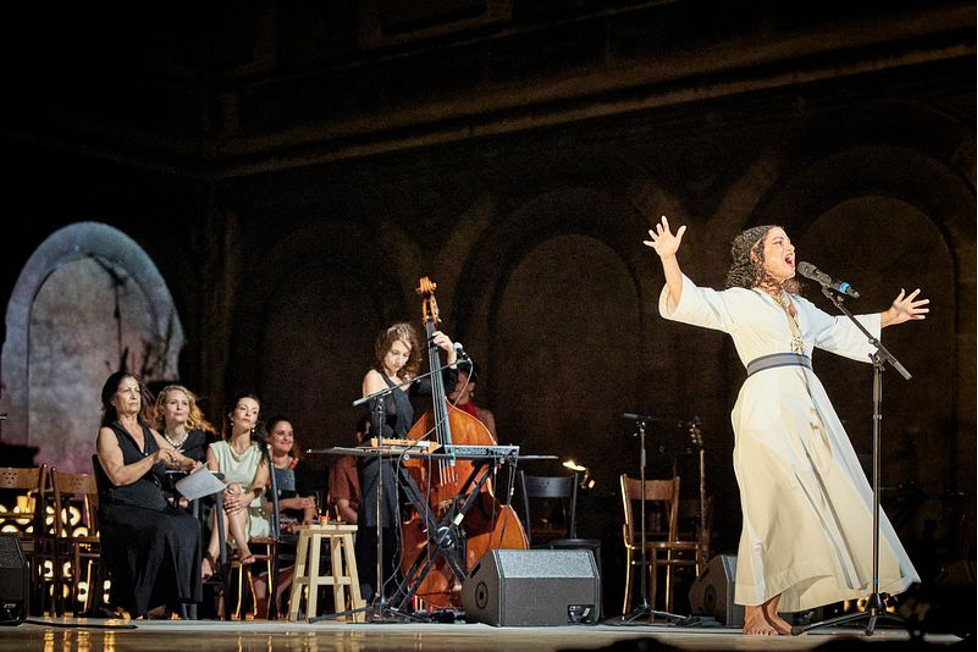
On the evening of July 14th, fifty years after the passing of Oum Kalthoum, the legendary Egyptian singer and songwriter known as the Star of the East, La Voix des femmes, under the musical direction of Lebanese producer Zeid Hamdan, presented a monumental two-hour concert composed of a variety of love songs delivered by seven artists invited to pay tribute to this great singer. They were accompanied by six superb musicians (among them Zeid Hamdan in the percussion section) and a violinist as well as more traditional instruments such as a qanun (a sort of oriental harp or lute).


Nour (“light”in Arabic), a much larger piece, involved numerous artists from the Arab world in an evening of concerts, performances, readings, and screenings at the Cour du Lycée St Joseph. Twenty-four major personalities, musicians, actors, poets, and dancers performed ancestral texts along with contemporary poets. The evening’s offerings were structured around foundational themes such as love, spirituality, nature, and resistance. Hala Mohammad, Syrian Protest Poet in exile. Maryam Saleh, Egyptian singer and songwriter, Mohammed Al-Qudza, a Palestinian poet writer from Gaza City, were just a few of the artists featured in this event.

Held inside in one of the meeting rooms in the Cloître St. Louis, home of the Festival offices, the play One’s own room Inside Kabul by Caroline Gillet, Kubra Khademi and Sumaia Sedi was presented. Spoken in both English and French, the work was a fascinating introduction to the life of Raha, a 21-year-old Afghan woman isolated from the outside world after the Taliban had taken over her country. Entering a makeshift living room, the audience takes their seats on red velvet cushions lined up against the walls facing each other. Between them, a white tablecloth set with 40 carefully arranged ceramic plates, beautiful teapots and vases of flowers. On each plate there are a few words telling the stories of other Afghan women who, like Raha, were forced to lead a confined existence. Raha spoke to us of her secluded life by way of an immersive video/audio installation. The audience was able to follow her thoughts through voice messages and spatialized sound design. Clearly her determination to remain “in her own room” inside Kabul was a brave act of resistance, but a stirring testimony to her and others like her.
There were numerous more traditional works of theatre. La Distance, a fascinating new play by Festival director Tiago Rodrigues, was a futuristic drama in which a father living on earth and his daughter who had left earth to live on the planet Mars in the year 2077 attempted to communicate. With over 139,805,518 miles between them, they play posed the question “how could they”? The father, powerfully portrayed by Adama Diop, tried desperately to stay connected to his daughter through voice messages and long-distance calls. But these took at least five months to be delivered. The daughter (lovely Alison Dechamps) now a member of a newly formed colony on Mars, had been given the gift of forgetting thanks to programmed amnesia. As a result, her memory of earth and her father was being erased. Time became of the essence for her father to communicate with her one last time.
This drama of separation took place on a unique stage design composed of two platforms in rotation that came close together at times and then drifted apart at others. Accompanied by music, light and color designs, they move around each other in perpetual motion, accelerating, decelerating and rare moments of standing still. On the stage, father and daughter were visually separated from each other by a barren landscape composed of an imposing rock formation next to a surrealistic display of a tree trunk with imposing bare branches reaching out into the void. Father and daughter never really saw each other although at times she seemed to be right next to or behind him. Other times, she was hanging over him from the top of the rock, even though they are miles apart.

The distance between father and daughter was both generational as well as real; the daughter had chosen to leave earth to invent a new life, and she was happy to be free from the past. Still living in the past, the father was unable to let go of her.
The Distance concluded with the father’s final moments with his daughter, moments that only the audience could hear and appreciate. As the play neared its end, the father sent his daughter birthday greetings. He put on a record to wish her a “happy birthday” as he placed family photos on the ground. Though on separate planets, they shared a laugh together. “You left because you wanted to have hope,” he told her, “hope and forgetfulness.” She had achieved her goal of inventing a new life on Mars as the father, on earth, was left with the tragic loss of his daughter and unable to accept it. The powerful ending was devastating.

Israel & Mohamed was a documentary dance performance created and performed by two well-known contemporary artists, noted Spanish contemporary flamenco dancer and choreographer Israel Galván and well-known author and documentary theater maker Mohamed El Khatib. Inspired by both their similarities and differences, they created a captivating biographical piece inspired by their family histories and their choices to pursue their own careers beyond what their fathers expected of them. Early in the show, Mohamed and Israel sat in the orange chairs and watched videos of their fathers talking about what they had hoped for their sons and their disappointment that their sons had chosen careers in theater and dance, Evidently, both artists came from deeply traditional families with high expectations; Israel’s father had hoped that his son would continue the family tradition of classical flamenco dance while Mohamed’s cannot understand why his son did not pursue a path as a professional academic.
Israel & Mohamed played out across the full length of the Cloître des Carmes stage. At either end Mohamed and Israel had make-shift tables facing across the stage from each other. These movable tables became “altars” set with mementoes and reminders from their past. In the middle of the stage, sat two bright orange chairs on which they watched videos of their fathers. On Mohamed’s table, were the “babouches” (Moroccan slippers) his father used to teach him a lesson whenever he would forget a line from the Koran. Above him was the head of a stag and beneath him was a portrait of his father. Israel’s altar featured a mechanical parrot that sang along with a large pile of medals and prizes he had won. throughout his career. Among these archives of his life was also a portrait of his father.

Seated on the uncomfortable chairs, their backs to the audience, they silently watched videos of their fathers talking about their expectations their sons lives and careers and their ultimate disappointment. Israel, celebrated for his avant-garde flamenco performances (La Curva, in particular) had been raised in traditional flamenco, Mohamed chose theater despite his academic background. While Israel’s father voiced his disappointment that his son did not follow in his family’s traditional flamenco style. Mohamed’s father who left Morocco to work in a factory in France to support his family, had hoped that his son’s educational degrees would lead to professional success rather a career making documentary theater.
In the evening’s memorable finale, the two artists, collaborators and friends created an original dance number. Their pas de deux represented their happy yet emotional response to their fathers’ collective disappointment.

BREL, was another collaboration, this time between legendary Belgian choreographer Anne Teresa De Keersmaeker and Solal Mariotte, a young French breakdancer and a member of De Keersmaeker’s Rosas dance company. A new creation set to the iconic songs of the great Belgian singer and songwriter, Jacques Brel and was presented in the Carrière Boulbon, an immense quarry outside of Avignon. Conceived, choreographed and danced by the two, their work was inspired by a selection of 26 Brel songs. Just to listen to these glorious songs in such a magical space would have been enough but watching De Keersmaeker and Mariotte respond to them was an enchantment. BREL was performed on a simple bare platform set up against the quarry walls on which larger than life projections accompanied a number of scenes. The special play of shadow and light against the walls added to the mystery of the evening during which the dancers often played in silhouette. A gigantic image of Brel hung over the early scenes, and his aura became an important part of the performance.
The opening number was a solo by Anne Teresa, (Le Diable ça va or The Devil, everything’s okay) dramatized the devil’s visit to the earth where he is delighted to find that men are still having fun playing the dangerous game of war and putting bombs on railroad tracks. Each line of the song ends with “ça va.” “All’s well!” In case the audience missed the irony of Brel’s words, CA VA was projected in giant letters on the quarry wall some 130 feet above the playing space.
Appearing alone out of the shadows and wearing a grey tailored pants suit, De Keersmaeker with her back turned to the audience. As she turns around, she smiled as if to suggest that BREL was going to be something quite different from what we might have expected. She waltzed with great twisting and turning movements, clearly enjoying Brel’s social commentary. As she finished the opening, Mariotte joined her and became her partner for the evening. Together they explored 26 of Brel’s classic songs, not so much interpreting them as testing out possible contemporary responses to Brel’s world as compared to our own with waltzes and love songs and tangos, duets and solos. There were a number of Brel’s love songs “Quand on n’a que l’amour” (“When Love is All we have”) and “Ne me Quitte pas” (“Don’t Leave me”), but especially “Marieke,” about a lost love from long ago, performed by Mariotte, whose choreography brought out not just the sadness of Brel’s plea to the young woman he once loved, but more importantly, perhaps, he seemed to emphasize Brel’s longing for his Flemish homeland, the Flemish sky that wept with him, the flat land that was his and the endless mist. Solal’s familiarity with the back spins, freezes and footwork of the breakdance tradition added a note of urgency to Brel’s song. Toward the end of his solo, De Keersmaeker joined him lying on the floor, reaching out to him as if to comfort him, they rolled across the stage together. Solal’s breakdance background was even more visible in his solo interpretation of “Une valse à mille temps” (“A Thousandth-time waltz ). He clearly welcomed this song which began with a slow waltz (Une valse à trois temps) and built to dizzying moments of twirling, spinning and frenzy.

Their very different styles, their backgrounds, their difference in age, (Solal is 26, De Keersmaeker in her 60s) and their very different choreographic approaches, allowed numerous possibilities for movement: playful at times, mocking at others, all displayed by somewhat tongue-in-cheek choreography. Their collaboration melded together very different styles into a unified collaborative work.

With MAMI, Mario Banushi, Albanian born artist, 26 years old, offered audiences an exciting new voice. His stunning “visual poem,” dedicated to different women, different “maternal” figures from his life, was a wordless landscape of memories that paid tribute to his early years and featured many women, young, sweet, angry, and old from different moments in his lifetime. Images ranging from mothers giving their breasts to their babies to a son feeding his elderly mother are just a few of the fascinating moments in MAMI. A wordless mixture of theater and dance, the work presented the mysterious relationship between mother and child. Banush noted “My work mixes theater and dance, my shows are a mixture of sensations, feelings, colors, odors… there is no text per se but they are telling a story. It’s like an epiphany.” His pieces are landscapes composed of shapes, sensations, colors and fragrances and filled with performers of all ages. Young and old, actors, actresses, dancers and singers, many of whom were non-professionals were involved and many cultures were mixed and juxtaposed.
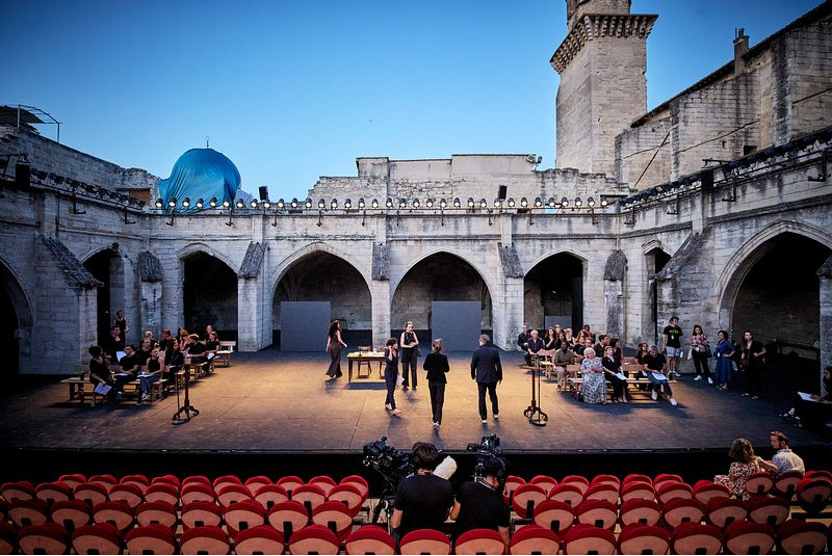
A large sign hung outside of the Théâtre des Carm that read Le Procès Pelicot (The Pelicot Trial) representing the words spoken by Gisèle Pelicot at the trial “Pour que la honte change de camp! “Shame must change sides.” Le Procès Pelicot, written by Servane Dècle and directed by Milo Rau, was advertised as a night of readings inspired by the landmark trial that took place in a court in Avignon, from September 2 to December 4, 2024. On trial were Dominique Pelicot, Gisèle Pelicot’s husband, who over a period of nine years, had repeatedly drugged and raped her and recruited dozens of men contacted through an on-line website, to join him. Fifty men in all, from ages 27 to 74, responded to the invitation. All of these men were found guilty and were convicted. To create what Rau called “le théâtre du réel,” (reality theater or theater of the real), the authors used real testimony from the case as well as interrogations, pleas, lawyers’ summations and other commentaries to create a reenactment of the trial, a distillation into four hours accentuating and condensing the most powerful moments. Gisèle Pelicot’s words from the actual trial were delivered by three different actresses. The evening was divided into 40 segments with a prologue and an epilogue.
On the stage, a minimal version of the courtroom, two women sat behind a desk in the center, the judges. On either side, rows of wooden benches, filled by French actors and actresses with transcripts in hand. As the play proceeded, the presenters took turns reading at the two lecterns located stage front. Three different actresses delivered the words that Gisèle Pelicot had spoken in court. One of the case’s expert psychiatrist’s Laurent Layet, read the diagnoses of the defendants that he had delivered in court. For four hours, the fifty some readers watch, listened and remained present. It was a stunning achievement and a devastating performance.
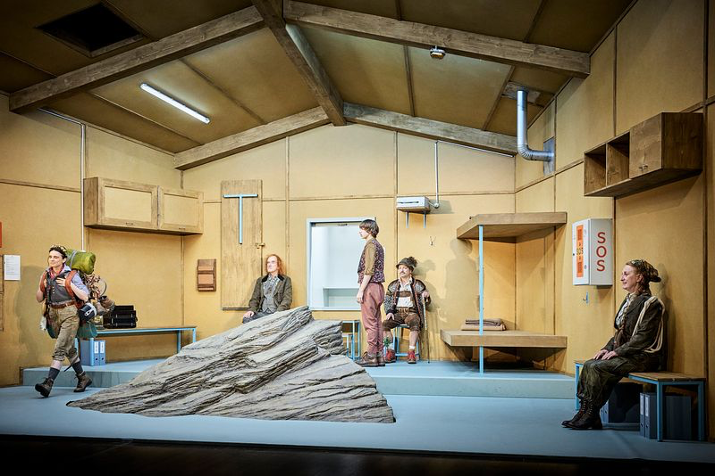
Le Sommet, a comedy by Swiss theater director and musician Christophe Marthaler, was one of the great moments in this year’s festival. Six characters from different nationalities, three men and three women, were gathered in a chalet atop a mountain for a high-level summit. The actions of the political world leaders verged on the burlesque and absurd. To complicate matters, they did not even speak the same language. The early scenes take place in the interior of the chalet - a small, uncomfortable room where they wait for the important meeting to begin. Their surroundings are anything but luxurious. A small table in a corner, uncomfortable chairs, and one double decker bed. A strange rock formation in the room created a challenging obstacle course and, with no doors, the only access to the space was via a dumb waiter.
Since they do not understand each other’s languages, they invent a number of activities to keep busy or to entertain themselves. Fortunately, one of them plays the accordion. They dance, they sing, they hum, they even yodel. And they all seem to know the words to “Edelweiss,” the famous song from The Sound of Music. They also chime in on “En haut de la Montagne … un beau chalet,” a traditional French mountain song. To top it off, they improvise a dance number using ski poles. Before long, numerous seemingly important documents arrive via the dumb waiter, that require their review and signatures. The group hastily signs them – unread. As the work progresses an impended battle seems imminent and they are delivered some forty plastic fire extinguishers for safety by a helicopter. A separate battle about what to do with the extinguishers begin to take place Where can they hide if indeed there is a war? Behind their clothes hanging over the bench?
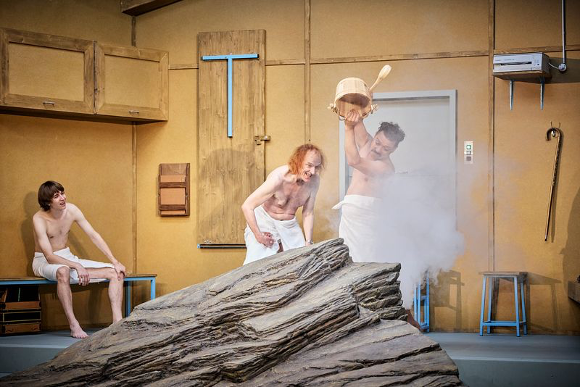
With no windows to the outside world and little ventilation, they soon complain of suffocating in their small, enclosed space. Their panic leads them to remove their clothes and improvise a hilarious sauna scene.

Later in the work they begin to get dressed an elegant dinner; the women change into fancy evening gowns while the men put on tuxedoes. While they admire themselves in their new attire, we hear sounds of bombs bursting somewhere and helicopters flying overhead, hints of an attack of some kind outside of their safe haven. They listen in vain to the walls and the floors and climb up to the top bed, trying to escape what might be an attack, but there is no way out of their confined quarters. Now the news comes that the roads are blocked and they clearly are stuck in their chalet for an indefinite period of time – perhaps as long as 15-18 years. The work ends with their future in complete disarray with no clarity as to how they might survive in the tiny confined environment.

Eric Ruf’s magnificent staging of Paul Claudel’s Le Soulier de Satin (The Satin Slipper) in the Honor Court, with opulent costumes by Christian LaCroix and masterful performances by twenty Comédie-Française actors playing some sixty different roles, was a glorious moment of theater. Claudel’s epic masterpiece (1919-1934) has rarely been performed. Antoine Vitez ‘s memorable version in the Cour d’honneur in 1987 has been the reference until now. Claudel’s verse drama is a love story that takes place over a period of twenty years. Set in the Spanish Empire during the 16th century at the time of the Conquistadors. The central couple Don Rodrigue, a Conquistador and Doña Prouhèze, wife of Governor Don Pélage, struggle not to give into their passion. They believe that there’s a divine mission to achieve the Grace of God.
The work was divided into four days that covered over fifty years. The major event, over eight hours long was performed on an unadorned stage with props, costumes, lighting, and music, all of which served to suggest the many locations and jumps in time. The on stage orchestra played throughout the entire evening. Eric Ruf’s Soulier de Satin is a glorious adventure story, filled with suspense and unforgettable images.

The Comédie-Française Soulier de Satin was truly a major festival event. A marathon welcomed by an enthusiastic audience who mostly stayed until the end. Director Ruf’s had chosen to include the audience in on the story telling, which was especially refreshing given the length and the seriousness of Claudel’s epic verse drama. The work was expansive and utilized every available space including the aisles of the theater, the windows as well as the stage itself. It is rare to see shows in the Honor Court taking advantage of the entire house. The 2000 member Cour d’honneur audience became an integral part of Le Soulier de Satin as the actors moved among and interacted with the audience.
References
About the author(s)
Philippa Wehle is Professor Emerita of French Language and Culture and Drama Studies at Purchase College, State University of New York. She writes widely on contemporary theater and performance and is the author of Le Théâtre populaire selon Jean Vilar, Actes Sud,1981(revised editions in 1991 and 2016), Drama Contemporary: France and Act French:Contemporary Plays from France (PAJ Publications). She is a well-known translator of contemporary French and American plays. Her book Eclairer la Cour d’honneur, interviews with a selection of lighting designers who created the lighting for important shows in the Honor Court of the Pope’s Palace in Avignon, from 1969 to 2025, due to be published in May 2026 by Actes-Sud Papiers. Dr. Wehle is a Chevalier in the French Order of Arts and Letters.
European Stages, born from the merger of Western European Stages and Slavic and East European Performance in 2013, is a premier English-language resource offering a comprehensive view of contemporary theatre across the European continent. With roots dating back to 1969, the journal has chronicled the dynamic evolution of Western and Eastern European theatrical spheres. It features in-depth analyses, interviews with leading artists, and detailed reports on major European theatre festivals, capturing the essence of a transformative era marked by influential directors, actors, and innovative changes in theatre design and technology.
European Stages is a publication of the Martin E. Segal Theatre Center.

