
Theatre in Poland, Fall 2025
Published:
December 1, 2025
By Steve Earnest

Image Credits:
Theatre in Poland, Fall 2025: Konfrontacje Festival 2025, The Cyrkulacje Festival of Circus Arts and If I Had A Gun I’d Take Them All Down in Lublin and AlphaGo_Lee. Theory of Sacrifice at Studio Theatre and Waiting for Godot at the National Theatre Warsaw.

Located in eastern Poland, just 100 KM or so from the Ukrainian border is the city of Lublin. The city has a strong legacy of support for people of the Jewish faith as well as being a regional leader in artistic production. The Konfrontacje Festival began as a film/theatre/arts festival in the 1970’s and has now risen to the point of being a major arts festival that attracts numerous art forms, but primarily live performance. Held in Lublin every October, the festival features the work of Polish and international artists and presents the best new trends in European theatre.

2025 Festival centered on Janusz Oprynski, a celebrated Polish director, writer and theatre artist whose work has been featured at the Provisorium Theatre in Lublin for 50 years. Like Grotowski, Oprynski’s production style focused on experimental and “poor” theatre with radical confrontations of political systems. Eventually known for his staging of novels, Oprynski’s best known works include Ferdydurke (from Witold Gombrowicz), The Brothers Karamazov and The Idiot (Dostoyevsky), The Kindly Ones (Jonathan Little) and Ice by Jacek Dukaj. Co-founder and artistic director of the Konfrontacje Festival, Oprynski has received numerous European awards for his work including the Konrad Swinarski Award as well as a special award for artistic merit by the City of Lublin in 2025.
The Lublin Centre for Culture presented the Theatr Provisorium production of Oprynski’s Ward 6 on the festival’s opening night. Like many of his previous works, Ward 6 featured something of a library setting. Oprynski’s work has been characterized by an “addiction to books” as the post show discussion revealed, but the work itself considered the nature of mental hospitals and the nature of rights and freedoms that had been taken away from (historically) Polish citizens who found themselves imprisoned by Russians into these confined situations. The performance was based on Chekhov's famous short story, "Room No. 6" which was very important for Polish people fighting for freedom for many years and showed how the "abnormal society" locked normal people in hospital. Set in the land of Ulro, (borrowed from Blake) or the land of spiritual suffering, the characters of Ward 6, named only as Mr. G and Dr. R were inhabitants of the land of Ulro, where they suffer for their individuality. They were guarded by Mr. N and spent their whole lives in passionate reading; making their world is a great theater of imagination, a theater of reading books. "By eating books," they swallow the "bitter wisdom" that makes them poignantly lonely. It was Oprynski’s belief that the abnormal society fears such people and locks them up in hospitals and prisons.
The performance featured extremely minimalist or “poor” theatre techniques, but the nature of the space allowed for numerous possibilities. The use of projections created a huge library of books on the white paper strips that dangled from the ceiling. Physical books were also included in piles all around the stage as the actors made reference to them throughout. Oprynski noted in the post show discussion that his was a “theatre of books” and that there were both good and bad books in the world. He noted how the works of Dostoyevsky had both been an inspiration for him but also had haunted him for his entire adult life.

If I Had a Gun I Would Take Them All Down was presented in a smaller studio space at the Lublin Centre for culture and relied only on a video background for its scenic elements. The one-man show was directed by Paul Bargetto and performed and co-conceived by Michael Rubenfeld. Rubenfeld offered the following summary of the plot:
“The play follows the character Time, a Kyiv-based narrator who guides the audience through the city’s streets, weaving together contemporary wartime reality with a century of political violence, memory, and resistance. As spectators walk alongside him, Kyiv becomes both stage and character—a living archive where fences, boulevards, and monuments summon stories of empire, occupation, and the city’s continual fight for self-determination. The frame is intimate and conversational, collapsing the distance between past and present: every location contains a hidden rupture, every building holds the echo of a struggle. At the center of the historical thread is Dmitry Bogrov, a young Jewish Ukrainian anarchist who, in 1911, assassinated Russian Prime Minister Pyotr Stolypin at the Kyiv Opera House. The play reconstructs Bogrov’s world—his radicalization, his ideological turmoil, his entanglement with the Okhrana secret police, and his profound loneliness. As the narrator retraces Bogrov’s final movements through the city, the story reveals a man pulled between ideals of justice and the brutal realities of revolutionary violence, culminating in the chaotic moment of the assassination and his swift execution. Running parallel to Bogrov’s story is the narrator’s own life, marked by activism, disillusionment, flight, and return. He recounts encounters with political art movements, the Euromaidan revolution, the Russian invasion of Eastern Ukraine, and the personal cost of resistance—including the loss, exile, and moral ambiguity that accompany armed struggle. Contemporary Kyiv appears simultaneously ordinary and surreal: a place with street musicians and gardens, yet also a place where journalists are assassinated, dissidents are hunted, and air-raid sirens punctuate daily life.
Throughout, the play interrogates the ethics of violence, the meaning of freedom, and the weight of memory. It juxtaposes Bogrov’s anarchist dreams with modern Ukraine’s ongoing fight against Russian aggression, questioning what—if anything—political murder can achieve. The piece ends not with resolution but with solidarity: a collective gesture of singing, looking into one another’s eyes, and recognizing shared vulnerability. In this final moment, the audience stands in the city as it is now—scarred, defiant, and alive—asked to consider their own place in history’s ever-tightening circles.” (Michael Rubenfeld)
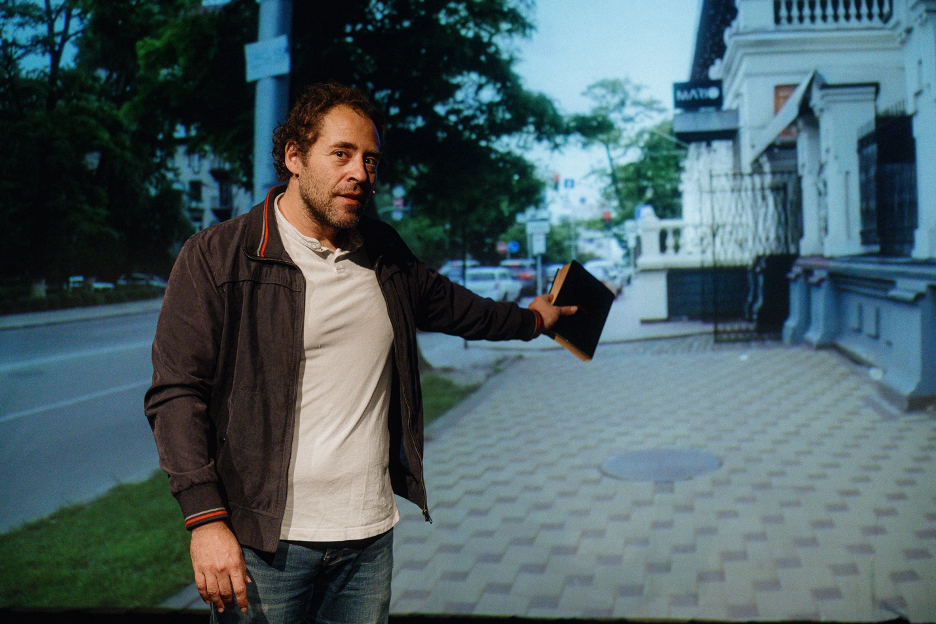
The production was inspired by the true story of Dmitry Bogrov (1887–1911) – a Ukrainian-Jewish lawyer, double agent, and revolutionary who, in 1911, assassinated Russian Prime Minister Pyotr Stolypin (1862–1911) at the Kyiv Opera House. Bogrov was arrested, tried, and executed shortly thereafter.

Through innovative use of video and sound design, the performance immersed the audience in both historical and contemporary Kyiv; retracing the path that led the young Bogrov to his final act, while at the same time reflecting the author’s personal experiences of the ongoing conflict in Ukraine. Rubenfeld’s epic nearly two-hour monologue performance was extraordinary. As he led the audience on the journey through space and time of the play’s story his delivery was both informative from a reporter’s standpoint, but also highly personal as one who was invested in the story as an actual participant. Given the nature of the works travel (primarily a walking tour) through the streets of Kyiv, the camera work and Rubenfeld’s careful stage placement blended incredibly well. The resultant cinematic journey allowed the audience to experience the story in real time. Rubenfeld’s personal connection to the material was dynamic, personal and highly moving. If I Had a Gun I Would Take Them All Down was a relevant and compelling performance, especially considering the nature of world events in 2025 when it was presented.

Sponsored by the European Capital of Culture Lublin 2029 and the Adam Mickiewicz Foundation of Poland, our group consisted of numerous theatre scholars, producers and other artistic personnel from New York, Chicago, South Carolina and California and engaged in many events related to the history of Lublin but especially of the historically Jewish nature of the city. Many of the areas that we toured and the sites that were visited are featured in the 2024 movie A Real Pain. The study tour was arranged and coordinated by Tomek Smolarski on behalf of the European Capital of Culture Lublin 2029 and included the numerous performances but also visits to various sites in Lublin as well as neighboring cities like Kazimierz Dolny a medieval settlement with an important Jewish History. The event also included access to several additional performance events. One of these was the Cyrkulacje Festival presented at the Centre for the Meeting of Cultures in Lublin from October 4-10, 2025. Two works were available to be seen by our group – a work by Common Ground and Diaries in Motion, a physical theatre work by a group of young women from numerous European countries.
The Cyrkulacje Festival brought together artists living in or originating from Poland, Lithuania, Latvia, Estonia, Finland, Belarus, the Czech Republic, Hungary, Ukraine, and Slovakia. The festival is defined by diversity — of styles, aesthetics, and creative voices. The festival is built on exchange and dialogue, creating space for discovery, curiosity, and artistic circulation (yes, that’s where the name comes from!). The festival also hosts discussions, artist talks, and meetings with the jury. These encounters allow audiences to better understand the creative process and offer artists a chance to hear from their audience — and from each other. The program features both full-length productions and short-form pieces. From intimate solos to large-scale ensemble works, the festival showcases the depth and variety of the region’s circus voices.
Since its beginnings in 2013, Cyrkulacje has helped contemporary circus artists grow, connect, and take the next steps in their careers. It’s a platform for experimentation, development, and recognition — a space that encourages originality, celebrates craftsmanship, and supports ambitious work. As part of the festival certain participants receive main prizes and special awards, including Best Trick, Audience Award, Media Award, Youth Award, and Partner Engagement Prizes. In 2019, Cyrkulacje was awarded the EFFE Label – a mark of excellence granted by the European Festivals Association. This recognition places Cyrkulacje among Europe’s most innovative and artistically significant cultural festivals.
Common Ground is a physical theatre artist collective based in Belgium with members from across Europe, North America and Asia. Performers include Andreas Bartl, Lisa Rinne, Emma Laule, Marius Pohlmann, Evertian Mercier and Zinzi Oegema. The group features immensely skilled physical artists in the areas of trapeze, human stunt work, devised work with physical objects, gymnastics and other related activities. Their hour-long exhibition (not given a specific title for the festival) included the use of numerous hollow wooden squares of various sizes that were carefully designed to create immense stage pictures while supporting (at times) a sizeable amount of weight. The artists manipulated the stage area with long poles, ropes and pulleys to form trapeze areas, climbing areas and shapes and carefully configured areas for the achievement of human stunts.

Diaries in Motion was produced by Daniel Burow with direction and artistic coaching by Christine Dissmann and Stacy Clark. Four artists from circus schools in Berlin, Montpellier, and Kyiv (Lera Kutsenko, Daniela Levina, Alina Scharbl, Daria Ilnytska) attempt to answer these questions through the language of contemporary circus.
The ninety-minute performance really had no story but certainly aimed toward meaning as the performers took the audience on a moving journey through “dreams and struggle, led by the desire for freedom,” as stated in the program. According to the production team the work aimed to tell the story of a generation forced to stand up for its most essential values - a performance that tells a tale of transformation from isolation and constraints to rebellion and collective strength.
The four female artists were all highly trained acrobatic artists capable in the areas of floor work including German wheels and other rolling devices, flying work with a lyra, silks and other aerial devices in addition to any other related physical performance related elements including general stage movement and delivery of occasional lines of text. The nature of the work was based in strong athleticism and skill and the main goal, in addition to the potential story aimed at by the tone and nature of the background music, was the pure display of learned skill in the various disciplines. The performers measured up to the highest of world standards with their abilities in these areas and the sold-out audience witnessed breathtaking feats of physical work that can be achieved by only a small percentage of the world population and the highly athletic nature of the event appealed to both lovers of performance works as well as those more interested in sports and the display of highly skilled athletes. The blending of these two worlds was what characterized Diaries in Motion.


The city of Warsaw is something to behold for all lovers of European travel and the National Theatre firmly represents the Polish nation’s desire to present theatrical art at the highest world level. The Royal Palace of Science and Culture include numerous theatre spaces with one company named, the Studio Theater. However, some confusion exists at times because the National Theatre of Poland, about fifteen minutes away by car or train, also has a Studio Theater. Both companies are included in the following section.

Located in the beautiful Palace of Culture and Science in the city center of Warsaw AlphaGo_Lee: Theory of Sacrifice was presented at the Studio Theater. Directed by the company’s Artistic Director Natalia Korczakowska, the work considered a popular Korean board game – AlphaGo and dealt with the actual historical story of the 2016 match between Korean Go master Lee Sodal and the computer program itself in an AI format. The event, which took place at the Four Seasons Hotel in Seoul, represented the fight between humanity (represented by Lee) and Artificial Intelligence, as represented by the AlphaGo game. The stage production detailed the events of the actual historical occurrence of the event, which was organized by Google and streamed live to the very large Chinese market who wanted to witness the ultimate battle between humanity and AI.
The work is based on research by Natalia Korczakowska, who visited Seoul, Tokyo, and London, meeting with Go experts such as Prof. Chihyung Jeon (KAIST), Prof. Chihyung Nam (Myongji University), and members of the Korean Baduk Association. Their insights inform the production’s symbolic texture, embedding the Korean perspective at its core. Lee Sedol’s philosophical reflections—his belief that Go is an art form created from nothing by two human minds—resonate as the emotional heart of the piece. Korczakowska’s incredible conceptual approach was supplemented by lighting and live video by Rafal Paradowski, animation by Marcin Kitty Kosakowski, choreography by Sung Im Her, spacial arrangement and costumes by Marek Adamski and music by Marcin Lenarczyk and Dominik Ossowski. The production featured the use of an onstage camera crew that captured the scenes using 2 – 4 onstage cameras from various angles with the camera feed then projected onto numerous screens in live time. The lighting, sound and staging all contributed to an extremely well realized visual mise en scene that very capably revealed both very intimate scenes in addition to very high energy dance and public scenes that really stretched the nature of the performance. The stage itself became a monumental gaming space where the characters’ lives became the source of the game. Behind the scenes power plays by the leaders of Google DeepMind (based in London) were contrasted with bursts of dance, technological imagery and humans grappling with the depth and power of artificial intelligence.

Presented at the Studio Theatre of the National Theatre of Warsaw, Waiting for Godot was presented in the Studio Space of the National Theatre Warsaw. The production played to sold out audiences for nearly three years and featured numerous well renowned Polish actors, many known for their numerous film and television credits, in addition to their stage credits in major Polish theatre companies. The work was directed by Piotr Cieplak with scenic, lighting and costume design by Andrzej Witkowski.
The Studio Theatre of the National Theatre has a specific (and quite unusual) physical layout. Consisting of a 300-seat frontal view theatre that seemed to be designed with the Elizabethan theatre in mind, it had doors on either side of the backstage wall and a rather large discovery space in the middle. The discovery space was quite large in both size and depth, and several scenes were realized in that area, though the effect was not always successful as the concept of place was not clearly designated in the work. In addition, a stage left door, just past the entry area for audience members, was a part of the physical space but was used at numerous times in the production. This spacial arrangement was curious as it blurred the concept of place, awkwardly blending the practical nature of the exit with the world of the play.

So many elements of this performance were surprising, and the work took on an usually serious tone with very little comic action. From the outset Estragon’s struggle to take off the boot seem a bit disingenuous and unrealized. The actors seemed to stand outside of their roles and comment on them in quasi-Brechtian fashion, which given the background of director Cieplak, would offer some explanation for the stylistic choices made. Mariusz Benoit and Jerzy Radziwilowicz seemed oddly cast in the roles as the as their performances were very dry and highly understated. Pozzo and Lucky (Cezary Kosinski and Bartlomiej Bobrowski, respectively) did little to rescue the dryness of the production’s tone. Anytime I see Waiting for Godot, it is with the intent that I am seeing an amazing universal work that, at its center, speaks so clearly to so many areas of the human experience and condition. I was incredibly hopeful but not completely satisfied in the overall achievement of this production. Sadly, I feel that much of the difficulty of the production came from the unusual and rigidly defined nature of the Studio Theatre space.

The study tour curated by Smolarski was incredibly stimulating and included numerous theatrical and historical events worthy of a much longer and more detailed report. This rather short overview just manages to offer a partial view of the highly invigorating and varied nature of the arts scene in just two of Poland’s important centers for the arts and the brief nature of the trip (only 6 days) only allowed for a short glimpse into the incredibly diverse and highly supported work that happens in Poland. The country clearly prioritizes the arts and that spirit permeates all work that is both produced or presented there.
References
About the author(s)
Steve Earnest is a Professor of Theatre at Coastal Carolina University. He was a Fulbright Scholar in Nanjing, China during the 2019 – 2020 academic year where he taught and directed works in Shakespeare and Musical Theatre. A member of SAG-AFTRA and AEA, he has worked professionally as an actor with Performance Riverside, The Burt Reynolds Theatre, The Jupiter Theatre, Candlelight Pavilion Dinner Theatre, The Colorado Shakespeare Festival, Birmingham Summerfest and the Riverside Theatre of Vero Beach, among others. Film credits include Bloody Homecoming, Suicide Note and Miami Vice. His professional directing credits include Big River, Singin’ in the Rain and Meet Me in St. Louis at the Palm Canyon Theatre in Palm Springs, Musicale at Whitehall 06 at the Flagler Museum in Palm Beach and Much Ado About Nothing with the Mountain Brook Shakespeare Festival. Numerous publications include a book, The State Acting Academy of East Berlin, published in 1999 by Mellen Press, a book chapter in Performer Training, published by Harwood Press, and a number of articles and reviews in academic journals and periodicals including Theatre Journal, New Theatre Quarterly, Western European Stages, The Journal of Beckett Studies and Backstage West. He has taught Acting, Movement, Dance, and Theatre History/Literature at California State University, San Bernardino, the University of West Georgia, the University of Montevallo and Palm Beach Atlantic University. He holds a Ph.D. in Theatre from the University of Colorado, Boulder and an M.F.A. in Musical Theatre from the University of Miami, FL.
European Stages, born from the merger of Western European Stages and Slavic and East European Performance in 2013, is a premier English-language resource offering a comprehensive view of contemporary theatre across the European continent. With roots dating back to 1969, the journal has chronicled the dynamic evolution of Western and Eastern European theatrical spheres. It features in-depth analyses, interviews with leading artists, and detailed reports on major European theatre festivals, capturing the essence of a transformative era marked by influential directors, actors, and innovative changes in theatre design and technology.
European Stages is a publication of the Martin E. Segal Theatre Center.

