
Summer 2025 in London, England
Published:
December 1, 2025
By Amy Hamel

Image Credits:
While the primary goal of being in London this past summer was professional development - participating in quality acting classes for both stage and screen and taking a plethora of dance classes of various styles and levels – another goal was to pack in as much live theatre as possible. The shows on the agenda before arrival were Hamlet and Hail to the Thief (a mash-up with Radiohead), and whatever was playing in the West End theatres or at the Globe Theatre. Anything that could be seen in the United States was not on the list of desired theatre attendance. The programs, exquisite theatres, and their fascinating architecture, as well as the impeccable service and ushering, were just some of the notable differences that made the experience unique. Within three weeks, we saw 11 plays and one Mod Ballet. The following is a reflection on a few of the productions witnessed, with the first two being featured for their amazing stories, soundtracks, choreography, and technical specialties.
Hamlet Hail to the Thief, by the Royal Shakespeare Company in co-production with Factory International, was adapted by Christine Jones with Steve Hoggett, music by Radiohead, and additional orchestrations by Thom Yorke (lead singer of Radiohead). When I was in Stratford-upon-Avon in 2006, I saw Romeo and Juliet by this company with tap dancing as the fight scenes, and it was evident that the actors were uncomfortable and not as skilled in that style of movement as they were with the spoken text. Nearly twenty years later, this current production completely redeemed my skepticism in movement or choreography in Shakespeare, and I will never be able to see any other production of this iconic play without thinking of this one! Oddly enough, it was just about that time, twenty years ago, when this particular Hamlet project began. The music, lights, imagery, projections, fight choreography, and ensemble performance blended Shakespeare’s text with Yorke’s orchestrations of Radiohead’s album Hail to the Thief to near perfection. The stage environment included amplifiers and speakers used as scenic elements along with blocks and pedestals, all synced together to create this epic, rock concert-infused, one-of-a-kind interpretation of the tale of the Danish prince.

When first walking in, the dimly lit, fog-covered stage was filled with long trench coats hanging suspended all over the stage, floating as though you could see old ghosts in a cemetery. King Hamlet’s ghost appeared in the projections on the upstage wall, and then the coats disappeared into the fly space. The set of the thrust stage was primarily bare, featuring a two-story platform along the upstage wall where people could climb one of two ladders to sit or stand above. Additionally, two singers appeared in bookending doorways on the top floor space when it was time for them to sing. There were three separate plexiglass booths on the bottom floor for the band, with the drummer in the center booth.
The choreography, by Jess Williams, featured several unique dances, physical gesture work, and distinct movement vocabularies, like the dance where the players portray the royals, upon Hamlet’s insistence, told through a contemporary style ballet. In Act Two, Scene Two, when Hamlet and his school buddies Rosencrantz and Guildenstern are in dialogue, they are also in a series of leaning movement sequences, showing that just when they think Hamlet’s thoughts are moving one way or another, then they will lean in opposition or lean towards him to gain his trust. Then the childlike, adventurous dancing to some of Yorke’s music established a deeper relationship between Hamlet and Ophelia than is seen or heard in the text, representing the length and depth of their friendship, consequently making Hamlet’s rejection of Ophelia all the more heartbreakingly powerful.
Examples of clever fight choreography and staging by fight director Kev McCurdy were seen when Hamlet confronts Gertrude in her own bedroom, and Hamlet kills Polonius in the supposed wardrobe; there was no furniture, but through movement, it provided clarity to the storytelling. The final fight between Hamlet and Laertes was also well-choreographed and contained a variety of fighting styles, including wrestling, which required perfectly timed dance-like partnering. There were moments when it was somewhat unclear as to what was happening due to the addition of strobe lights, but one moment of clarity in the fight was Gertrude’s grotesque reaction to the poison she drinks as she violently spewed blood everywhere, especially onto the combatants, making for an extremely gory stage picture. As the fight concludes, death falls upon most of the stage. Horatio, touchingly portrayed by Alby Baldwin, cradles Hamlet’s body on the floor and delivers his final speech. The long trench coats from the top of the play, as the cemetery, began to lower down into their original suspended state, and as the final word was spoken, an audible latch was released, and all of the coats dropped to the floor. Blackout, followed by an audience-wide gasp. A moment that is now forever connected in my memory to this play.
Samuel Blenkin’s embodiment and delivery of the young prince, Hamlet, contained just the right balance of fire and finesse, teen angst and grief-driven, dutiful son seeking vengeance. It is a role that can easily be portrayed as very whiny, snobby, or the actor “milks the cow” for sympathy and becomes annoying. That was not the case here. His engagement with the audience made it feel as though we were the only ones whom he could trust, and even though most knew the ending of the story, he made us have hope that it would end differently. His singing of Yorke’s music and text was effortless, and his voice floated as though his thoughts were flowing through the space. It helped that actors Paul Hilton as Claudius and Claudia Harrison as Gertrude did their jobs exceedingly well, being so disgustingly evil, giving us more reasons to root for and like Hamlet.
What made this production even more memorable was the treatment and portrayal of the role of Ophelia, hauntingly performed by Ami Tredrea. Before reading more of the director’s insight regarding this tortured character, it was evident that she was receiving some extra attention. Through her movement, physical gestures (her arms were almost always lifted as if she was always in a state of surrender), her singing in her madness, and her repetition of Hamlet’s “to be or not to be” speech, connecting their grief with the same conflict of life, the performance was stunning. Lights for Ophelia have four clear lines creating a box around her, with the box sizes differing depending on who she is speaking to, or who is verbally putting her in a box. The projections on the back wall during her descent into madness showed flowing water, and the sound of rain and water, and as she finished repeating Hamlet’s speech, the box of light became a rectangle and established an opening in the stage with water appearing to cascade into it. Ophelia lay down beside it and simply rolled into the space and disappeared. This is one of the only productions that I have experienced where Ophelia’s death is shown on stage, and it has left another lasting impression.

Pete Townshend’s Quadrophenia, A Mod Ballet with orchestral score, based on the album and movie of the same name, was presented by Sadler’s Wells, Extended Play, and Universal Music UK. Written by Pete Townshend. Directed by Rob Ashford. Choreographed by Paul Roberts. Music Direction and Orchestration by Rachel Fuller, with Orchestrator Martin Batchelar. Set Designer, Christopher Oram. Costume Designer, Paul Smith. Video Designer, Yeastculture.org.
All of the above are important to mention, as each of those components coming together so spectacularly is what made this piece special. I was familiar with the story due to personal connections with one of the actors in the 1979 film, and I had heard that Pete Townshend was talking about this potential project, where the story would be brought to life again through dance. So, when I saw the poster for this show around London, that the show had come to fruition, and that it was with Sadler’s Wells (another artistic viewing bucket list), it went straight to the top of the must-see list. It did not disappoint!

Set in 1960s London and Brighton, Quadrophenia follows Jimmy, a young man navigating life and love, unhappy in his factory line job and determined to become more. In his search for his identity, he finds release in music, dancing, going to clubs, and doing drugs. He becomes a Mod, a subculture of the time and place characterized by tailored suits, their love for modern jazz music, and riding scooters, specifically Lambrettas. The rivalry with another subculture called the Rockers, known for their love of rock music and motorcycles, serves as the backdrop for his story. The super short version of the plot is that a childhood friend of Jimmy’s becomes a Rocker, some Rockers hurt one of Jimmy’s Mod friends, and the childhood friend becomes the target of the Mod’s retaliation. All while Jimmy chases after his dream girl who belongs to another Mod with no clear chance of having her. This sends Jimmy further into a personality crisis, and the rival groups into historic riots on the beaches of Brighton.
Lead dancer, Paris Fitzpatrick as Jimmy, is joined by four other male dancers who represent different facets of Jimmy’s personality: the TOUGH GUY, the ROMANTIC, the LUNATIC, and the HYPOCRITE. At the top of the show, we see all 5 men standing on the Brighton Beach rock, doing a series of lifts, and actually showing the portrayal of the end of the show, where a vital decision is about to be made. Then the set transitions to a psychiatrist’s office, and the audience is transported to a week earlier in the story, when the character first learns of the multiple facets.

As Jimmy’s journey progressed, many characters would dance with him, depending on the environment or the situation. For example, in scenes at the club when he was infatuated with the main Mod Girl that everyone wanted to be with, then the ROMANTIC would be incorporated into the dance, or at the end, when Jimmy sees one of the top Mods working as a bellhop, then the HYPOCRITE danced with them. There were times at the beginning when the other facets dancing along were confusing. It took a couple of scenes to realize this theatrical convention and understand the distinction of when Jimmy was dancing with another character, one of his fantasies, one of his facets, or all of those. It was a pioneering and dynamic approach with a compelling and lasting effect, especially once it became clearer, and the stellar performances of Fitzpatrick and this ENSEMBLE cast contributed to Jimmy’s story being so effectively told.
Along with Rachel Fuller’s amazing orchestration, with select instruments used to interpret the original rock score, and captivating choreography, this production relies on intricate technical aspects to enhance the storytelling. From projections and fly work that transport Jimmy on a drug-induced train ride that leaves the audience feeling like they too are tripping, to sets with trap doors where dancers can disappear into a booth in a diner, and Jimmy can dance with his reflection outside of the diner. From a large rotating rock that represents Brighton Beach, to a bed that looks like only one person is in it when magically two more emerge, all the sets provided unique dance canvases, heightened the movement theatrically, and provided insight into Jimmy’s thoughts.
Glimpses of Jimmy’s home life are shown through dances between his MOTHER and FATHER that express their marriage and working-class struggles, and one imposing militaristic style of movement and formations of men in a memory dance of his father’s time in WWII. The same rock used for Brighton is also used in the Father’s War memory dance, and some of the men are depicted fighting up a hill or marching off the edge.

Jimmy and his childhood friend (turned Rocker) and their friendly bench dance in Act One, stood in stark contrast to the later Brighton Beach Riot where the teen angst driven choreography, much like the similar rivalry of the Shark and Jets, was reminiscent of West Side Story, and included vivid stage pictures to exhibit the violence of the fight. The father’s war memory, the diner dance with escape booth where Jimmy fantasizes about the Mod girl and her dreams and dances with the ROMANTIC too, the 5 guys on rock at top of show representing Jimmy and his personalities, the train ride while tripping, 2 couples dancing on the beach in time period swimwear with partnering that closely resembled the movement of classical ballet, and the club scenes with its specifically stylized, 1960s dance vocabulary, complete with the most fabulous time appropriate costumes and LaDuca shoes!
As Townshend’s notable, and the production’s final song “Love Reign O’er Me” is played, the final scene too is played out with Jimmy on the giant rock where the show began. The continued use of projections filled the stage with images of the moving sea and waves crashing on the rock. Jimmy is left alone in his emotional turmoil and faced with the final decision as to which facet he will let have control, determining his next movements. He jumps and the audience is led to believe that he has taken his life, but as the score triumphantly crescendos, Jimmy triumphantly climbs back up atop the rock, choosing to not allow his story to end in tragedy, and leaving the audience with a glimmer of hope for the young character and with an awesome soundtrack replaying in our heads.
The following three plays were selected for their topics, themes, and messages that linger and continue to raise questions, as quality theatre can do. Themes of these plays demonstrated cultural and societal relevance to today’s situations, addressing race, gender, social, and economic issues, and the numerous perspectives they hold. The standouts featured next were the Playwrights, Directors, and Actors' performances
Retrograde was written by Ryan Calais Cameron, directed by Amit Sharma, and played at the astonishingly gorgeous Apollo Theatre. Closing performance, June 14, 2025. This production was so thoroughly enjoyed that I purchased the script afterward, conducted further research on acting legend Sidney Poitier and the topics of the Red Scare and the House Un-American Activities Committee, and I rewatched his 2002 Honorary Oscar acceptance speech, which brought another level of appreciation for the man and his part in history in the arts, especially in America. The set was that of a 1950s office of a New York City NBC network television lawyer. The small cast of three includes Sydney Poitier, a screenwriter, Bobby, and the network lawyer, Mr. Parks.

This ninety-minute play encompasses some personal history of Poitier, his humble beginnings, how he got his break on Broadway, and covers information on his (then) current life, wife, and family for which he was responsible for feeding and providing. Bobby had brought Poitier to the lawyer’s office under the pretext that Poitier would be signing a contract for a new television show he was writing and just needed him to meet with the lawyer for proper protocol. Both Bobby and Poitier were shocked to discover his true intentions as he began to ask the rising star about his American allegiance and his political affiliations, bearing in mind that this was a time of communist threat to the American way of life and the rise of the civil rights movement to which Poitier was known to have had connections. The lawyer’s objective was to get Poitier to sign not just a loyalty oath, but a document that would disavow his political associations and specifically denounce his friend and hero, Paul Robeson, creating a moral and ethical dilemma that could hold great consequences with either final decision.
All three actors gave compelling performances and easily held the audience captive for the duration of the production. Ivanno Jeremiah’s embodiment of Poitier was breathtaking. Playwright Ryan Calais Cameron is quoted to say of his performance, “People who knew Poitier told me that Ivanno Jeremiah was almost possessed by his spirit”, and with this play, Cameron tackled the topic of race and politics in the 1950s with the same grace and respectful manner as Poitier himself.

Giant, was written by Mark Rosenblatt and directed by Nicholas Hytner. The cover of the program has a picture of the lead actor, John Lithgow, and displays the one-word title, with a tear or rift in the letter “a” in the graphics, along with the name of the theatre, Harold Pinter Theatre, previously known as the Royal Comedy Theatre. We attended an invitation-only, full-dress rehearsal featuring the understudies of the six-character cast. Instead of being taken in by the celebrity of the immensely talented Lithgow, this experience allowed me to truly see the play for what it is and the message it brings. It also allowed a glimpse into the life of an understudy in the West End. As one who began her career and Broadway experience as a swing, I have the utmost respect for those who are waiting in the wings or the dressing rooms, staying ready for the unknown, hanging on to every possibility. Much was learned about understudy life as a working actor on the West End and how it differs from that of Broadway and American Actors' Equity rules.
The play left me seeking more information about Roald Dahl, his “complex legacy” (Rosenblatt), and pondering the question the play asks: “at what point does one stop being the victim and start becoming the aggressor?” It demonstrates how one’s life experiences can shape one’s opinions, beliefs, and perspectives on another’s culture, and it even had me questioning some of my own beliefs concerning this topic.

Giant is set in the summer of 1983, in Roald Dahl’s family home, which is under construction. Dahl’s UK publisher, along with his mistress of eleven years, now fiancée, is discussing an upcoming book release, illustrations, and anticipating the arrival of his NY publisher. The NY publisher has sent a young female assistant, Jessica Stone, to try and connect with the writer in hopes of persuading him to make a public apology for what some believed to be an antisemitic book review he had recently written.
Dahl and Stone bond over their own children and the fact that both of their young ones suffered from debilitating illnesses (Dahl losing his child to that illness); however, it does not take long for Dahl to pick up on the clues that Miss Stone’s original name was Stein and that she herself is Jewish. Ultimately, the arguments are built with powerful monologues revealing their own truths and bringing up convincing points that one can’t help but weigh both sides and sympathize with them, and yet also be offended by both as well.
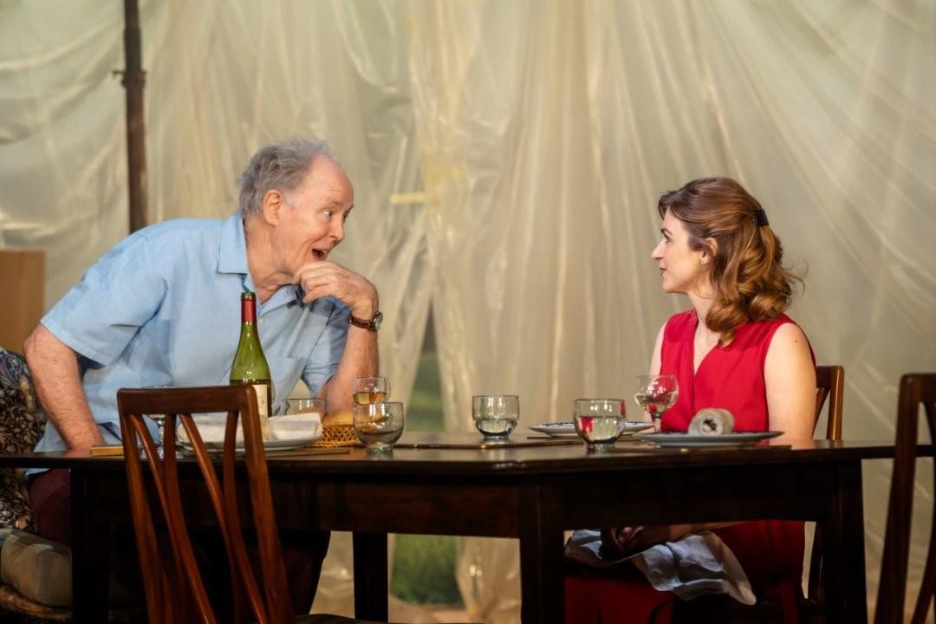
After the main blow-up at the end of Act One, Act Two consisted of Dahl talking to his houseworkers: a male groundskeeper and a female cook. It appears at first as though he is trying to get others’ views, but in reality, he is trying to get them to back him up. In the conversation with the cook, the audience discovers that she, too, is Jewish. Dahl stubbornly continues his soapbox rant, he offends her, she exits the stage, and at the end of the play, when he calls for the cook again, she does not return; it is discovered that she has left the house. After which Dahl is alone and sneaks to his phone to make a call. The audience is led to think that maybe he has seen the others’ side and felt the non-verbal statement of the cook’s departure; instead, he doubles down on his original statement, leaving us in thoughtful shock in this final moment of the play.
Mrs. Warren’s Profession, was written by George Bernard Shaw, directed by Dominic Cooke, and played at the Garrick Theatre, starring Imelda Staunton and her real-life daughter Bessie Carter. This ninety-minute, no intermission, controversial “problem play” and its history have much to offer in the way of discussion on the topic alone. The commentary is mostly on the artistic choices in the casting, the set, the visual imagery, and how those creative decisions impact the message of the play. In this case, celebrity was important in contributing to the dramatic impact of this show. As Bessie Carter herself puts it in an interview in the program, “Our relationship is adding a subconscious kinetic level”, and indeed it did, as they brought this dramatic classic to life.
Vivie, the daughter and recent Honors Mathematics graduate of the University of Cambridge, first appears barefoot, free, and fun. The estranged mother, Mrs. Kitty Warren, arrives well-dressed and classy, and the tension is immediately felt. The four male characters are Rev. Samuel Gardner, his son Frank, who is involved romantically with Vivie but also flirts with her mother, Mrs. Warren’s business partner Sir George Croft, who is also attracted to Vivie, and Mr. Praed, an architect, friend of Mrs. Warren, and potential suitor for Vivie. There is an ensemble of silent women, of different sizes and ethnicities, all dressed in white undergarments, who, through their physicality in acting, appear to age or grow with the daughter character. They do not engage with Vivie, but rather observe, and it is not quite clear who these women are or their significance at the top of the play.
The ethereal set had a low-hanging ceiling, over a circular rotating platform with a grassy knoll, garden flowers, and a white bench. The silent ensemble shows up in between scenes and changes the set by first moving the flower arrangements and bench while the stage rotates to become another garden, then changing after the next scene to take away all flowers to create an open field between the characters’ homes. Eventually, the ensemble of women even rolls up the grass to create a blank, open, bare stage, making room for the final scene’s staging, where a back wall, shaped in a semi-circle with a solo door, was lowered down onto the stage, two desks and chairs, and a waste basket were added to create Vivie’s office.

As the play’s physical environment gradually wasted away, it exposed more and more truths of Mrs. Warren’s past, the decisions she made that were vital to her survival (which also provided funds for her daughter’s education), scandals like the discovery that Frank may have been Vivie’s half-brother, and other situations that reveal the relational dilemma Vivie is faced with in the decision to embrace her mother and her profession. At one point, it seemed as though Vivie understood her mother’s reasons for her life decisions and even praises her resilience, but in the end, once she learns that her mother is still running the “business” even though she doesn’t need to, Vivie not only rejects her mother but also disowns her.
The final scene, which took place in Vivie’s office, offered Mrs. Warren’s last desperate plea to be in each other’s lives. Mrs. Warren was closer to “her girls” and has been more of a mother figure to them than to her own daughter. This, coupled with the casting of real-life mother/daughter dynamics, made the scene even more poignant. Vive’s education came from the work of the girls, and although she has been proposed to by her mother’s much older business partner, she is resolute in her determination to do her own work in an office and not take the easy or privileged route. This was made more obvious with the director’s decision to have the silent ensemble of women enter the office and stand on the other side of the desk after Mrs. Warren’s dramatic departure, reminiscent of Ibsen’s “door slam heard round the world”, and with that final powerful image, it is abundantly clear who these women were and that they had been supporting Mrs. Warren by providing for Vivie throughout the play and their collective lives. That imagery gives life to the unseen yet crucial characters in this story, adding another level of depth to the play’s significance.
The brilliance that is Ismelda Staunton and Bessie Carter and their gripping, heart-wrenching performances, especially in the final scene, is a master class in listening and being truly present. This, partnered with Dominic Cooke’s direction of the literary classic, easily qualified this as one of the strongest shows of the summer.
In conclusion, the range of theatrical experiences I encountered over the summer in London—comprising physically based pieces, new plays, and contemporary adaptations of classics—was truly extraordinary. From the innovative reimagining of Hamlet Hail to the Thief to the diverse performances across venues like the Royal Shakespeare Company and Sadler’s Wells, each production offered a unique perspective on storytelling and artistry. The combination of compelling narratives, powerful soundtracks, and mesmerizing choreography demonstrated the richness of live theatre and its power to connect with audiences on multiple levels. Whether through classic adaptations, fresh interpretations, or pioneering biographical pieces, the brilliant performances in every production highlighted London’s vibrant theatre scene, emphasized the importance of live art in fostering creativity and inspiration, and provided audiences much to talk about. This journey through England's theatrical landscape undoubtedly enriched my experience, offering invaluable insights and lasting memories that will continue to influence my personal and professional growth in the performing arts.
References
About the author(s)
Amy Hamel, (AEA, MFA Acting from University of North Carolina Greensboro, BA Theatre Arts from Palm Beach Atlantic University) is a performing artist, director, choreographer, and educator, currently serving as Visiting Lecturer of Theatre at Palm Beach Atlantic University, in West Palm Beach, Florida, teaching courses in both the Theatre and Dance departments. Her performance credits extend from regional theatres across the United States, and cruise ships around the world, to the lights of Broadway as a member of the historic closing company of the original production of CATS, at the Winter Garden Theatre in New York City.
European Stages, born from the merger of Western European Stages and Slavic and East European Performance in 2013, is a premier English-language resource offering a comprehensive view of contemporary theatre across the European continent. With roots dating back to 1969, the journal has chronicled the dynamic evolution of Western and Eastern European theatrical spheres. It features in-depth analyses, interviews with leading artists, and detailed reports on major European theatre festivals, capturing the essence of a transformative era marked by influential directors, actors, and innovative changes in theatre design and technology.
European Stages is a publication of the Martin E. Segal Theatre Center.

