
“The more I give to thee, the more I have…” 15th edition of the International Shakespeare Festival in Craiova
Published:
July 15, 2026
By Aglika Stefanova

Image Credits:
Featured Image:
Flystack Drone Show, opening of the International Shakespeare Festival (Photo Alex Savin)
The International Shakespeare Festival in Craiova, Romania was officially recognized in 2025 as the world’s most important festival dedicated to the English Bard. Its scale surpasses even the traditional festivals in the United Kingdom and the United States. Held every two years, during its 11 days it brings together not only artists inspired by Shakespeare, but also theatre critics and historians, university professors and their students, translators, festival programmers. This year it also offered a workshop for young critics under the auspices of the International Association of Theatre Critics (IATC). Founded in 1994 by Emil Boroghina, the festival has gradually expanded and today—from May 21 to 31, 2026—reaches into every corner of the city.
Its fifteenth anniversary edition featured more than 500 events in 40 languages, involving over 3,000 artists from more than 30 countries, across more than 60 venues (both indoor and outdoor). The total number of festival attendees is estimated at over 260,000. The theme of this year’s edition was WILL MATTERS.
Quite literally, Shakespeare seemed to peek out from behind every corner of Craiova. Everyday spaces were transformed into living stages. Even if Shakespeare did not interest you at all and you simply wanted to have a beer at Biergarten Bar, you had no chance: Shakespeare was there waiting for you. Outdoor you would be drawn into performances, like Elisabethan Gossip (Sabina Craescu, UNATC, Bucharest). If you were looking for performances suitable for autistic people, there was Twelfth Night for Autistic People (Kelly Hunter, UK) – an interactive and sensory show in which participants experience what it feels like to be inside the play. “Each autistic participant is celebrated as their own name is sung on stage and we acknowledge they are known and loved.” Senior citizens were not been forgotten either: theatre reached nursing homes and residential centers through Sonnet Recitals. For the villages surrounding Craiova, the Caravana Shakespeare was organized—a mobile stage carrying Shakespeare’s words to remote places without access to theatre.
If the overly conceptual or free interpretations of Shakespeare in the official program were not your cup of tea, then you could leave the huge and welcoming building of the “Marin Sorescu” National Theatre, walk through the charming streets of Craiova’s old town, and enter the vast Romanescu Park (one of the largest in Europe). Near the hippodrome you would discover Shakespeare Village and, as if in a time machine, travel back 400 years.

During the day, outdoor performances were staged on a wooden platform exactly as in Shakespeare’s time; food was prepared according to recipes from 1600, and in the evening, there were large drone light shows and musical concerts that drew all of Craiova’s youth into the festival atmosphere. It was here, sitting on a bale of hay, that I watched the charming production of Othello by The Lord Chamberlain’s Men, UK (director Peter Stickney), staged as Shakespeare’s plays were performed: men playing female roles, Elizabethan costumes, songs, music, and dance. The production had excellent rhythm and emotional power. The actors demonstrated outstanding diction and vocal technique. Shakespeare’s language reached the audience clearly and in all its beauty despite the wind and birdsong around us. Another production I saw in Shakespeare Village was As You Like It by The HandleBards (director Mark Collier, UK). Performed by only four actors, the show explored the imagination and playful nature of the comedy with great creativity and humour, and most importantly... it was a bicycle-powered production, as the troupe travel by bike, promoting sustainability and healthy living.
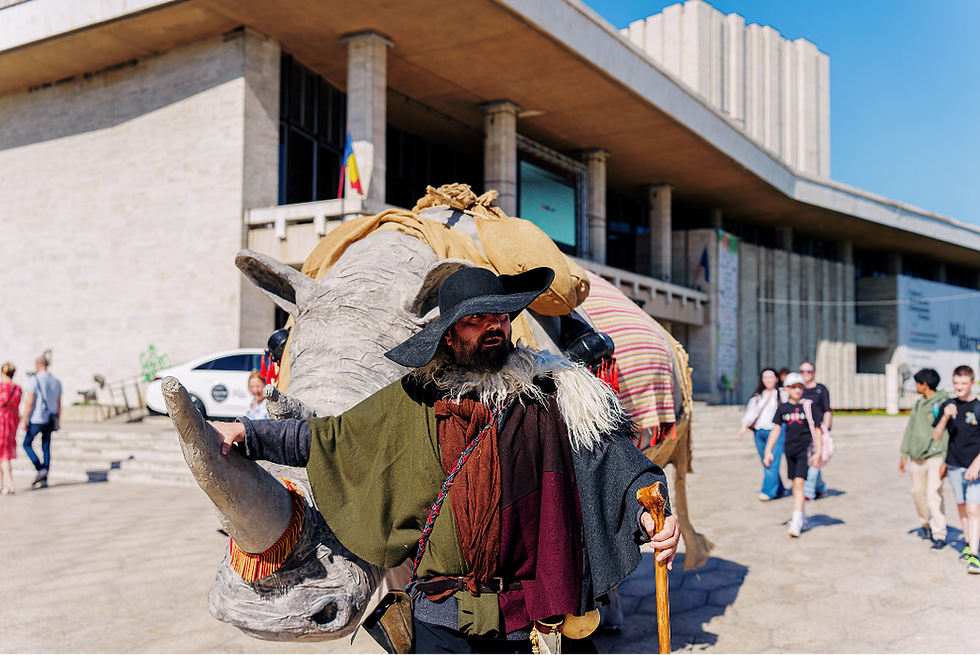
Street performances and cheerful brass bands, circus acts, exhibitions of theatrical costumes and sets, art installations contributed to the endless vibrancy that had taken hold of the city. You could meet a giant rhinoceros puppet wandering throughout the city.
I constantly felt as if I was missing something and was never where the most exciting event was happening. For 11 days, all of Craiova’s cultural institutions became theatrical venues. At the National Art Gallery (Constantin Brancusi Center), acting students presented their dynamic and rebellious Othello-Rap (director Mihaela Sârbu, UNATC), while Georgian State Pantomime Theatre retold Shakespeare’s bloodiest play “Titus Andronicus” (director David Shalikashvili) through dance, and pantomime in an impressive and emotional way. The Ethnographic Museum came alive after nightfall: from behind the trees in its beautiful garden, the forest dwellers of A Midsummer Night’s Dream in the Tower of Babel emerged, speaking many unfamiliar languages. These were Erasmus students, directed by Alexandru Boureanu, who blended into the natural scenery to tell us—with the ease of travelling performers, and with plenty of humour, improvisation, and makeshift materials (improvised costumes made from plastic bags and other everyday objects)—about the misunderstandings brought about by youth and love. The unfamiliar languages did not prevent us from following the plot. On the contrary, we truly understood that Shakespeare matters everywhere, not only in every corner of Craiova but in every corner of the world—and sounds equally beautiful in every language.
If nothing in the evening program on the many stages would appeal to you, you could go behind City Hall, where an open-air cinema screened famous film adaptations of Shakespeare’s plays.
It was impossible to see everything I wanted. Many performances began at the same time and I had to choose. Numerous events overlapped, forcing me to run from one venue to another. Sometimes I lost the race and arrived after the doors had already been closed. Then I would open the festival program, find another performance waiting for me, and hurry off again. From the main Shakespeare Core program, I managed to see 21 productions, though I would have liked to see many more. Every production I saw was a distinctive artistic interpretation of Shakespeare by world-renowned directors and companies. Their messages often spoke directly about today’s troubles—war, violence, injustice, and social inequality. Yes, once again we were reminded that Shakespeare is more contemporary than ever.
Titus Andronicus: Reborn, directed by Ryunosuke Kimura (Japan), aestheticized the violence of Shakespeare’s bloodiest play through elements of Noh theatre. Although blood was represented symbolically through red veils, its impact was almost unbearable, as if we were watching a horror film. In the second half of the production, a huge dinosaur suddenly appeared on stage, performing what seemed like a ritual dance of the destruction of humanity and the human world. The back of the stage opened, and blinding light assaulted the audience. Could this truly be a warning about the end of our world?

Cruelty, greed, selfishness, a thirst for violence and domination—almost every negative human quality was placed on stage and commented upon with merciless, even sinister irony in the show-concert The Tiger Lillies in A Macbeth Song, directed by Oriol Broggi (“The Tiger Lillies” and “La Perla 29”). Shakespeare’s play was not only faithfully retold, sung, and performed, but the protagonist was extensively commented upon and condemned, with clear message repeatedly sung to him: “You will go to hell” (ironically suggested, and ominously promised). It felt as though the trio were singing from Hell itself and were waiting to punish Macbeth when he would arrive.

While waiting, they would amuse themselves by analysing human nature. The pleasure of the songs and the production’s rich visual language—enhanced by projections and visual effects corresponding to the lyrics—created an event of sharing and sincerity, a moral compass for the troubled times in which we live.
Confession, openness, sincerity, and vulnerability radiated from the nonverbal dance productions Ophelia-s from Belgium (choreography and direction by Nicole Mossoux and Patrick Bonté) and Romeo and Juliet from Japan (choreography by Saburo Teshigawara). In Romeo and Juliet, fate intervened between the lovers (Saburo Teshigawara and Rihoko Sato), who danced alone on stage. It appeared as a beam of red light that literally struck Romeo, physically deforming him and causing visible suffering, after which he was completely transformed. The production combined elements of classical ballet with modern dance and physical theatre. After the lovers’ deaths, a final harmonious and melancholic dance of their liberated souls offered hope for a new beginning free from mistakes and hatred.
The Canadian non-verbal production Macbeth Muet (directed by Marie-Hélène Bélanger-Dumas and Jérémy Frankeur) used the techniques of silent cinema, comedic simplification of the classic story and the expressive means of object theatre to show how the pursuit of power and excessive ambition gradually causes the harmony of existence to drown in rivers of wine, blood, and broken raw eggs.

The final scene presented a pile of stage debris—the result of Macbeth’s final battle with fate. On top of it, the actor placed a tiny bright yellow paper crown. Was it worth it? Although the audience laughed almost continuously, the message was dark and invited reflection on the contemporary incarnations of Macbeth in our own time.
Self-irony, bitter laughter, and object theatre also dominate Petty Men (director Julia Levai, Buzz Studios, UK), where two young actors aspired to perform Julius Caesar and awaited the opportunity to demonstrate their abilities. Dressed casually in sportswear, as if preparing for an important athletic competition, they initially used random household objects—a coffee pot, a baseball glove—to enact scenes between Caesar, Cassius, and Brutus. Yet this harmless exercise seemed to summon the spirits of the ancient characters, who positioned themselves between the two aspiring actors (Adam Goodbody and John Chisham), infecting them with pride and ambition and gradually depriving them of reason. By the time all the murders in the play had been committed, blood was even flowing across the subtitle screen, and the friendship between Adam and John was destroyed.
King Lear, directed by Silviu Purcărete (Craiova National Theatre, Romania), offered a concentrated and stripped-down version of Shakespeare’s play in which we simultaneously witnessed the tragedy of two fathers (Lear and the Earl of Gloucester), who fail to understand their own children, deceive themselves or allow others to deceive them, and ultimately lose touch with reality. Two great Romanian actors—Claudiu Bleonț and Sorin Leoveanu—masterfully conveyed this duality in their characters and transformed from confident masters of their worlds into powerless and bewildered men unable to recognize the world they once governed so effectively.
In Purcărete’s interpretation, the two families were equally important regardless of social status. The differences between good and bad sons/daughters were clearly expressed through costumes and masks. The interplay between appearance and essence was brilliantly conveyed through contrast and allegorical costume. Edgar wore a white ballet costume: he was a man of art, detached from material concerns and violence. At the end of the performance, when forced into physical combat with his brother Edmund, he remained absurdly armed with a cardboard sword and cardboard helmet. Perhaps Purcărete depicted artists as fundamentally incompatible with the brutal realities of life. Cordelia and Edgar, the loyal children of Lear and Gloucester, were forced to wear disguises (she painted her face white and dressed as a fool, while he covered his face in mud and hided in a cardboard box). Neither abandoned their father; both followed him as secret protectors.

The large translucent white curtain dominating the back of the stage evoked a semi-transparent truth that is difficult to distinguish from lies and self-deception. The production possesses the purity of form and precision of movement familiar from previous Purcărete’s performances, giving it the force of a parable or sermon about how good and evil may be confused temporarily but never forever. One wrong conclusion or decision in Shakespeare’s world triggers an avalanche of mistakes, violence, and suffering. The harsh ending offered no comfort: corpses still lay on the table, while those still alive were eating and no one found this strange.
Corpses and brutal political games also abounded in King John by the Prague Shakespeare Company (director Guy Roberts) and Richard III by the “Mihai Eminescu” National Theatre of Moldova (director Petru Hadârcă). In King John, the conflict was relocated to the present day, mediated through the internet and television news. The cynicism of political decisions seemed entirely normal and reached the level of political satire and comedy. Richard III, meanwhile, offered dark insights into the present and future. The magnificent actor Anatol Durbală visualized the banalization of evil by portraying Richard as a relaxed and affable man who hardly cared about etiquette and appeared to behave as an ordinary “man of the people”. Through verbal dexterity he justified past and future crimes, demonstrating how injustice and evil could be minimized through verbal manipulation and behind-the-scenes manoeuvring. He was so persuasive that he began to believe his own lies. The scene in which Richard attempted to sit on the throne for the first time as king but spent nearly two minutes unsuccessfully trying to find a comfortable position on it was both hilarious and terrifying, a brilliant reminder of his guilt and illegitimacy.
Hamlet (Miklós H. Vecsei), in Gábor Tompa’s production of the same name (Hungarian Theatre of Cluj-Napoca, Romania), appeared as an allegorical image of the XXI century intellectual. Exhausted by the search for truth and having lost faith in humanity, he possessed a heightened sensitivity to injustice, lies, and hypocrisy.

Surrounded by books in his small library-room, he ultimately threw them away in a fit of rage because all their wisdom had failed to protect him from the corruption of the world. As a counterpoint to the mousetraps Hamlet and Claudius set for each other, to death and betrayal, two silhouettes of calm and cheerful children—Ophelia and Hamlet from the past—crossed the stage. Ophelia played the violin uncertainly, creating the only fragile harmony possible in this collapsing world. Their presence completely transformed the ending. Tompa has introduced a new text in which the child Hamlet addresses the audience with a calm and confident voice, speaking of patience and hope. His final line was: “Do not be afraid, open your souls and do not be afraid!” (Tompa quotes here words spoken by Pope John Paul II). As a true humanist, Gábor Tompa cannot abandon his belief in human goodness: “My hope is that young people will open their hearts and not be afraid, and that they will not believe the first fake news they receive today”, the director shared in an interview during the festival.
Shakespeare and the Alchemy of a Gender by Lisa Wolpe (USA) was a solo performance in which Shakespeare’s male monologues (Hamlet, Richard III, Shylock, Henry V) alternate with autobiographical stories. Using Shakespeare’s words, Wolpe attempted to tell the story of her family and inherited traumas with maximum emotional authenticity. The monologues were carefully selected and convinced us that Shakespeare is a universal author in whom we can find an equivalent for every modern suffering and the words not only to describe it but also to find comfort for it.
The actress’s personal story rivalled the darkest tragedies of the Bard. To the courage of self-revelation Wolpe added emotional depth, specificity, and sincerity in her interpretation of Shakespeare’s monologues. The performance commanded respect through its complete self-exposure and its exploration of the limits of artistic sincerity and vulnerability in the service of creativity and honesty toward the audience.
Venus and Adonis, Shakespeare’s narrative poem directed by Greg Doran (originally produced by the Royal Shakespeare Company), reminded us of the ancient art of storytelling, when the bard would speak slowly and clearly while everyone around listened in silence. This ancient pleasure was experienced by the audience of Venus and Adonis, performed by storyteller Simon Russell Beale with live musical accompaniment, while the story unfolded through puppets inspired by Japanese Bunraku theatre and Jacobean court masques.

The beauty of Shakespeare’s verse, the mastery of the puppeteers, and the expressiveness of the puppets created poetic perfection and a profound emotional connection with the audience—something rarely encountered in contemporary European theatre, so often infected by self-consciousness, self-control, scepticism, and irony.
Indeed, scepticism and irony reigned in director David Schwartz’s production of Timon of Athens (The Political Theatre Platform, Romania). Usually classified as a tragedy, here it was staged as a satirical comedy enriched with contemporary commentary mocking excessive generosity and hypocritical friendship. During special educational pauses, the actors explained certain principles of commodity markets and details about the lives of slaves and women in ancient Greece. The dynamic rhythm and sharply contrasting scenes fully engaged the audience, while three different actors successively played Timon, perhaps to make his emotional transformation more visible.

Production genuinely prompted us to ask whether money corrupts human relationships and whether everything can be bought and sold. Interestingly, Timon of Athens is Shakespeare’s only play without a love story. It concerns friendship based entirely on excessive gifts. Once the gifts stop, so does the friendship. Does friendship—or love—even exist?
And then came a true Shakespearean comedy— The Two Gentlemen of Verona, directed by Declan Donnellan with a Spanish cast—to prove that not only friendship but love exists, and in abundance at that. The production included a small battery-powered dog that melted the audience’s hearts and provoked loud laughter. Theatre, the living actor, old toys, old words and rhymes, old-fashioned emotions—are they not all forms of our instinctive resistance against our poor world becoming increasingly dependent on IT and AI?
I saw a lot, but much more remained unseen! I truly regret missing some performances. If I had taken different streets and entered different theatrical spaces at a different hour, perhaps I would be describing a different festival here. The festival in Craiova is endless, rich, and ever-changing, generous like Shakespeare himself. We entered the festival days as if entering the Forest of Arden: we left our everyday lives behind, put our worries at pause, so that we may lose ourselves in the world of theatre and emerge from it wiser and better. We met misanthropic philosophers, rulers in exile and rising tyrants, a wasteful noble from Athens, some fugitives from Verona, many young people with complicated relations, women disguised as men, men playing women, and a bearded actor disguised as Juliet (in Mercutio, dir. Kévin Olivier Salles, France) ... “The more I give to thee, the more I have…” Until we meet again, Craiova!
References
About the author(s)
Aglika Stefanova is theatre critic and historian. She graduated from the National Academy for Theatre and Film in Sofia, Bulgaria and at EHESS, Paris. She has a PhD in Theatre Studies at the Bulgarian Academy of Sciences. She is the author of Melodrama viewed by Theory (2000) and Genre Fields in Bulgarian Drama of the 90s (2004). She has worked as dramaturg at the National Theatre “Ivan Vazov” in Sofia, and State Drama Theatre “Stoyan Bachvarov” in Varna.
European Stages, born from the merger of Western European Stages and Slavic and East European Performance in 2013, is a premier English-language resource offering a comprehensive view of contemporary theatre across the European continent. With roots dating back to 1969, the journal has chronicled the dynamic evolution of Western and Eastern European theatrical spheres. It features in-depth analyses, interviews with leading artists, and detailed reports on major European theatre festivals, capturing the essence of a transformative era marked by influential directors, actors, and innovative changes in theatre design and technology.
European Stages is a publication of the Martin E. Segal Theatre Center.

