
NE:BITEF 2025: The Festival that Refused to Disappear
Published:
July 15, 2026
By Ognjen Obradović and Jelena Knežević

Image Credits:
Featured Image:
Audience gathering in front of KC Magacin in Kraljevića Marka before the program “They Are Coming”. Photo Credit: Nata Korenovskaia
The Belgrade International Theatre Festival (Bitef) experienced a profound institutional crisis in 2025, culminating in the first cancellation since its founding in 1967. The discontinuity was particularly significant given the festival’s long-standing commitment to maintaining continuity even during periods of international sanctions imposed on Serbia, the wars of the 1990s, and the COVID-19 pandemic.
The immediate background to the crisis can be traced to the 58th edition of Bitef in September 2024. During the opening ceremony, director Milo Rau criticized aspects of European policy regarding lithium mining in Serbia, explicitly referring to the Rio Tinto project in the Jadar Valley. The speech provoked a strong reaction from Serbian authorities and was followed by pressure on the festival leadership to distance itself from Rau’s views. When this did not occur, the mandate of artistic director Nikita Milivojević was not renewed. These developments unfolded within a broader socio-political context marked by student blockades and mass protests that evolved into a wider civic movement challenging authoritarian governance and the erosion of institutional autonomy. Against this backdrop, and following a series of controversial decisions surrounding Bitef, Miloš Lolić, a Serbian director with a significant international career, was invited to curate the festival programme in an effort to reaffirm the festival’s artistic autonomy and present its operation as independent of political influence. Lolić accepted the invitation after receiving assurances of full artistic independence and assembled a team that included Ana Vujanović and Borisav Matić. However, tensions soon emerged regarding the proposed programme. The Pelicot Trial, directed by Milo Rau, became a point of contention, not because of its content but because of the possibility of Rau’s return to Belgrade. Alongside this production, the work of students from the Faculty of Dramatic Arts – a faculty that had played a prominent role in initiating the student blockades – was also called into question. The exclusion of these projects was widely interpreted as evidence of political interference in artistic decision-making. Following these developments, Lolić withdrew from the festival, rejecting the possibility of realizing a programme whose key artistic decisions were subject to political approval.
The censorship generated strong reactions within Serbia and internationally. Milo Rau drew additional attention to the case through the initiative Resistance Now!, a transnational framework aimed at defending artistic freedom. As a result, developments surrounding Bitef became part of a broader European debate on censorship, institutional pressure, and the autonomy of cultural actors. In response, numerous artists and companies invited to the revised Bitef programme declined participation. Their refusal represented a powerful gesture of solidarity with the censored artistic team and affirmed the possibility of collective action within the European performing arts community. For the first time since its founding, Belgrade remained without a Bitef in the format in which it had previously existed.

Ne:Bitef emerged in response to the absence of the institutional festival and to the processes of censorship that had marked its cancellation. The prefix “ne” (“no” in Serbian) signified an act of refusal and resistance. Organized under the slogan “Bitef is wherever we gather,” it took place in Belgrade in December 2025, bringing together members of the former artistic team, long-time Bitef collaborators, independent cultural workers, and students of the Faculty of Dramatic Arts. In programme terms, Ne:Bitef relied largely on the selection originally prepared for the cancelled edition of Bitef, adapting it to an independent and guerrilla format. The festival unfolded over four days through several programme segments presented at selected venues in Belgrade, including spaces belonging to the independent cultural scene and public educational institutions. Its organizational model was described as a form of “capillary organization”: a self-organized initiative of the artistic and broader social community based on shared responsibility and resources, horizontal decision-making, and solidarity. The team expanded largely through personal recommendations and informal networks, according to the needs of individual programmes and tasks. Nearly two hundred people became involved in the realization of the festival, working on a voluntary basis and relying on communication, coordination, and mutual trust. What united this diverse collective was a commitment to preserving the continuity and critical spirit of Bitef despite the circumstances that had led to its cancellation.
As a result, Ne:Bitef functioned not merely as a response to censorship and cancellation but as a temporary experiment in collective cultural production. It demonstrated the capacity of artists, cultural workers, and students to sustain an important cultural event through solidarity and self-organization while simultaneously exposing the vulnerabilities of a cultural system dependent on functioning public institutions. At the same time, rather than presenting itself as a permanent alternative to Bitef, Ne:Bitef underscored the continuing need for autonomous public cultural institutions.
Without this socio-political and “forced” production context, it is impossible to fully understand and interpret the program of Ne:Bitef. The first day of the festival was dedicated to the performance of The Pelicot Trial and a discussion on repression in the cultural sector, conceived as part of the campaign Resistance Now! Together. The second day centered on the program section They Are Coming – a kind of showcase of the work of young artists Andreja Karčagin, Aleksandar Zain, Ana Janković, and the collective of the Faculty of Dramatic Arts, who through different artistic forms examined the repressive conditions in which their works were being created. This program gained additional weight from the fact that three out of the four presented projects had remained unfinished after the cancellation of the institutional Bitef, within whose production framework they were originally supposed to be realized.
The third day, through its very format, also testified to the festival’s guerrilla nature, as Romeo Castellucci’s performance Bros, unable to be staged live for financial reasons, was screened via video link accompanied by the director’s message of support for Ne:Bitef. The performance, which deals with police brutality and the phenomenon of institutionalized male violence, was further contextualized through the panel discussion Justice and/or Punishment: Toward an Abolitionist Future, dedicated to the relationship between justice, punishment, and the repressive state apparatus, as well as to the possibilities of progressive politics grounded in care, violence prevention, and solidarity.
At the end of its third day this “rebellious” edition of Bitef also found room for a punk concert titled Forgotten Workers’ Struggles – a musical evening by the band formed by technicians from Berlin’s Volksbühne, dedicated to the history of workers’ resistance. Organized in collaboration with local bands and students, many of whom joined the program on their own initiative and traveled at their own expense in order to express support and solidarity, the event further emphasized the festival’s activist and guerrilla character through music, a mini-exhibition, and collective gathering.
The questions concerning the relationship between art, institutions, and resistance – which Ne:Bitef opened through both its format and its program – were further deepened through the closing panel Art: Retreat and/as Resistance. The discussion brought together artists, cultural workers, and activists to reflect on whether, under conditions of censorship and autocratic cultural policy, meaningful action within institutions is still possible, or whether withdrawal and the refusal to “carry on” might today constitute the most powerful form of resistance.
The defining event of Ne:Bitef was the staging of The Pelicot Trial, not only because of the significance of the project itself, but also because of the additional meanings the event acquired through the fact that both the performance and its director had themselves triggered the festival’s censorship and its (self-)expulsion from institutional frameworks. To borrow one of Marvin Carlson’s key concepts from The Haunted Stage: The Theatre as Memory Machine, the performance carried multiple layers of what he terms ghosting.
In this case, the figure carrying with him the spirit of rebellion and refusal was the “banned director” himself, Milo Rau, who participated in all of the events during the festival’s opening day. The venue in which the performance was staged – the Faculty of Dramatic Arts – was itself likewise haunted while the festival’s very opening at 11:52 had itself become a “haunted moment” – a time that, through daily protests, had lost its neutrality and turned into a collective ritual of remembrance, mourning, and civic resistance.
Indeed, the festival’s first performance and opening program point consisted of sixteen minutes of silence for the sixteen victims who lost their lives on November 1, 2024, when the deteriorating canopy of the officially renovated railway station in Novi Sad collapsed on them. This tragedy triggered a profound social crisis and a powerful wave of resistance led by students and citizens, one of whose central rituals of protest, mourning, and solidarity became the daily gathering in the streets at 11:52 a.m. – the exact moment when the canopy, transformed into a symbol of the destructiveness of the current regime, crashed down onto the people standing beneath it. It was the hour during which citizens, through silent and persistent resistance, halted city traffic by stepping into the streets and repeatedly reminded the public that the innocent victims must not be forgotten.
The immediate trigger for the student blockades – the central pillar of the spirit of resistance in the preceding period – was the moment when regime supporters physically attacked students of the Faculty of Dramatic Arts during a commemorative gathering on November 22. Three days later, the students of the Faculty of Dramatic Arts entered into a blockade, and by mid-December 2024 all public universities in Belgrade, Novi Sad, Niš, and Kragujevac had joined the protests through institutional blockades.
A little more than a year later, at precisely that time and in precisely that place – in front of the Faculty of Dramatic Arts – stood Milo Rau and Servane Dècle, together with students, citizens, and other participants of Ne:Bitef. In that moment, different gestures and agents of resistance to authoritarianism – students and professors, local cultural workers, international artists such as Rau and Dècle, as well as the “rebellious” creators and organizers of Ne:Bitef – merged into a shared performative act.
What followed was a panel discussion titled 90 Minutes of Silence, whose very title, as well as its timing (the discussion took place immediately after the collective commemoration), directly echoed the socio-political circumstances and protests that preceded it.
Alongside Rau, the panel brought together local cultural workers, artists, and researchers whose experiences offered a cross-section of some of the most pressing forms of cultural repression in contemporary Serbia. Miloš Vojnović, an actor from the Šabac Theatre, spoke about the pressures and acts of retaliation directed at employees who had participated in the protests, including the dismissal of organizer Jelena Ivetić. Nenad Lajbenšperger, meanwhile, pointed to the political pressure exerted on the Institute for the Protection of Cultural Monuments in relation to attempts to revoke the protected status of the Old General Staff building in order to make way for an investor project connected to Donald Trump’s administration. Milica Pekić further broadened the discussion by drawing attention to forms of pressure operating outside institutional frameworks, focusing on the systematic deterioration of working conditions and the ongoing marginalization of the independent cultural scene.

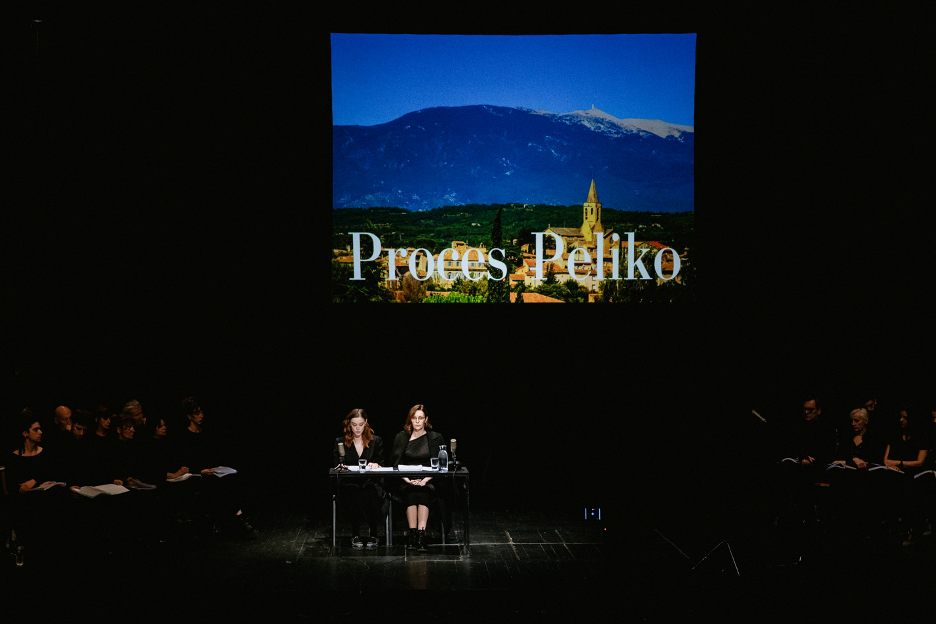
Some of these themes haunted The Pelicot Trial through the bodies, biographies, and social positions of its performers. In keeping with the concept devised by Milo Rau and Servane Dècle, the piece is performed in each local context by domestic actors, activists, and cultural workers. Such a format suited the festival’s guerrilla character both productionally and symbolically: from a production standpoint, only the creators of the performance – the dramaturg and researcher Servane Dècle and Milo Rau – traveled to Belgrade, allowing the piece to fit within the festival’s modest budgetary conditions; on the level of meaning, however, the performers themselves, through their social engagement and public positions, inscribed local socio-political meanings into the performance.
One of the performers in the production was Jelena Ivetić, the dismissed organizer from the Šabac Theatre mentioned earlier, whose presence not only carried the spirit of resistance to cultural repression, but also created a direct link to the panel held earlier that day, during which both the theatre and her case had been explicitly discussed. The performance also featured environmental activist Ljiljana Bralović, whose presence evoked public resistance to the Rio Tinto project while simultaneously pointing to the broader political context within which Rau’s presence and work in Serbia had become politically inconvenient.
Performers such as Jelena Ivetić and Ljiljana Bralović brought into the performance, through their “haunted” bodies and biographies, meanings that were not directly tied to the play’s central theme, but rather to the local socio-political context.

Alongside these layers, a more direct form of Carlsonian ghostting was also at work. One of the performers was Milena Radulović, who publicly accused her former acting teacher Miroslav Aleksić of sexual abuse, thereby triggering a wave of testimonies from other former students of his school, as well as from women who had experienced sexual violence more broadly.
Her presence in a performance dealing with the mechanisms of sexual violence and public testimony did not function merely as a symbolic reference or media attraction, but further complicated the multilayered interplay between reality and fiction, documentary and personal experience, performance and testimony. In this way, the production acquired yet another layer of local social and emotional ghostting, as the audience was simultaneously watching both an actress and a public figure whose biography – as another example of refusing silence – had already become deeply inscribed in Serbia’s public sphere.
During the performance, Milena Radulović performed with visible emotional tension. Radulović’s participation – her biography, exposed vulnerability, and the persistence with which she carried the performance through – had a powerful effect on the audience, further intensifying spectators’ identification and emotional involvement.
Particularly significant was the fact that, together with Nada Šargin, Radulović was not cast in the role of a victim, but of a judge. In this way, the production avoided an overly literal overlap between her biography and the stage material, while the symbolic distribution of roles functioned as a kind of repositioning of the figure who testifies to endured violence into a position of authority and judgment. The fact that the performance took place precisely at the Faculty of Dramatic Arts further amplified this symbolic dimension, given that Radulović herself graduated in acting from that institution, in the class of Biljana Mašić – the wife of Miroslav Aleksić – who taught at the faculty and publicly supported her husband after he had been accused of abuse.
In that sense, her return to the Faculty of Dramatic Arts precisely through the role of a judge functioned as a powerful symbolic act – not only as a reclaiming of a space indirectly connected to the case that shook the Serbian public, but also as an attempt to shift the figure of a woman who publicly testifies about violence away from the position of suffering and vulnerability and into one of authority, speech, and judgment.
Vesna Trivalić delivered Gisèle Pelicot’s monologue with such acting precision and emotional conviction that a large part of the audience broke into tears during the performance. Many spectators later stated and wrote – as evidenced by the considerable number of texts published about Ne:Bitef – that this had been one of the most powerful theatrical experiences they had ever witnessed, an assessment with which the authors of this text also agree.

What makes this particularly significant is the fact that Vesna Trivalić has for decades been recognized in Serbian public culture primarily as an extraordinary comic actress and one of the country’s most beloved television performers, thanks to series such as the family dramedy A Better Life (Bolji život, 1987–1991) and the sitcom Open Door (Otvorena vrata, 1994–1995). Trivalić’s body, deeply haunted by previous comic roles, collective nostalgia, and the audience’s television memory, here appeared instead as the bearer of a painful and serious testimony, further intensifying the emotional effect of the performance. This shift could also be interpreted as a sign that the social moment had reached a point at which there was no longer any room for laughter.
It was precisely through this example that one could observe how the exchange between performers and audience, in moments of social crisis, can become especially intense and emotionally charged. The audience was responding not only to the stage material and the actors’ skill, but also to the broader social context surrounding the performance and into which it was deeply and multiply embedded. Under such circumstances, theatre becomes a site of shared affect and collective emotional “release,” a space for recognizing and confronting social trauma.
Due to the extraordinary interest of the audience, the performance was simultaneously streamed via video link, which opened up an interesting question concerning the relationship between live performance and its digital transmission. After the three-hour production had ended, I caught myself, already on the bus ride home, rewatching the recording of Vesna Trivalić’s monologue – the moment experienced as the emotional climax of the performance – thereby extending an experience that did not conclude upon leaving the venue itself. In this sense, the digital stream did not function merely as documentation of the performance, but as a continuation and prolongation of its affective force.
An additional connection between the performance and the concrete socio-political reality was established through the very mode of its digital transmission. The Pelicot Trial was streamed via the YouTube channel Svi u blokade (“Everyone Into the Blockades”), which students of the Faculty of Dramatic Arts had launched during the faculty blockades in order to share information, protest footage, and other materials related to the student resistance movement. At the same time, the performance was collectively screened in Novi Sad, Ljubljana, and Skopje as a gesture of regional artistic solidarity and support.
In this way, the very digital infrastructure through which the performance circulated became itself “haunted” by protest, student resistance, and gestures of regional solidarity, transforming from a neutral channel of transmission into an active component of the production’s political and symbolic framework.
At the moment when the institutional Bitef ceased to exist in its previous form, its symbolic, political, and social potential continued to live on through a collective practice of self-organization, solidarity, and resistance. Precisely for this reason, the question of whether Ne:Bitef was the “real” Bitef may not be the most important one; more important is the fact that it opened up space for the very notion of the institution to be reimagined and rebuilt – not as an instrument of political control, but as a space of autonomy, critique, and public dialogue. In this sense, Ne:Bitef did not represent merely a reaction to censorship and the cancellation of the festival, but also an attempt to imagine, through theatre, a different model of cultural and social togetherness.
The death of Miroslav Aleksić in January 2026, and the outcomes of years-long court proceedings, once again opened up in the public sphere the question of justice and its realization in cases of sexual violence. Unlike the case of Gisèle Pelicot, which in the public sphere reached its judicial epilogue and closure, the case of Milena Radulović remains remembered as a symbol of a #MeToo moment in Serbia in which justice, despite public testimony and enormous support, continues to be experienced as something unfinished, postponed, and painfully inaccessible.
At the same time, Bitef appointed a new selector. This time, there was not even an attempt to appoint a figure who would broadly satisfy the professional criteria traditionally associated with the position or command wider respect within the theatre community. Those who had publicly defended Bitef’s autonomy and opposed its censorship were removed and replaced.
Everything indicates that Bitef will not return this year as an institution capable of restoring its own autonomy and critical function. The question remains whether Ne:Bitef will remain merely a document of a brief historical moment in 2025, in which the festival refused to disappear, or whether it will demonstrate its vitality and strength until Bitef is liberated. Here, one must above all count on the potential and networks of solidarity within the European artistic community – on the willingness to decisively refuse participation in the institutional Bitef and to support some future Ne:Bitef in the way that the musicians’ band of Berlin’s Volksbühne technicians, Milo Rau, Servane Dècle, and Romeo Castellucci did last year.
References
About the author(s)
Ognjen Obradović is a theatre scholar and Assistant Professor at the Faculty of Dramatic Arts in Belgrade. His research focuses on contemporary theatre, performance studies, and the relationship between theatre and politics.
Jelena Knežević is a theatre producer and Teaching Assistant at the Faculty of Dramatic Arts in Belgrade. Her research interests include theatre festivals, cultural management, and alternative organizational models in the arts. She served as Executive Director of Bitef from 2008 to 2023 and was a member of the organizational team of Ne:Bitef 2025.
European Stages, born from the merger of Western European Stages and Slavic and East European Performance in 2013, is a premier English-language resource offering a comprehensive view of contemporary theatre across the European continent. With roots dating back to 1969, the journal has chronicled the dynamic evolution of Western and Eastern European theatrical spheres. It features in-depth analyses, interviews with leading artists, and detailed reports on major European theatre festivals, capturing the essence of a transformative era marked by influential directors, actors, and innovative changes in theatre design and technology.
European Stages is a publication of the Martin E. Segal Theatre Center.

