
Power, Shame, Vanity and Opportunism – Productions of the 63rd Berliner Theatertreffen
Published:
July 15, 2026
By Steve Earnest

Image Credits:
Featured Image: Cast of Wallenstein. Photo credit: Armin Smailovic
At the audience talkback following the nominated production Three Times Left is Right, Vincent Koch, a member of the Theatertreffen jury noted that one of the key elements involved in this year’s final show selection had to do with each work’s provocative quality – it’s ability to provoke the audience through the theatrical process. Given the increasing worldwide polarization in political positions, a great many of the works considered not only the nature of world politics but also many of the byproducts of that ongoing dialectic. It may be said that “the politics of war” was a theme of this year’s festival – not only traditional war between nations or regions but wars in the bedroom and war against oneself. As is always the case at the festival each May, many unique production approaches were seen and many great seasoned and new theatre figures displayed some of the highest-level work in Europe. Sadly, Florentina’s Holzinger’s A Year Without Summer could not be presented during the festival dates as it had been previously scheduled to tour to Australia during May 2026. The work was rescheduled to appear in October 2026 at the Volksbühne. Also, given the early starting dates of the festival it was not possible to review productions of The Leopard or Mephisto. A total of seven of the works of the 63rd Berliner Theatertreffen will be considered in this article.
Admittedly, hearing that The Glass Menagerie was selected as one of the “Ten Remarkable Productions” was something that did not excite me. Having seen the production in the USA various times in both professional as well as amateur settings, it only conjured images of Tom and Amanda sparring in a typical box set with Laura presented as someone with various deficiencies. From the outset it was clear that this would not be the case with this production from Theater Basel. Director Jan Woodcock-Stewart focused on the fragile structure of the family and especially the roles of women in the work. Many metaphors were created with regard to the scenic elements utilized in the first half of the play – the layout consisted of several loosely defined performance areas: a long winding upstage walkway used for all entrances and exits, a small office and computer area for Laura (the production was not at all tied to the 1930’s) and a family gathering area, loosely defined by contemporary power plates, vibrating cushions typically used for exercise. For several of the scenes the actors stood on the vibrating plates and delivered their lines – creating a metaphor for the “shaky ground” on which each was standing. To further enhance the metaphor, coins had to be inserted by Tom into the power plates in order for them to keep working. Laura’s peculiar nature was defined in numerous ways, but none more striking than her online vocal lessons with a female teacher of heavy metal screaming. The hilarity of these scenes cannot be overstated. The inclusion of this element paid huge dividends later in the production, particularly in the scene when Tom and Amanda were discussing Laura’s “peculiar nature” while she was running around the room in headphones screaming heavy metal lyrics. Antionette Ullrich’s performance as Laura was highly physical and worked against the notion of her being crippled physically, but rather socially. The menagerie itself was striking, and Laura used a hand-held camera to focus on the collection of glass horse figures as all were horses except for the one unicorn that was later broken.
As Amanda, Hilke Altefrohne gave a much younger take on the role than one might typically see. At one point a microphone appeared, and she sang the sexy disco song “Rescue Me,” as her desperate financial situation became increasingly apparent. The visit of Jim, the “gentleman caller” was marked by an incredible scenic change. An enormous realistic/dream set was lowered onto the stage to symbolize Amanda’s ideal dinner night. Dark green in color, the unit set was only used in that scene and marked a clear break from the fragmented world previously established to define the dysfunctional, fragmented life of the trio. As Laura had been forced into what appeared to be the costume of a whore, Amanda had arranged a beautiful table for dinner; Jim arrived on a motorcycle and wore a flashy motorcycle outfit. However, before coming face to face with Jim, Laura ripped off the dress in favor of a baggy sweatshirt and more traditional house clothing. Led by Tom, played by Jan Bluthardt, the family sang grace by rote and the scene followed with the table being vibrated by the same power plates used in the early scenes. The entire dinner became a physical fiasco due to the vibrating table and the resultant spillages and even breakages of plates and glasses. As is often the case, the Jim and Laura scene was one of the play’s highlights – Julian Anatol Schneider’s portrayal of Jim was marvelously understated. As he left, so did the marvelous set and thus Amanda’s dream was ended. In the end Tom screamed “Laura – blow out the candle’s!” nearly ten times before she did it, leaving the audience somewhat unsettled.

The production received a mixed reaction to those in attendance that evening, with some audience members loudly booing the directorial interpretation of the work. It should be noted that there was an equally loud group who stood and cheered the approach and the bold choices made by Woodcock-Stewart and her production team. The young British director is noted for her refusal to simply retell works in their traditional form but to find new methods of storytelling that reenvision stories for a contemporary world. The Glass Menagerie was a prime example of this directorial process.

Presented at the Hans Otto Theatre in Potsdam, Serotinin was based on the novel by Michel Houellebecq and was presented as a monodrama by the actor Guido Lambrecht. Directed and designed by veteran Sebastian Hartmann, the work was presented on the small Probebühne stage in Potsdam on a single white set. The nearly five hour work was characterized by moments of stillness, silence and thought – an endless stream of consciousness monologue presented by Lambrecht who fared very well given the Herculean task of telling the story of his life, his parents, of the new generation, and key elements of his own personal struggles that reflect many of the struggles of western society. Embodying the character of Florent-Claude Labrouste, Lambrecht tells the story as someone whose life is near its end. Rendered impotent by prescription drugs, he relives many of his failed relationships both with women and with others though his sad and uneventful life. Lambrecht’s performance was extremely filmic, and an argument could be made for this work to be presented in that medium. As a theatre work, it was somewhat tedious, and the absence of any subtitles made it difficult to follow the entire story with complete accuracy. Because of the relative stasis of the work which included very little movement and really no scenic variety whatsoever, it made the work stand apart from the entire slate of other performances. The work seemed a curious selection when compared with the other, highly developed gesamtuntwerk-like productions of the 2026 Theatertreffen. However, there is a history there - Serotonin was not the first of Houellenbercq’s novels to be staged as a theatrical work; The Elementary Particles was staged by Schauspielhaus Zurich in 2004 and invited to the 2005 Theatertreffen. The writer maintains a strong presence among the European public and his works continue to speak to the contemporary public in a relevant way.

Another solo work, Fräulein Else, was presented by Volkstheater Wien, directed by Leonie Böhm and performed by Julia Riedler. Much shorter than Serotonin, Riedler’s performance lasted a mere hour and a half – still quite a feat as a solo work. The work was adapted from Arthur Schnitlzer’s controversial novel of the same name, written in 1924, that involved Else’s father, deeply in debt and a deal that is brokered to resolve the debt. An elderly art deal named Dorsay agreed to resolve the debt provided that Else exposes herself naked to him for a quarter of an hour. Böhm and Riedler adapted the work as an inner monologue that explored both the comical as well as the more serious and even shameful nature of the situation. Apparently, Dorsay had observed the young Else since she was thirteen years old and had always been a “fan.” She describes in detail the meeting between them as he asks her to sit on his knee, fondling her and calling her names like “dear child” and “desirable creature.” Throughout the work Riedler remained in constant dialogue with the audience, actually asking questions and receiving answers, which guaranteed each performance to be slightly different based on the responses given. On the night I saw the production she asked the audience whether she should expose herself or not, to which the majority shouted “nein!” But she told them she would only say yes after she had the bank transfer in hand and had taken a very strong tranquilizer. Her strip show was a little spectacular.

Presented on the main stage of the Berliner Ensemble, Fräulein Else began with Riedler in the audience trying to make her way onto the stage while stopping to flirt with and ask questions of many of the (particularly) male audience members. Obviously, a seasoned actress in improvisation the journey to the stage took nearly a quarter hour, and when she finally arrived on stage her narrative discussion of the story began. Within the context of the work, she investigated areas of power, male dominance, humiliation and shame. Utilizing only a large mountable chandelier she once rode up on the device that was lifted to a great height in the theatre. Soon after her decent she began to take off her clothes and appeared naked on stage for the required quarter of an hour, discussing the nature of what it felt like to be naked in front of others in such a voyeuristic situation. Riedler’s great skill as a comedic actress was certainly the highlight of the show; she had the audience up dancing in the aisles and even doing “the wave.” Riedler also pointed out the fourteen naked female statues that were a part of the interior architecture of the Theater am Schiffbauerdamm and managed to throw an insult out to the former leader, Bertolt Brecht, who was well known as a womanizer (in her words).
Schiller’s epic Wallenstein trilogy was presented by the Munich Kammerspiele as “A Slaughter in Seven Courses.” Staged by resident director Jan-Christoph Gockel, the seven-and-a-half-hour spectacle included nearly everything one could imagine from a theatrical performance. Power, betrayal and opportunity dominated the work which spanned decades but in fact considered many different times and places all united by the landscape of war. In the original, the character of Albrecht von Wallenstein was in fact, a mercenary, a loyal subject (but basically a businessman) who profits from war. Gockel introduced the parallel story of Vladimir Putin’s contemporary associate Yevgeny Prigozhin, a mercenary who supplied the Russian army with food during the early years of the war in the Ukraine. A huge Putin loyalist, Prigozhin had worked his way up from the position of a menial worker to Putin’s lead chef. To illustrate that conceptual idea, the first major scene of the play, nearly one hour in length, consisted of a huge kitchen area, populated by nearly one dozen chefs and cooks, all contributing to the creation of a magnificent feast. Entitled “Cooking is War,” an onstage camera crew (popular with many productions at this year’s TT) captured all of the slicing, dicing, mixing, straining and other duties associated with food preparation. The extensive detail of the cooking session featured no actual stage dialog, instead the soundscape consisted of the sounds created by the chopping, mixing and casual unscripted conversation of the onstage workforce. The cameras allowed for the action to be seen from many angles as projected onto the three onstage screens.
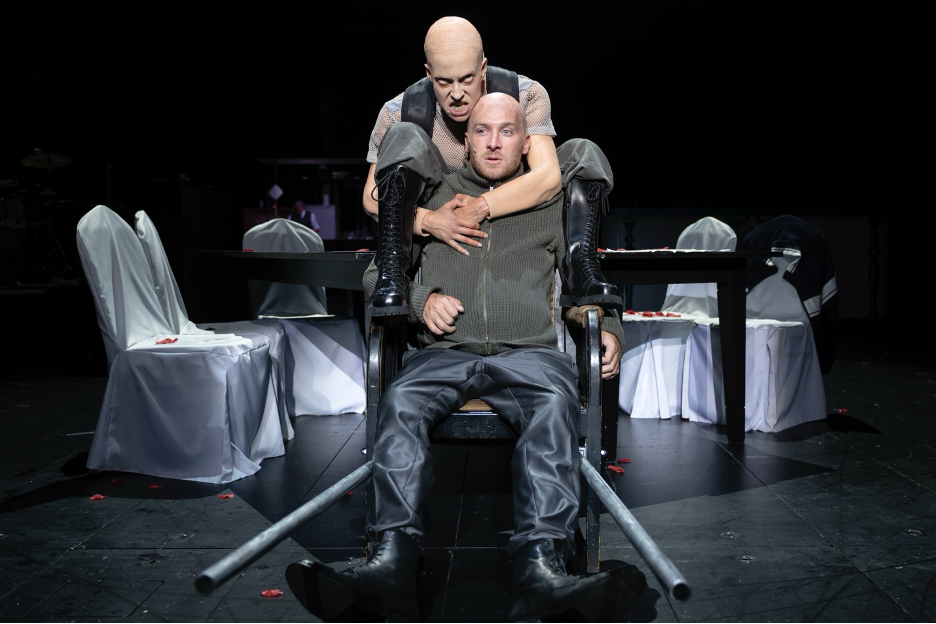
Portrayed by paraplegic actor Samuel Koch, the character of Wallenstein became a puppet – both literally and figuratively. Two incredible elements contributed to this idea – a miniature puppet of Koch’s character that was skillfully manipulated by actor and puppeteer Michael Pietsch and an amazing electric “wheelchair/throne” that turned the character of Wallenstein into something of a monster puppet (i.e. a monster truck). Though a loyal ally to the emperor, Wallenstein made enough mistakes (a parallel to the story of Prigozhin) that he was eventually assassinated. The funeral scene (as it may be called) took place on a large green screen as Wallenstein’s (Prigozhin’s) span of life was chronicled through a series of images that illustrated the incredible damage to the war effort (Ukraine) that he helped orchestrate as a supportive ally. The powerful ending revealed one of Wallenstein’s greatest epiphanies – that man is greater than war. Katharina Bach’s performance as Illo was one of the true highlights of the festival. Playing the part of a male associate of Wallenstein, Bach donned a male muscle shirt and even exposed a long penis at one point – cutting it off and flinging it into an onstage mess of residual effects. Later in the play Illo went hunting for the severed penis and, in a hilarious video assisted scene, found the object among the aisles of the audience and Illo arrived to try and revive the penis, offering “chest pumps,” as well as mouth to mouth resuscitation. The incredibly funny scene was just one of many from a production that created an incredible balance of serious as well as comedic scenes.
Wallenstein included a total of 5 pauses – three were 30 minutes in length and the other two were about 10 minutes each. Two of the lengthier breaks were themed as audience members were fed the Russian soup dish soljanka during one of the breaks and another consisted of a Russian “kitsch,” a dance party with techno music as audience members were invited onstage to dance with the cast members. Following the dance party break, certain selected audience members were given scripts to read selections from Sergei Okunev’s writings about the lives of mercenaries. Based on a concept from playwright/director Heiner Müller, the use of audience members led to several very comedic moments but also some extremely profound and meaningful scenes. The audience members were joined onstage by many of the cast members, who lightly coached the chosen spectators, all of whom were seated on a very wide table situated downstage. Wallenstein featured a great deal of audience interaction, which helped to alleviate any issues caused by the production’s length. In so many ways, Wallenstein was the most complete and stylistically solid production of the 2026 Theatertreffen.

Die Welt im Rucken (The World at My Back) chronicles the life and experiences of Thomas Melle, who suffered from extreme bipolarism. Initially a successful playwright and novelist, Melle’s mental condition led him to sell off his prized library, live in a drunken stupor, engage in sexual fantasies, and be confined to a psychiatric hospital after numerous arrests, several of which were violent in nature. The stage version of the novel, produced by Schauspiel Stuttgart under the direction of Lucia Bihler and Gwendolyne Melchinger featured a cast of seven – Paulina Alpen as Thomas Melle flanked by a company of six doppelgangers; all were dressed in the same costume but only Alpen’s role saw many visual changes as far as costumes as properties were concerned. The doppelganger’s served as a chorus for the work. A complicated theatrical performance, the play began with an overview of Melle’s condition: the loss of his library, his criminal undertakings and other activities considered to be a part of the large “elephant in the room” of Melle’s life and career. The staging and performance of the work were exceptional. By developing the Melle novel into a Greek style chorus the work was one of the most celebrated of the Theatertreffen. The choral aspect of the work included many physical feats (trampolines as well as choreography) but also the repetition of key sections of text were an important element of the performance.
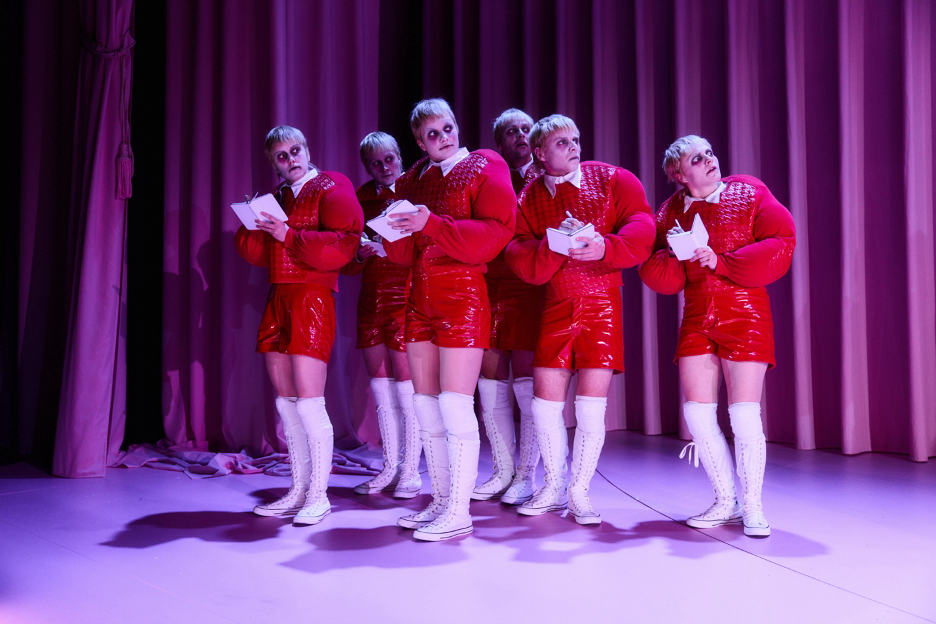
Perhaps the strongest element of Die Welt im Rucken was the scenery, designed by Paula Wellmann. The striking pink curtains served as an enveloping scenic element to frame the action within a particular world. Once Melle’s condition reached a certain point, the curtains were dropped and formed a physical barrier for the action. Additional platforms and other scenic elements, including flying equipment, accentuated the play’s action. The stunning curtain drop and later use of the fallen curtains to provide a scenic space was an ingenious invention. The space was utilized to provide a universal setting for many of Melle’s both lived and internal events that defied the necessity of a literal place. Wellmann was able to construct a literal “mental landscape” that supported Melle’s journey.
Carl Zuckmayer’s The Captain of Köpenick is a standard German farce and is typically known by all German readers of literature and theatre. As presented by Staatstheater Cottbus, It was very much a performance about the work and not a play of the performance itself. The work was presented as something of a puppet show in a confined environment that allowed the performers a frontal space defined by their ability to communicate in a parallel environment – very close to visually resembling a large puppet stage. The cartoon like element of the production – seen in many previous Theatertreffen finalists – has been a popular format for productions in Germany and offers directors and production teams the ability to experiment with stylistic choices in a formalized structure. Entrances and exits were often made from below, as characters were able to simply “pop up” from below. Music was utilized throughout and there were many scenes that had the feel of a Berlin cabaret, and most of the 8-person cast played at least one musical instrument. The text itself was altered greatly, and long sections of narration were interpolated into the work. For example, a section was included from Zuckmayer’s personal writings regarding his travels from Germany to France during the war years. Additionally, there was a long discussion of the Berlin transit system as Sebastian Hartmann’s concept took into the consideration the village of Köpenick itself,

Studio Julian Hetzel presented Three Times Left is Right, an autobiographical work based on the lives of a real couple – an undisclosed husband and wife from Vienna – who were portrayed by Belgian actors Kristien De Proost and Josse De Pauw. As the actors, acting as narrators in the beginning noted, the couple was exceedingly happy and loving and, in the end, had only one major difference – their political views. The work began in direct address – the preshow video listed the numerous elements of the play that some audience members might find offensive. These included: abusive language, hate speech, homophobic references, physical violence, toxic masculinity and basically any possible element that could offend anyone. As Kristen and Josse took the stage (they used their own names) they spoke the entire performance in direct address to the audience. While they were clearly in love physically, as they displayed throughout the production, their political views were polar; Josse was a left-wing liberal but Kristen was a well-educated right-wing writer and scholar. The production balanced their views and conversations until the point that Kristen decided to cut open Jesse’s belly and pull up his intestines and other internal organs, including his liver.
The production, which has now played in not only Germany but Belgium, Holland and Switzerland, has opened a true dialog about the nature of political polarization, especially among individual households. The political bent of the work was clearly neutral, and kudos to the production team for creating a work that allowed a space for reflection, decision making, comedic reaction and ultimate choice. Julian Hetzel’s team created a work that served as a forum for both political and social discussion and did so through a medium that generated both comedic as well as serious face to face discussions.

Three Times Left is Right was presented in the rather astonishing Hebbel Theater, a space I had never visited before. The beautiful theatre space was in the area of Hallesches Tor, a major area of the former East Berlin and the theatre obviously held a major position in the community there. With almost all seats in the theatre being less than 50 meters from the downstage center area, the theatre had one of the most intimate feelings of any major theatre I visited in Berlin over the past 30 years.

The 2026 Theatertreffen marked the 7th straight year that the judges utilized a minimum of 50% female quota as far as directors are concerned. However, after extensive meetings and consideration, that quota will be abandoned for the 2027 and 2028 festivals, and productions will be selected solely based on merit rather than the gender of the director. It was noted that the process is completely fluid and would be revisited each year to make sure that all elements of inclusion were considered. At the end of the day, the works are consistently stellar and continue to provide evidence that the Germanic Theatre system (including Germany, Austria, Switzerland and all related countries in the region) is the strongest among the theatre producing countries of the world.
References
About the author(s)
Steve Earnest is a Professor of Theatre at Coastal Carolina University. He was a Fulbright Scholar in Nanjing, China during the 2019 – 2020 academic year where he taught and directed works in Shakespeare and Musical Theatre. A member of SAG-AFTRA and AEA, he has worked professionally as an actor with Performance Riverside, The Burt Reynolds Theatre, The Jupiter Theatre, Candlelight Pavilion Dinner Theatre, The Colorado Shakespeare Festival, Birmingham Summerfest and the Riverside Theatre of Vero Beach, among others. Film credits include Bloody Homecoming, Suicide Note and Miami Vice. His professional directing credits include Big River, Singin’ in the Rain and Meet Me in St. Louis at the Palm Canyon Theatre in Palm Springs, Musicale at Whitehall 06 at the Flagler Museum in Palm Beach and Much Ado About Nothing with the Mountain Brook Shakespeare Festival. Numerous publications include a book, The State Acting Academy of East Berlin, published in 1999 by Mellen Press, a book chapter in Performer Training, published by Harwood Press, and a number of articles and reviews in academic journals and periodicals including Theatre Journal, New Theatre Quarterly, Western European Stages, The Journal of Beckett Studies and Backstage West. He has taught Acting, Movement, Dance, and Theatre History/Literature at California State University, San Bernardino, the University of West Georgia, the University of Montevallo and Palm Beach Atlantic University. He holds a Ph.D. in Theatre from the University of Colorado, Boulder and an M.F.A. in Musical Theatre from the University of Miami, FL.
European Stages, born from the merger of Western European Stages and Slavic and East European Performance in 2013, is a premier English-language resource offering a comprehensive view of contemporary theatre across the European continent. With roots dating back to 1969, the journal has chronicled the dynamic evolution of Western and Eastern European theatrical spheres. It features in-depth analyses, interviews with leading artists, and detailed reports on major European theatre festivals, capturing the essence of a transformative era marked by influential directors, actors, and innovative changes in theatre design and technology.
European Stages is a publication of the Martin E. Segal Theatre Center.

