
Staging Tradition, Testing Form: The Second Showcase of the National Theatre of Sofia
Published:
July 15, 2026
By Savas Patsalidis

Image Credits:
Featured Image:
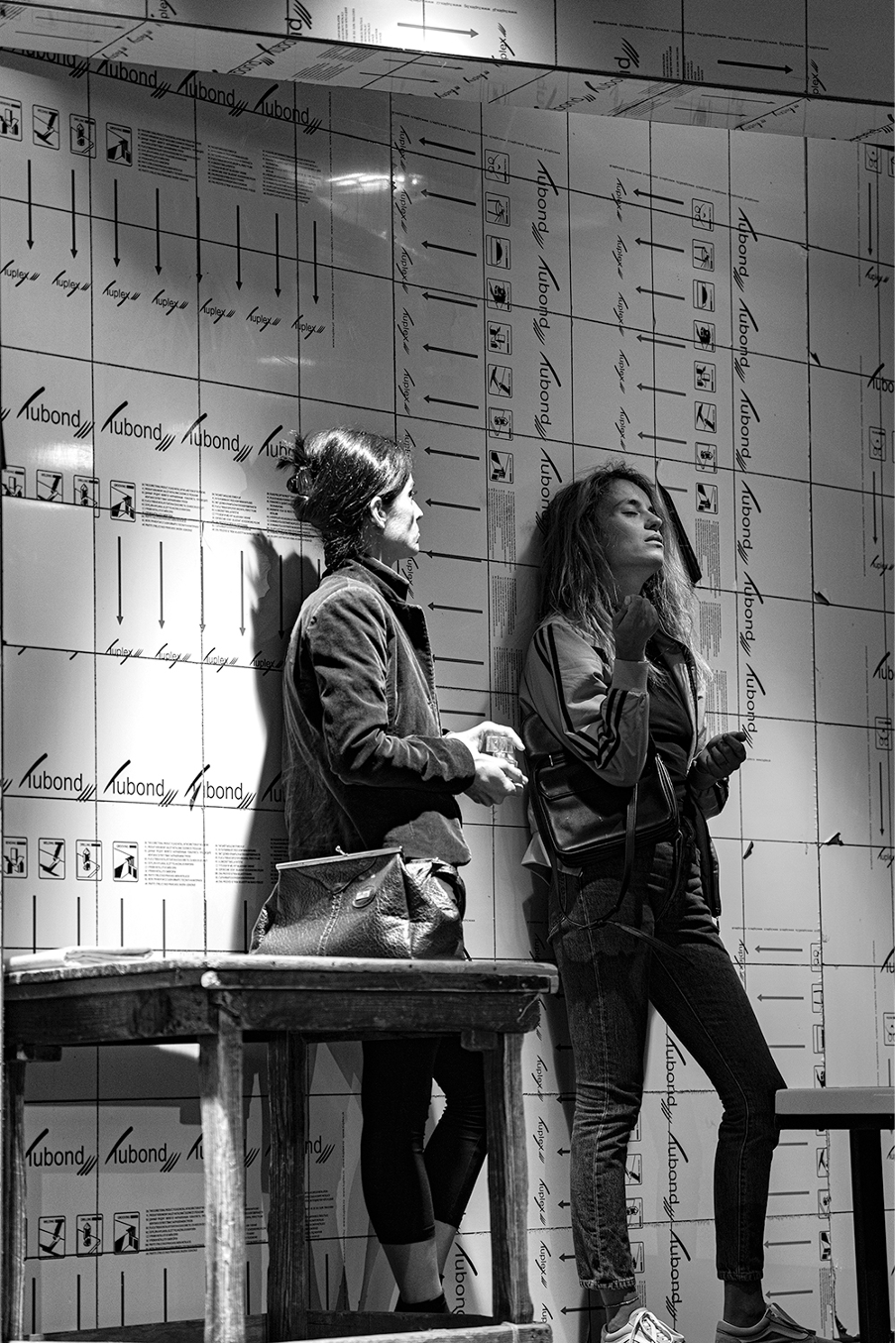
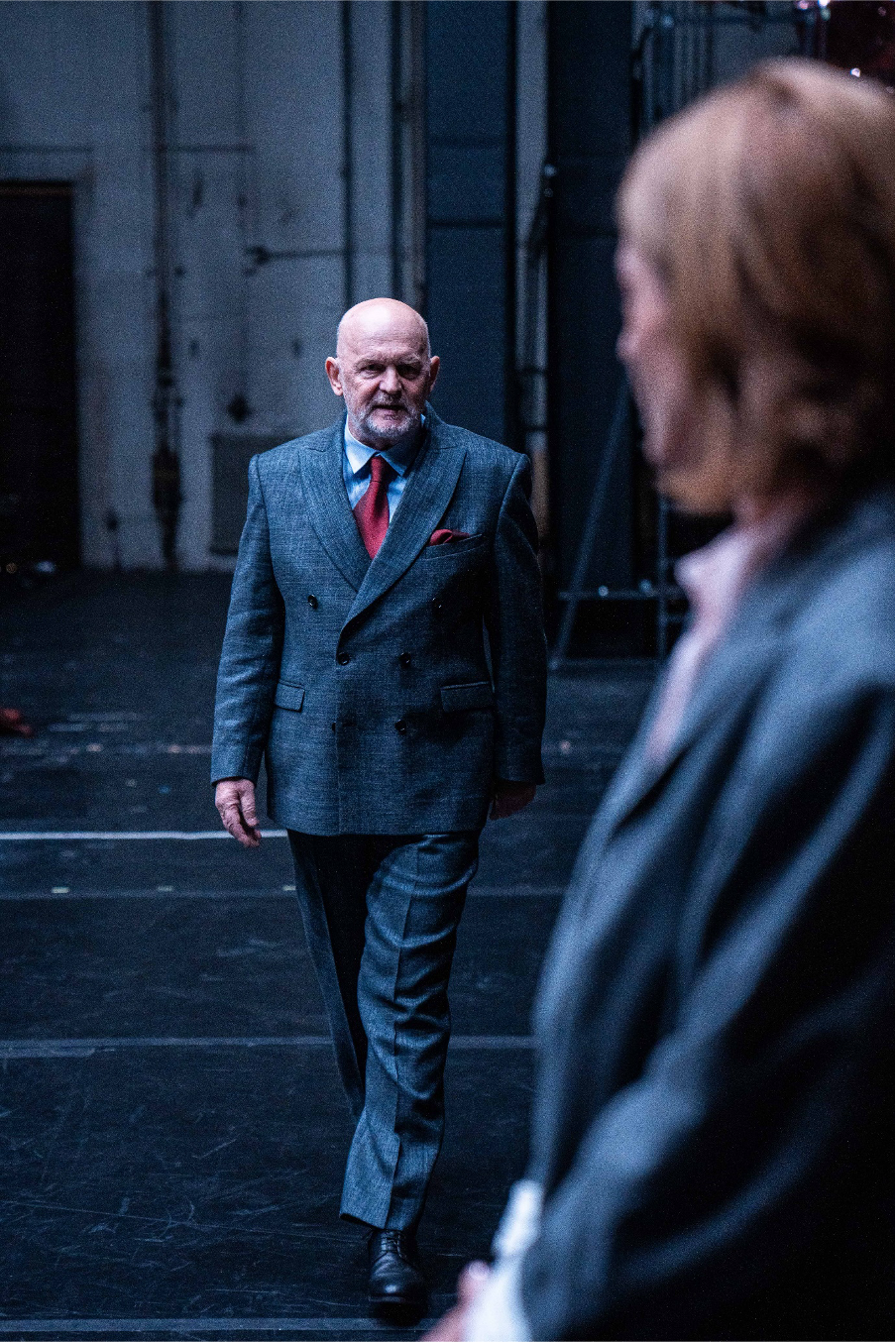
Aleksander Tonev and Yocheva rearranging the “constructivist” stage design of Petya Boyukova in Convenience Store Woman (Keiko Furukura). Photo: Stefan Zdraveski.
Prologue
The second Mini Showcase of the Ivan Vazov National Theatre brought me back, in the heart of winter, to a lightly snow-dusted and quietly beautiful Sofia. Three times larger than its inaugural edition, and therefore more representative of the theatre’s recent artistic trajectory, this year’s program aimed at more than a parade of productions; it felt like a statement of identity. And as Peter Brook famously reminded us, theatre is not the building but the event. The question, then, is, what kind of event the national stage of Bulgaria seeks to articulate today through its choices.
The choices included sixteen productions staged across six days, a theatrical endurance test that invoked a wide range of sensations and impressions. The program unfolded as a mosaic of classics and contemporary stage writing, engaging with trauma, psychology, existential dread, satire, black humor and social critique, not always with the same sharpness, but with a consistent sense of purpose. What follows is a necessarily selective commentary on the works I was able to see, beginning with two promenade performances staged within the theatre’s own architectural body.
1. Fragments in Motion
The first performance, pointedly titled The Infinite Stages, invites us on a mental journey back in time. Written by Martina Novakuva and Miguel Valentin, the narrative carries us through key periods that shaped the institution’s history, including the First Balkan War, the First World War, and the devastating fire that razed the building to the ground, events that left a lasting imprint not only on the theatre’s trajectory but also on the country’s cultural memory.
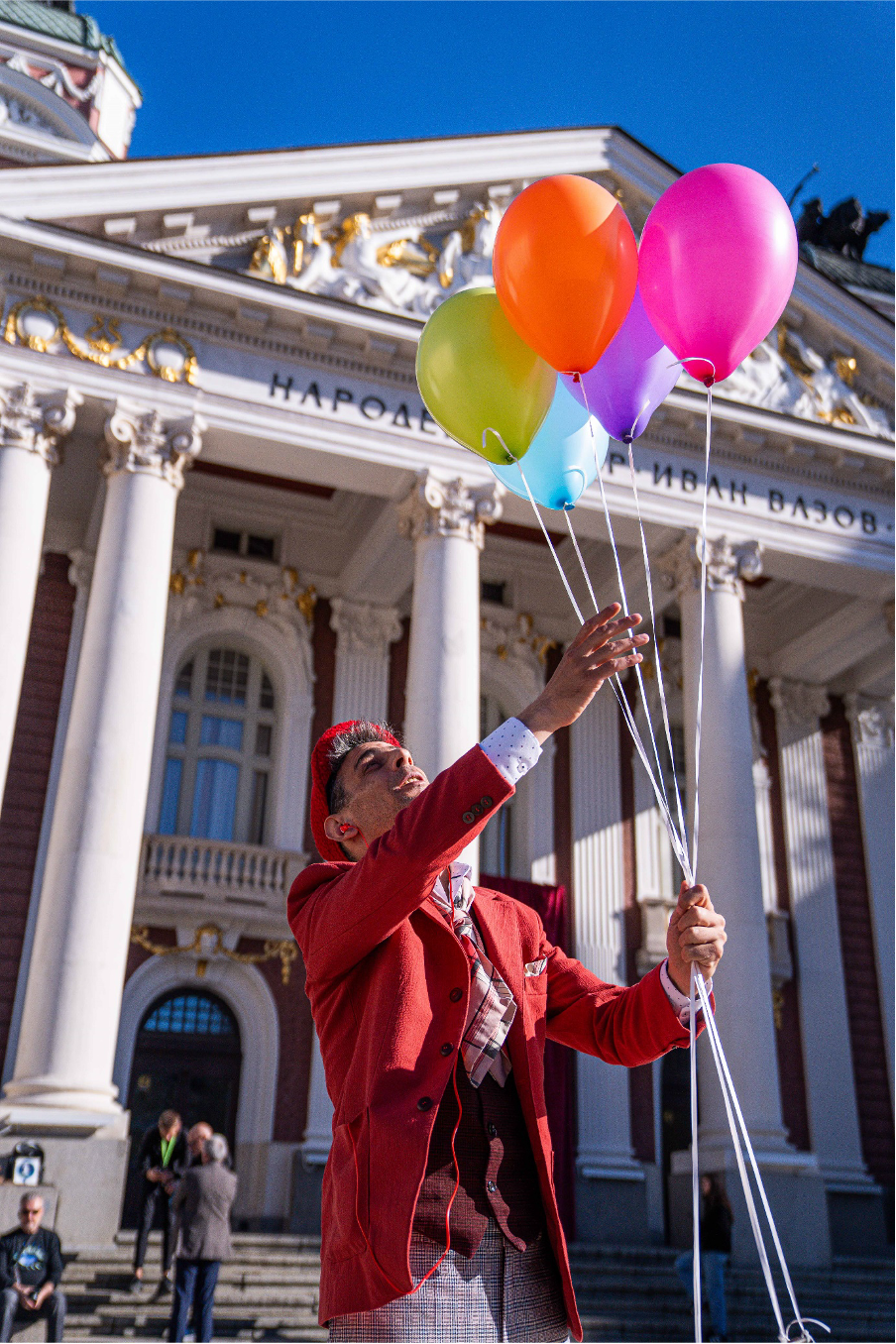
As with many performances of this kind, history is not presented as a cohesive narrative but as a fragmented experience of passage through the mist of time. We do not watch; we traverse. With headphones on, we climb staircases, slip through corridors and backstage areas, as live scenes alternate with archival recordings and sonic fragments. The result is a weave of simultaneous stages that reveal themselves as we advance. Each wall seems to carry its own story, sometimes historical, sometimes mythical; each corner holds the echo of an earlier bow. If, in Shakespeare’s oft-quoted line, “All the world is a stage,” here the world becomes many stages at once.
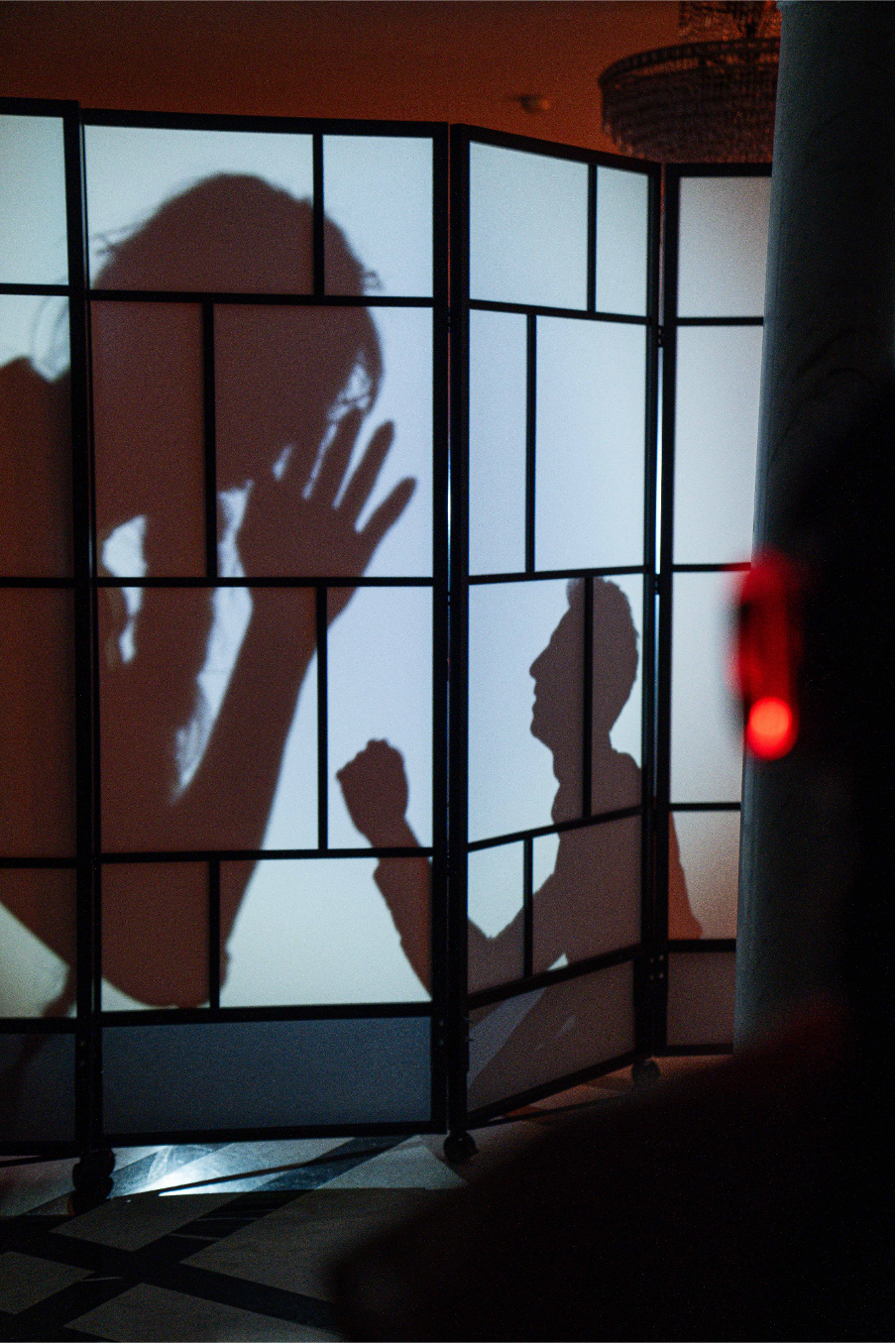
I emerge from the experience enriched on multiple levels, yet I would have been even more rewarded had this historical charge been activated less declaratively and more viscerally. Had the narrative incorporated more inventive scenic and technological interventions, the experience might have gained greater density and theatrical voltage. In such forms, the aim is not simply to guide an audience through a building, but to shift it inwardly, to let the space pass through the spectator.
If life indeed contains infinite stages, theatre must convince us each time that the one we are crossing is utterly, irreducibly singular.
2. When Excess Overwhelms Meaning
The other promenade piece, Petrovs in and Around the Flu, drawing on the 2016 novel by Alexey Salnikov, plunges us into the feverish everyday life of a Russian family stricken by a severe flu, an illness that gradually morphs into a metaphor for psychic disintegration and a broader crisis of identity.

Directed by the young and promising Boyan Kracholov, the production unfolds along deliberately unpredictable tracks. The choice of a promenade structure appears designed to spatialize the fragmentary texture of the source material. Around ten locations within the Ivan Vazov National Theatre host distinct action-images, each a shard of a world in disintegration. The directorial aim is clear: to implicate the spectator in this instability, exposing them to the family’s collapsing routines and latent violence at close range, without protective filters.

What eluded me, however, was a clear sense of how each scene conversed with the space that contained it. Too often, the encounter between text and location feels incidental, at times even disorienting, in ways that hinder rather than deepen audience engagement. I understand the impulse behind the heightened vocal intensity and physical extremity of the performances: chaos rendered through excess. Yet when spectators are asked to inhabit chaos, clarity becomes essential if intensity is to register as meaningful rather than merely loud.

That said, despite the reservations that surfaced as I watched, I found the overall venture compelling. It was an oblique reading of a difficult text, a slanted, fertile, and courageous approach. And when boldness is grounded in genuine artistic intent, it deserves respect, even if its execution does not always land with full force.
3. A Mirror Left Unbroken
Marilyn Monroe’s Last Session, presented at the Studio, was directed by Deyan Donkov, who also appears on stage as the psychoanalyst Dr. Ralph Greenson. The text is authored by two psychoanalysts, Vivian Pramatarov-Hamburger and Andreas Hamburger. The action unfolds over the night from August 4th to 5th and touches on familiar biographical coordinates of the Hollywood icon: childhood abandonment and foster institutions, the absence of maternal care, failed marriages, fear of loneliness, dependency on medication and the anxiety of sustaining a public image that ultimately consumed the fragile Norma Jeane.

The dramaturgical core lies in Monroe’s relationship with Greenson, where the boundaries between professional detachment and emotional entanglement grow dangerously blurred. As a concept, the play is intriguing. It does not aim for straightforward biography but gestures toward a psychological drama about a fractured self—between Marilyn and Norma Jeane—and about the limits of psychoanalysis when confronted with the human hunger for love and acceptance.
A genuinely fresh text might have emerged had the authors pursued this fault line more rigorously. Instead, they remained confined within a relatively superficial handling of the material, guided by familiar tropes and easy melodrama. The familiar, and the melodramatic, however moving, rarely become challenging in the sense of offering a new angle of perception.
I found myself questioning, for instance, the directorial choice to present Marilyn Monroe as the perennial sex kitten, complete with the breathy, coquettish, almost childlike voice. The premise of psychoanalysis presupposes the shedding of masks. One enters that room not to perform but to unveil, to strip the soul bare. Yet rather than witnessing a rupture with the myth, we are offered, in part, its reproduction.
We do not truly see illuminated the fracture between the desire of the gaze and the destruction of the body, nor are we pressed to confront questions of responsibility, exploitation, or the manufacture of public image. It is not enough to display the icon; one must fracture the mirror—yet that fracture never fully occurs.
I would, however, single out the use of video (Maya Vselenska, Stefan Zdraveski) as one of the strongest elements of the production. The dialogue between live performance and projection is deftly handled. Each intrusion of video opens an additional layer of perception, at times commenting on or counterpointing the stage reality, reminding us that Monroe exists first and foremost as image, and that images often outlive the human being they once framed.
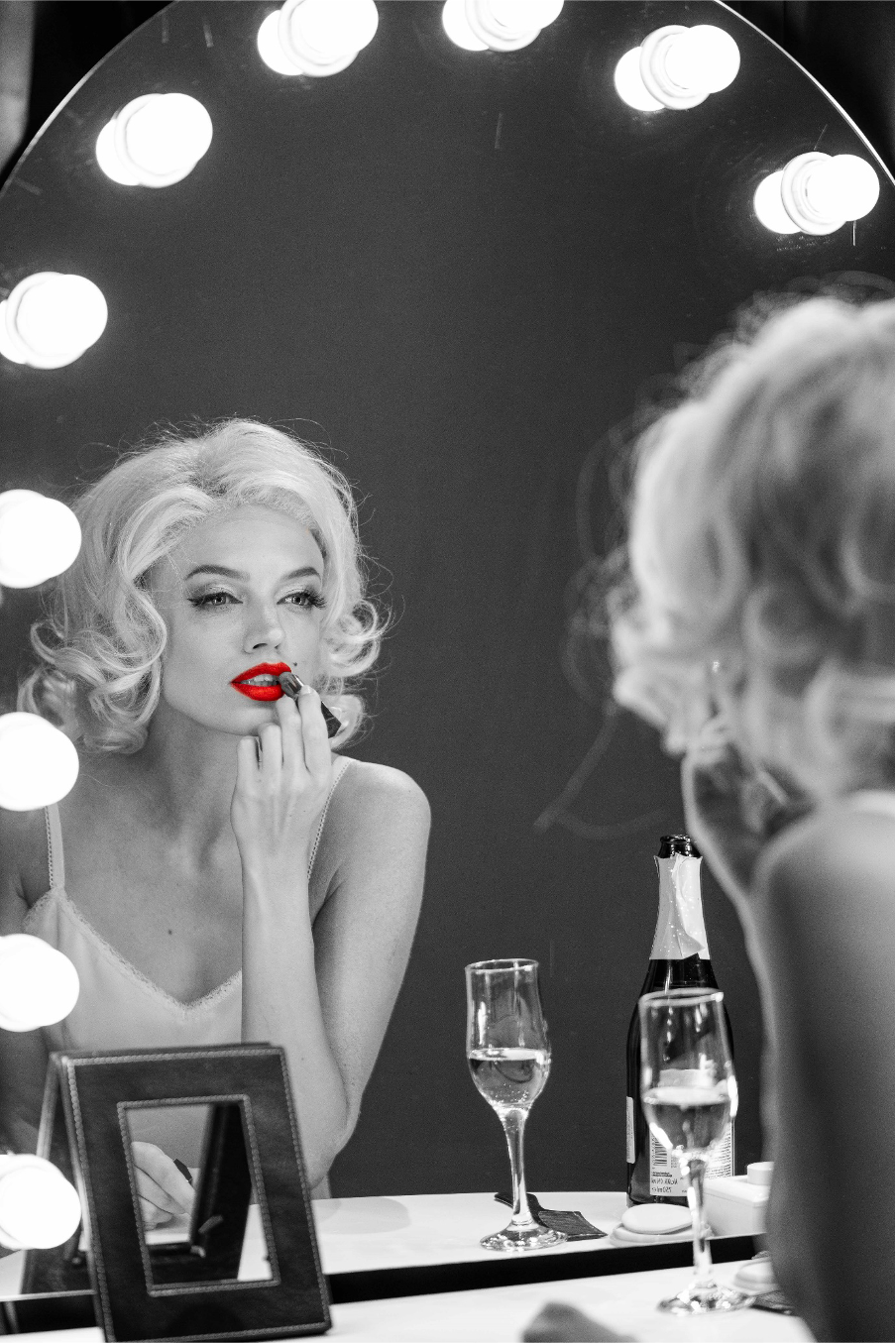
Donkov delivers a measured performance as the psychoanalyst, functioning effectively as the narrative axis of the evening. The young and striking Anna Koshko as Monroe moves with ease but remains on the surface, without the depth or inner rupture the role demands. The direction does little to draw her away from stereotype and toward risk. Something more oblique, more unsettling, would not have been excessive—it would have been necessary.
4. The Architecture of Mourning
Pieces of a Woman has been part of the Ivan Vazov National Theatre repertoire since 2022. Based on the play of the same name by Kata Wéber, with dramaturgical adaptation by Mayia Pramatarova, it does more than tell a story: it confronts trauma and the experience of pain, illuminating the psychological and emotional dimensions of loss.

The narrative follows a young couple awaiting their first child. They choose a home birth which ends in tragedy, as the newborn dies shortly after delivery. From there, the play turns its gaze inward, focusing on the mother’s silent, interior struggle along with the gradual unraveling of the couple’s relationship. Each parent processes grief differently, enduring the pressure of family and societal expectations while clarifying responsibility and seeking justice when the story takes a judicial turn.
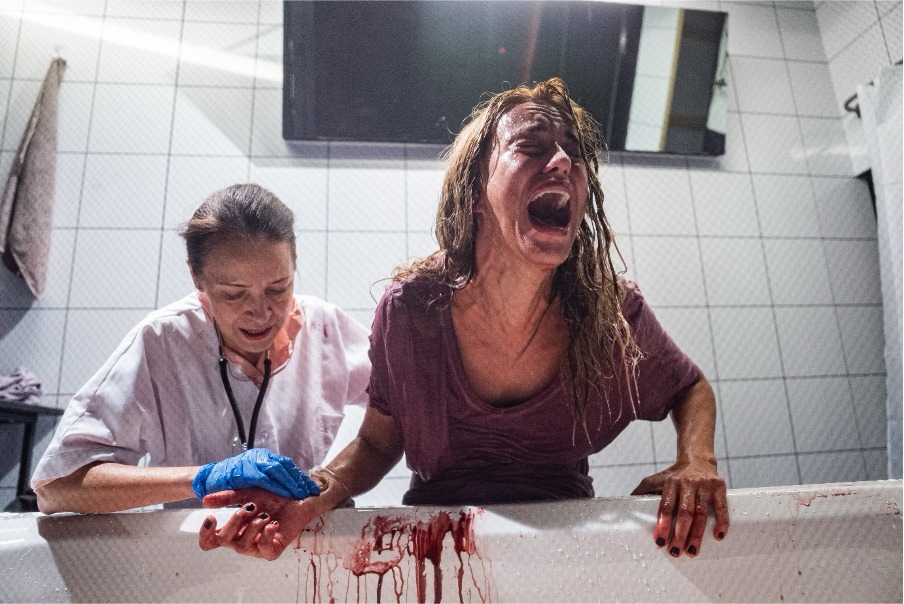
Pieces of a Woman does not seek easy emotional resolution. It is a study of mourning, silence, the female bodily experience and the impossibility of communication when the unthinkable occurs. Premiered in Budapest and widely known through Kornél Mundruczó’s 2020 film adaptation starring Vanessa Kirby, the play has a reputation for raw emotional honesty.
Director Kris Sharkov skillfully leverages theatrical form, with set design and costumes by Nikola Toromanov. Spectators are seated in the round, with many scenes unfolding behind them, while four screens suspended above the centre of the stage project live footage of what cannot be seen directly. The effect is claustrophobic. As spectators, we feel trapped within the drama, just as the protagonists are; there is no exit. The staging becomes more than an aesthetic choice: it functions as a kind of prison, a commentary on grief which, though it burns from within, cannot be confronted head-on. It can only be approached obliquely, through its angles.
At the centre of this structure is Maria Kavardzhikova as the mother, Magdalena, in a striking performance recognised with the ASKEER Award. Without theatrical flourish or exaggeration, she conveys far more suffering than words can contain. Her interiority, restraint, and authenticity render grief visible, removing the need to perform it.
Radina Kardzhilova, as the daughter, moves with precision through the fissures of her role, conveying a quiet disintegration. Together with Stefan Valdobrev, Martin Dimitrov, Ana Papadopulu, Tsvetan Aleksiev, and Zhaklin Daskalova, the ensemble demonstrates strong stage presence. Their realist performances generate chemistry and articulate fracture and tension, even for spectators who do not understand Bulgarian. The production, sensitive yet courageous, conveys the unbearable weight of loss with honesty, depicting tragedy without melodrama. It does not seek catharsis, and perhaps for that reason it becomes all the more essential. Grief has no climax; it has duration.
5. Too Much Stage, Too Little Intimacy
On the same day, I saw Tom Stoppard’s Rosencrantz and Guildenstern Are Dead on the main stage of the Ivan Vazov National Theatre. It was the theatre’s first staging of the play, directed by the young, already award-winning Boyan Kracholov, marking his main-stage debut with a work of considerable complexity. The Bulgarian translation is by Svetla Maneva, while the Shakespearean passages are rendered by Alexander Shurbanov.
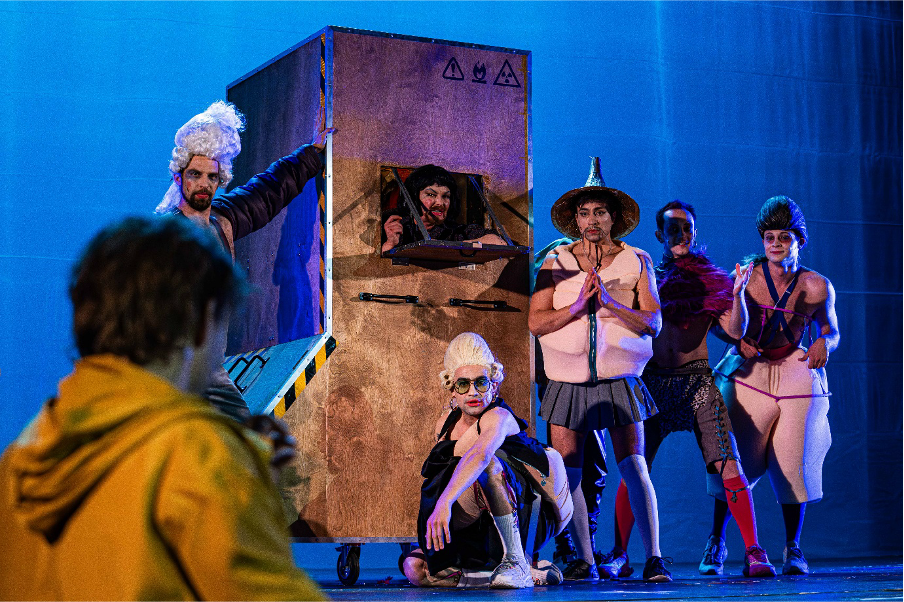
The play is a tragicomedy that elevates two minor courtiers from Hamlet into central figures, trapped within the margins of a story they cannot access. Their world is governed by instability and epistemic confusion. Attempts to impose order consistently fail, most clearly in the famous coin-toss scene, where chance itself appears to malfunction and heads repeatedly defy probability. Randomness ceases to behave as randomness, and laughter becomes a cover for existential unease. Tragedy is never shown directly, but it is constantly inferred through its effects.
Stoppard constructs a surface dense with verbal traps—witty, agile, and often humorous—beneath which lies a tightly structured philosophical architecture. Kracholov foregrounds the metatheatrical dimension and the rhythmic intelligence of the text, with clear echoes of Samuel Beckett, yet the production does not fully carry its philosophical tension into stage dynamics. The result is a disjunction between conceptual density and performative delivery. Ideas remain legible, but not fully embodied in rhythm, pacing, or spatial interaction.
Despite strong performances, particularly by Nencho Kostov and Plamen Dimov, and the visually compelling set design by Boris Dalchev and Mihaela Dobreva, the relationship between stage and audience remains uneven. The scale of the main stage dilutes the precision and intimacy the text demands, dispersing attention rather than concentrating it. In this configuration, the performance struggles to sustain the close intellectual focus required by Stoppard’s dramaturgy, where meaning is carried as much by linguistic cadence as by action.
The production reveals careful preparation and clear directorial intention, but it stops short of fully resolving the gap between philosophical structure and theatrical articulation.

6. The Weight of the Unseen
Someone is Going to Come by Jon Fosse (1996), an author presented for the first time to the Sofia audience, carries the creator’s distinct poetic and existential voice. The story revolves around a Woman and a Man who move to an isolated house by the sea, seeking absolute solitude, a pure space for their relationship to develop. Almost immediately, however, a creeping sense of threat emerges: “Someone is going to come.” The phrase is repeated, as a voice, a whisper, then a shadow. The anticipation of a third party, real or imagined, gradually erodes the couple’s bond. When the Other eventually appears, it is not an event per se; it is the confirmation of a preexisting fear.
The action does not unfold externally; it emerges from within the characters, through psychological tension, pauses and repetition. The dreaded someone operates on multiple levels, as a visitor, a projection of jealousy, a symbolic figure of death or loss, or even as the impossibility of perfect union between two people. Fosse seems to suggest that no relationship can exist in complete isolation; the Other is inevitable, even when nameless.

The style is structured around Fosse’s characteristic minimalism: short sentences, extended silences, and a dramaturgy of tension produced through absence rather than articulation. Language operates cyclically, with a near-musical logic. Repetition functions not as a limitation of expression but as a rhythmic inscription of affect—particularly anxiety, jealousy, and fear of abandonment.
The Woman’s experience is shaped by isolation as a form of pressure, while the Man’s subject position is marked by acute insecurity, his demand for exclusivity gradually transforming into coercive control. The relational dynamic does not disintegrate in response to external events; rather, it undergoes internal corrosion, generated by self-reinforcing structures of fear. The empty maritime landscape operates as an externalization of interior voids. Nature does not offer consolation; instead, it intensifies ontological exposure, amplifying conditions of diminishment and solitude.

Director Katya Petrova foregrounds the delicate existential tension of Fosse’s text, resisting overt dramatization in favour of sustained atmospheric restraint. The precarious set by Boris Dalchev and Petya Karadzhova functions as a spatial analogue of relational erosion. Its circular design, with a moving vehicle on peripheral tracks, reflects the dramaturgical logic of repetition: words returning, phrases looping, and thoughts circling without resolution. Stage movement translates linguistic recurrence into physical rhythm, while Svetlozar Georgiev’s soundscape deepens the sense of suspended tension.

Performances by Elena Dimitrova and Veselin Mezekliev are understated yet concentrated, built on precision and restraint, while Kire Gyorevski’s “Other” introduces a destabilising contrast through heightened physicality, vocal excess, and rhythmic disruption. Their interplay allows fear to surface not through action but through controlled variation within repetition. Carefully calibrated silences generate anticipation, shifting dramatic weight away from event and toward expectation itself.
The production sustains a quiet intensity that aligns closely with Fosse’s dramaturgy. Silence is not treated as absence but as structural presence, reinforcing the idea that in Fosse’s theatre, meaning is produced less through what is spoken than through what remains suspended.
7. Trapped in Repetition
Convenience Store Woman, by Japanese author Sayaka Murata, is not one of those novels that can easily be adapted for the stage. Its pervasive irony, social satire, and the existential anxiety that runs through the story, combined with its strong Japanese aura, make the task of adaptation particularly challenging.
The story follows Keiko Furukura, an employee at a 24-hour convenience store in Tokyo who finds meaning and identity only within the rules and routines of her workplace. Outside that context, society deems her strange, as she has always struggled to mimic what others consider “normal” behavior. When a cynical and disillusioned new employee, Shiraha, enters her life, he pressures Keiko to conform to societal expectations such as marriage and a conventional career. As their uneasy relationship develops, Keiko is forced to confront whether she should continue living according to the rigid but comforting structure of the convenience store or attempt to reshape herself to fit a society that has never fully accepted her.

Director and dramaturg Mariy Rosen translates Sayaka Murata’s Convenience Store Woman into a visually stripped, almost clinical stage world. Metallic constructions evoke a corporate skyline, while cold white lighting drains the space of warmth or emotional contrast. Petya Boyukova’s set design reinforces this aesthetic of functionality—precise, efficient, and deliberately distant. The production positions itself between social satire and existential study, circling questions of conformity, normalcy, and social exclusion within a system that rewards compliance. In this sense, repetition and routine are not only thematic material but also structural principles.
Yet this approach exposes a central difficulty: sustaining theatrical tension within monotony. Rather than generating pressure, the accumulation of repetition often remains inert. This becomes apparent early on in the extended opening sequence, which, despite its narrative clarity, lacks performative density. The shift between narration and live dialogue does not establish a consistent rhythm, nor does it fully integrate its formal layers. Similarly, the use of recorded voice and live action remains underdeveloped, relying more on juxtaposition than on dramaturgical necessity. With tighter structuring and more decisive transitions, these elements could have carried greater tension rather than functioning as illustration.
Some of the monologues addressing gender roles, labour, and social expectation remain too familiar in tone, reiterating ideas the novel already articulates more subtly, and could have benefited from further condensation in adaptation.

Within this framework, Boryana Yovcheva captures the external rhythm of routine and its psychological containment, yet the performance rarely breaks through into deeper interiority. Aleksander Tonev, by contrast, adopts a more physical and sharply articulated presence, bringing contrast and energy to the stage dynamics.

Aleksander Tonev and Yocheva rearranging the “constructivist” stage design of Petya Boyukova. Photo: Stefan Zdraveski.
Ultimately, by steering Keiko’s world toward a more direct narrative of nonconformity, the production reduces the productive ambiguity of Murata’s novel. What is lost is not clarity, but tension: the unstable space where conformity is both critique and survival strategy.
8. Ideas Without Embodiment
Bill Gates and Steve Jobs Talk About the Future of Technology, written and directed by Ivan Panteleev, begins with a concept that is, in principle, compelling. Rather than constructing a biographical portrait of two technological figures, the production attempts to stage a discourse on digital futures through their symbolic and cultural weight. Yet this conceptual ambition is not matched by dramaturgical articulation.

The opening sequence, supported by live music by Milen Apostolov, Petko Slavov, and Ivan Yurukov, and framed by references to industrial revolutions, initially suggests a layered and responsive theatrical structure. For a brief moment, the production appears to operate across multiple registers, historical, technological, and performative. However, this complexity quickly dissipates as the performance settles into illustrative commentary rather than dramatic progression.

What follows is a gradual shift from theatrical exploration to a sequence of recognisable and largely pre-digested ideas about artificial intelligence, technological anxiety, and the continuity between industrial and digital revolutions. These ideas are not developed through conflict or stage action, but delivered as thematic statements, which remain external to the performative core of the work.
The staging multiplies perspectives and narrative voices, but these function less as dialogic exchange and more as discrete informational positions. Instead of generating tension between viewpoints, the structure accumulates commentary. Likewise, the use of varied theatrical forms and devices reads as a demonstration of available techniques rather than integrated dramaturgical logic.
The central questions—what it means to be human in a technologically accelerated world, and how innovation reshapes agency and control—remain at the level of articulation rather than experience. They are posed, but not problematised on stage. As a result, sociopolitical reflection does not emerge from action or interaction, but remains external to it.
What is ultimately missing is not thematic relevance, but dramaturgical transformation: the passage from discourse into embodied conflict. Without this shift, the production remains illustrative rather than performative, closer to a staged essay than to theatre that generates its own necessity.
9. The Safety of the Stage Mirror
Theatre Theatre by William Somerset Maugham centres on Julia Lambert, the celebrated star of the London stage, and examines the porous boundary between performance and lived identity. Julia inhabits a world in which professional, social, and private roles constantly overlap, making selfhood inseparable from performance. When a younger admirer destabilises her sense of control, she is forced into a confrontation with aging, desire, and identity. The narrative ultimately follows her return to dominance, reasserting authority both on stage and in life, where performance itself becomes survival strategy.
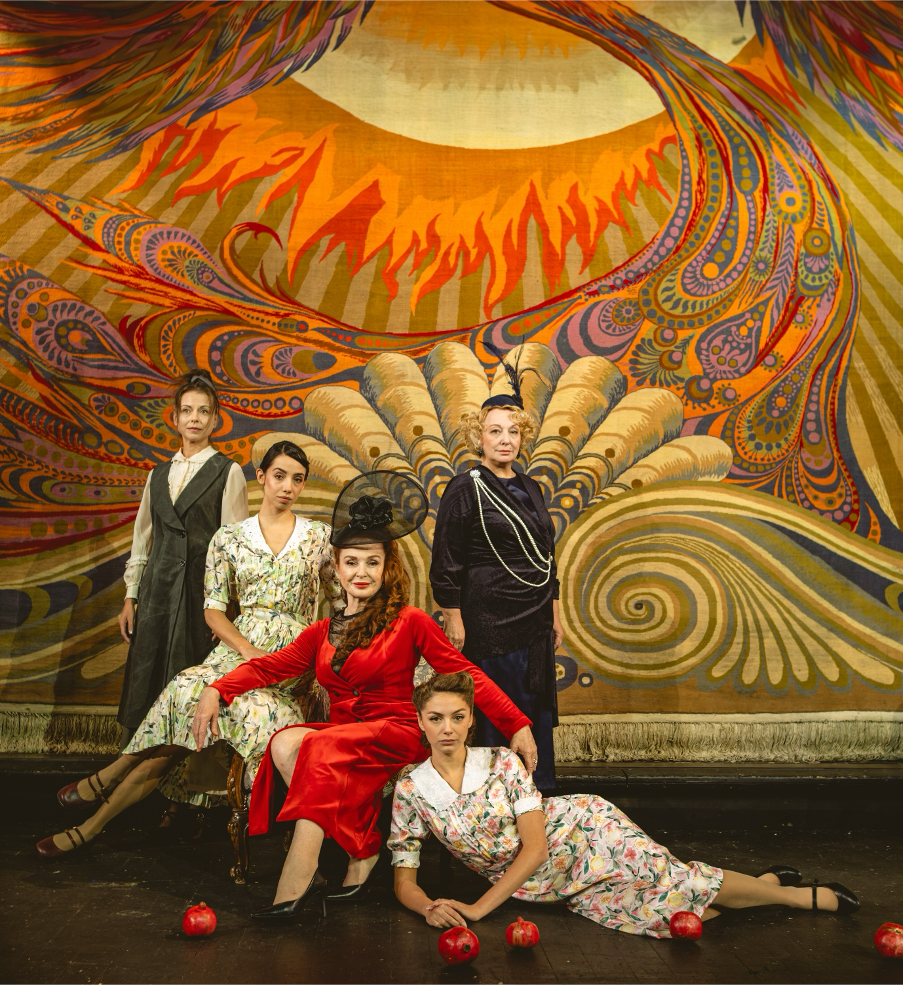
Boyka Velkova’s adaptation preserves the satirical tone and light comedic surface of Maugham’s text, maintaining its focus on theatrical illusion and social performance. The production is constructed around the idea of theatre within theatre, with acting as a continuous negotiation between mask and authenticity.
Velkova’s direction highlights Julia’s transformation most clearly in its treatment of her midlife crisis: the gradual shift from self-satisfied theatrical narcissism to a more vulnerable awareness of her own constructedness. Irinei Konstantinov offers a controlled and technically precise performance, while the ensemble maintains a consistent level of craft within a carefully regulated stage environment.
The visual world, created by Tsetska Ivaylova and Chavdar Gyuzelev, combines refined aesthetics with psychological suggestion, though it remains primarily illustrative rather than dramaturgically disruptive. Occasional moments of direct address and informal interaction—such as actors acknowledging the audience or a waiter serving wine—introduce brief ruptures in the fourth wall, but these gestures remain episodic rather than structurally integrated.
Ultimately, the production remains faithful to the tonal and structural logic of Maugham’s original, but it does not significantly reframe it. Its psychology remains legible, but not newly interrogated. In a contemporary context marked by sharper uncertainties around identity, performance, and visibility, the staging feels more like a careful reproduction of theatrical irony than an active reinvention of it. As a result, the spectator’s position remains largely observational rather than critically or emotionally implicated.

10. The Space of ‘There’
The performance-installation TAM, conceived and choreographed by Deyan Gergiev, proposes a hybrid form between contemporary dance and spatial installation, where movement, sound, and scenography operate as interdependent systems rather than separate theatrical elements. The title itself—tam (“there” in Bulgarian)—functions as both a spatial marker and an existential axis: a point of projection for memory, absence, and desire, constantly shifting between presence and displacement.
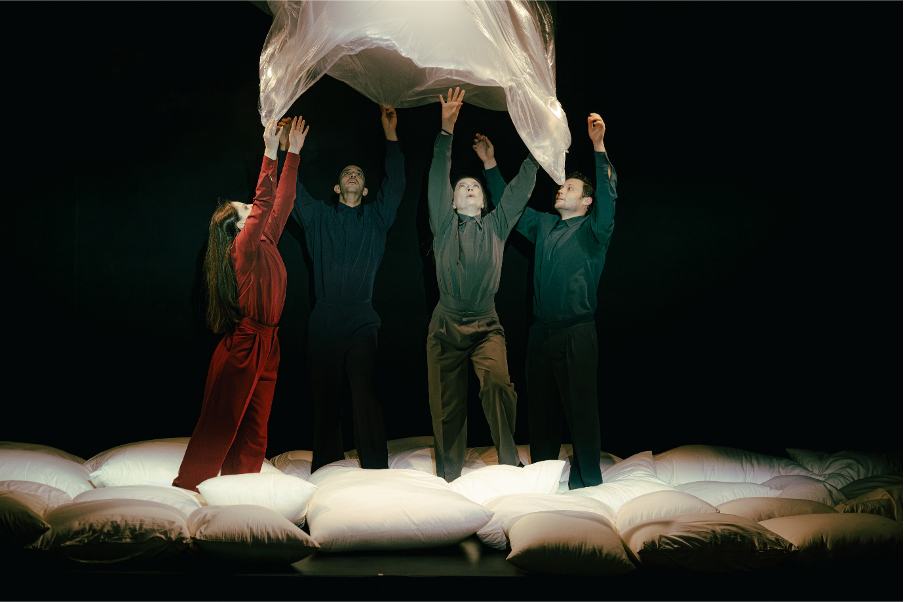
The piece deliberately rejects linear narration in favour of an environment in which the spectator is positioned within, rather than in front of, the performance. Body, sound, and space are configured as a single perceptual field, closer to a living installation than to conventional choreography. Audience proximity or direct incorporation into the action dissolves the boundary between observer and event, placing perception itself under negotiation.

Movement is restrained yet highly charged, built on repetition, duration, and controlled exhaustion rather than expressive climax. This produces a tension that accumulates gradually rather than resolves, sustained by a carefully calibrated interplay of silence, rhythm, and physical persistence. The atmosphere oscillates between stillness and subtle disturbance, with sound, voice, and light forming a unified sensory structure that animates the space from within rather than decorating it from outside.
A recurring rhythmic logic runs through the piece, comparable to tidal motion: gestures return, dissolve, and re-emerge with slight variation, generating a temporal experience that is cyclical rather than progressive. Within this structure, time becomes perceptual rather than narrative, inviting reflection that is bodily as much as intellectual.
The lighting design by Viktor Georgiev and the scenography by Gabriela Kardzhilova, with its accumulation of pillows functioning alternately as terrain, obstacle, and concealment, reinforce this sense of mutable spatial logic. Objects are not static props but shifting agents within the performance environment.
TAM constructs a total sensory field in which perception is continuously reoriented. Its effect lies less in spectacle than in sustained atmospheric pressure, where memory and physical presence overlap. In this sense, the work operates as an embodied spatial experience rather than a representation of movement.
.
11. Trust as Dramaturgy
I first saw Medea at the Varna Festival and wrote about it at length in a review published in The Theatre Times (January 2026). Since I consider it a strong production, it would be reductive to omit it here, particularly in a text that engages with multiple works from the same showcase. What interests me in this context, however, is not the production itself, but the broader relationship between tragedy and simplicity, a question I did not fully address in my earlier review.

One of the recurring challenges in staging ancient tragedy today is an uneasy, often defensive attitude toward simplicity. It is frequently treated with suspicion, as though it were aesthetically impoverished or dramaturgically insufficient, requiring compensation through interpretative excess or formal complication. In this framing, it is frequently mistaken for naivety—an entirely different condition.
Simplicity, however, is never a starting point; it is an achievement. It presupposes reduction through knowledge, discipline, and interpretative clarity. It is not absence of complexity but its distillation into legible form. Naivety, by contrast, bypasses this process entirely. Where simplicity condenses, naivety merely flattens.
Despite the communicative strength that simplicity can generate, many contemporary stagings gravitate toward an undifferentiated complexity that risks obscuring rather than intensifying meaning. This tendency often stems from an assumption that difficulty of access is equivalent to artistic depth, and that clarity somehow diminishes artistic authority. Yet clarity is not the opposite of depth; it is one of its conditions. Depth emerges not from obscurity, but from the precision with which a work articulates and sustains its questions.
Ancient tragedy, despite its canonical status, is still frequently described as a “popular” or “public” form of theatre, yet accessibility remains culturally ambivalent. What is easily intelligible is sometimes dismissed as insufficiently serious, as though legibility were incompatible with complexity. In reality, however, accessibility and depth are not mutually exclusive categories; they depend on how meaning is structured, not on how difficult it is to decode.

To render emotionally and conceptually dense material with clarity is among the most demanding tasks in theatre. In this sense, simplicity in staging tragedy is not a reduction or simplification of thought, but a discipline of articulation. It is also a risky position, since it requires constant vigilance against sliding into oversimplification or conceptual flattening.
Such an approach presupposes measure, precision, restraint, and above all trust in the dramatic text itself—trust in its internal density and its capacity to sustain meaning without excessive interpretative layering. Without this trust, even deconstructive strategies risk losing their object. Deconstruction presupposes a prior understanding of the structure it interrogates; a grasp of what its being deconstructed. Without that, it ceases to be useful analysis and becomes erasure.
Declan Donnellan’s Medea offers a clear example of this economy of means. Stripped of decorative excess and interpretative overcoding, it is a production governed by clarity of intention rather than accumulation of concept. Donnellan removes Medea from mythic abstraction and places her at eye level with the contemporary spectator, not to diminish her stature, but to render her structurally legible as a human presence. In doing so, she becomes less distant and more disquieting: not an elevated figure of myth, but an intelligible proximity that intensifies, rather than softens, her violence and vulnerability.
.
Scenographically, the production avoids any sense of excess. Its language is one of radical minimalism: a bare stage structured around a single small platform at its centre. Thornton Wilder’s dictum that “Theatre is two boards and a passion” finds a literal realisation here, where meaning emerges not from accumulation but from intensified presence.
That intensity is carried by Radina Kardzhilova, one of the leading actresses of the Bulgarian National Theatre, in a performance defined by physical and emotional exposure without protective distance. Moving among the spectators, she erases the conventional, protective separation between stage and auditorium, transforming proximity into ethical unease. The spectator is no longer external to the event but structurally implicated within it, drawn into a form of theatrical encounter that is immediate rather than mediated.
The Chorus, similarly placed within the audience, resists any ornamental or stabilizing function. It operates instead as a shifting collective consciousness --at times questioning, at times empathising, at times withdrawing —thereby reflecting and destabilising the spectators’ own oscillations between judgement and identification. In this configuration, the audience is not only observed but mirrored.
Donnellan’s direction constructs a Medea that is stripped of mythic abstraction yet not reduced in scale. Rather than an icon of monstrosity, Medea emerges as a structurally legible subject, negotiating exclusion in real time. Her rage is no longer allegorical excess but articulated response, produced within the constraints of rejection and social dislocation. The production’s force does not derive from spectacle, but from precision: a clarity that does not simplify but exposes relations. In this sense, it acquires a political dimension, not through explicit statement, but through the staging of exposure itself —of bodies, voices, and structures of exclusion made perceptible within a shared space.
What sustains the production is not simply trust in the text, but its disciplined calibration between text, performer, and audience: a fragile architecture in which meaning is not illustrated from above but risked in real time.
Epilogue
The Ivan Vazov National Theatre showcase demonstrates that theatre cannot rely solely on the stability of the classical repertoire. The selected productions span a broad formal and thematic range, from tragicomic surrealism to psychological minimalism and installation-based performance. While some works are distinguished by clarity of intention and directorial precision; others remain anchored in strong conceptual premises that are not fully realised in performance, resulting in uneven degrees of theatrical articulation.
The more experimental works tend to attract smaller audiences. This is not solely a question of accessibility, but of risk: they demand a different kind of attention from the spectator, one that is less passive and more exposed. At the same time, this demand is not always matched by an equivalent precision in staging, and in some cases the openness of the conceptual frame risks drifting into dramaturgical indeterminacy. Yet it is precisely this tension—between exposure and articulation—that sustains theatre as a living form. Without it, performance risks becoming repetition rather than encounter.
Seen as a whole, this second showcase reveals a repertoire marked less by synthesis than by productive instability, between convention and experimentation, clarity and excess, compositional control and moments of formal uncertainty. Its significance lies less in coherence than in friction, in the points where different theatrical languages test, and occasionally strain, one another within the same institutional frame.
In this sense, the repertoire does not present a unified artistic identity, but a field of negotiation between established forms and emerging practices, between inherited expectations and the uneven pressures of transformation.
References
About the author(s)
Savas Patsalidis is Professor Emeritus in Theatre Studies at Aristotle University of Thessaloniki, where he has taught at the School of English for close to 35 years. He has also taught at the Drama School of the National Theatre of Northern Greece, the Hellenic Open University and the graduate program of the Theatre Department of Aristotle University. He is the author of fourteen books on theatre and performance criticism/theory and co-editor of another thirteen. His two-volume study, Theatre, Society, Nation (2010), was awarded first prize for best theatre study of the year. In 2019 his book Theatre & Theory II: About Topoi, Utopias and Heterotopias was published by University Studio Press. In 2022 his book-length study Comedy’s Encomium: The Seriousness of Laughter, was also published by University Studio Press. In addition to his academic activities, he writes theatre reviews for various journals. He is on the Executive Committee of the Hellenic Association of Theatre and Performing Arts Critics, a member of the curators’ team of Forest International Festival (organized by the National Theatre of Northern Greece), and the editor-in-chief of Critical Stages/Scènes critiques, the journal of the International Association of Theatre Critics.
European Stages, born from the merger of Western European Stages and Slavic and East European Performance in 2013, is a premier English-language resource offering a comprehensive view of contemporary theatre across the European continent. With roots dating back to 1969, the journal has chronicled the dynamic evolution of Western and Eastern European theatrical spheres. It features in-depth analyses, interviews with leading artists, and detailed reports on major European theatre festivals, capturing the essence of a transformative era marked by influential directors, actors, and innovative changes in theatre design and technology.
European Stages is a publication of the Martin E. Segal Theatre Center.

